































Essential Evolution Models Worksheet | Grade 8-12 Science

Paste this activity's link or code into your existing LMS (Google Classroom, Canvas, Teams, Schoology, Moodle, etc.).
Students can open and work on the activity right away, with no student login required.
You'll still be able to track student progress and results from your teacher account.
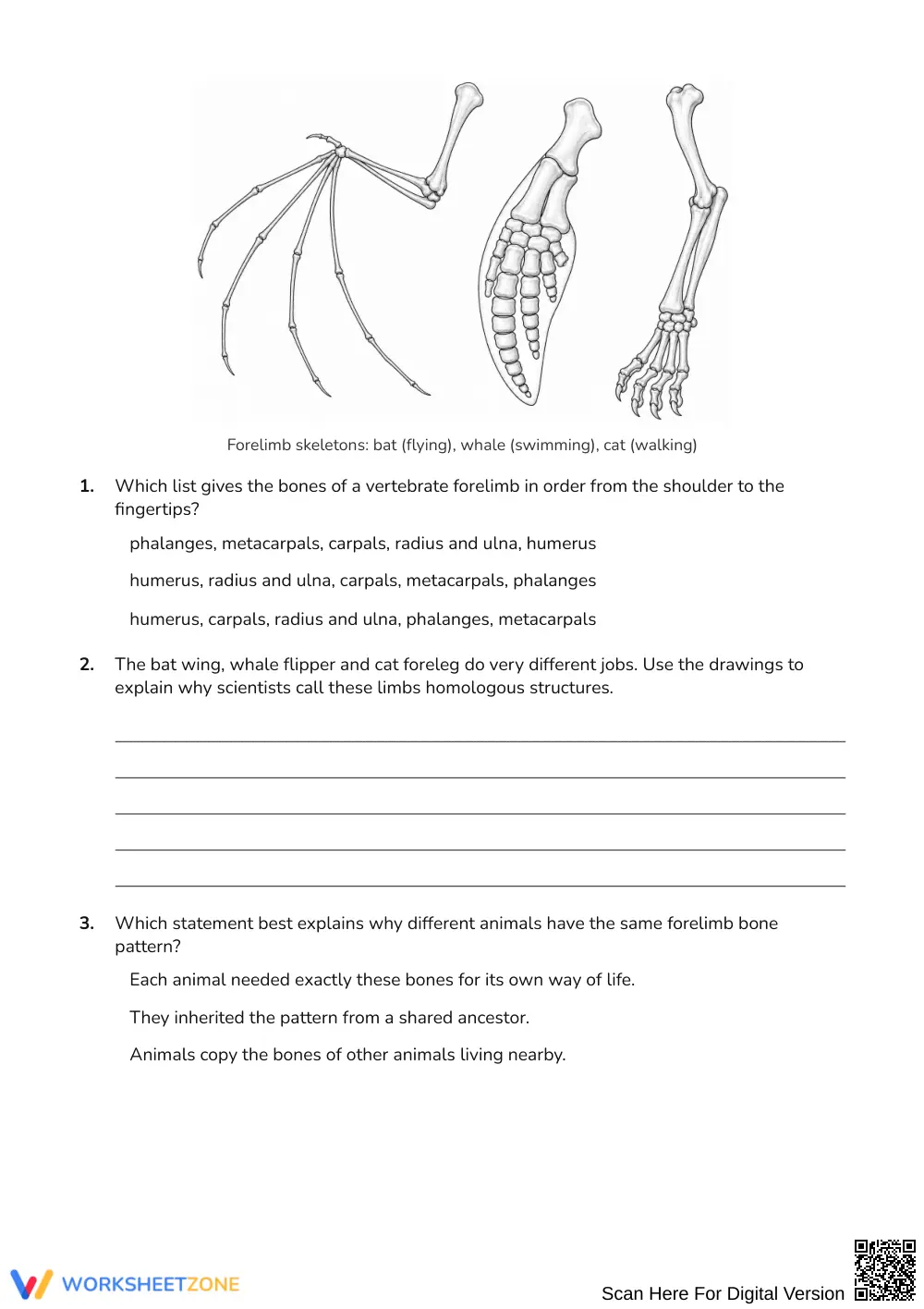
This evolution worksheet guides students through interpreting visual biological models, including homologous vertebrate limbs, phylogenetic trees, and transitional fossil layers. Designed for Grades 8–12 science classrooms, learners analyze anatomical evidence and lineages across 23 targeted tasks to explain common ancestry and biological change over time.
At a Glance
- Grade: Grades 8–12 · Subject: Science
- Standard: Life Science Core Ideas — Construct evidence-based explanations for common ancestry and evolution
- Skill Focus: Evidence of evolution via homologous structures, trees, and fossils
- Format: 4 pages · 23 problems · Answer key included · PDF
- Best For: Visual model practice and conceptual review
- Time: 40–55 minutes
What's Inside
Across four pages, students engage with anatomical diagrams, cladograms, and fossil tables. The resource features bone labeling, multiple-choice checks, and evidence-based explanations. It incorporates an anatomical word bank (humerus, carpals, phalanges) alongside visual comparison figures. A complete four-page teacher answer key provides full model responses for every question.
Skill Progression
- Guided practice (Part A): Students label arm bones with a word bank and analyze limb homology across vertebrates under structured guidance.
- Supported practice (Part B): Learners interpret phylogenetic nodes and correct common linear evolution misconceptions using diagrammatic evidence.
- Independent practice (Part C): Students analyze fossil layer sequences and independently justify how vestigial structures demonstrate common descent.
This framework follows the gradual-release model, advancing from direct anatomical identification to independent scientific argumentation.
Standards Alignment
This worksheet aligns to Life Science standards on biological evolution. Students evaluate empirical evidence from anatomical similarities and fossil sequences to substantiate common descent. Supporting standards address analyzing cladograms to model evolutionary relationships. Both standard codes can be copied directly into lesson plans, IEP goals, or district curriculum mapping tools.
How to Use It
Implement this worksheet during mid-unit direct instruction or assign it afterward to consolidate learning. During class, circulate during Part B to ensure students identify common ancestors at tree nodes rather than assuming modern species evolved directly from adjacent tips. Completion requires 40 to 55 minutes.
Who It's For
This resource serves general biology and life science students in Grades 8 through 12. Visual scaffolds and provided vocabulary support English learners and students receiving accommodations. Pair this worksheet with comparative anatomy limb models or an introductory lecture on macroevolution.
Visual modeling and structured scientific reasoning remain central to student mastery in secondary life science classrooms. In accordance with contemporary life science standards, this resource cultivates rigorous evidence interpretation, requiring students to evaluate anatomical homology, decode phylogenetic branching trees, and trace evolutionary change through transitional fossil strata. Educational research by Fisher & Frey (2014) demonstrates that structured gradual-release frameworks, transitioning from guided diagram labeling to collaborative misconception analysis and autonomous data synthesis, substantially strengthen student comprehension of abstract biological mechanisms. By engaging directly with 23 analytical items across four scaffolded pages, learners do not merely memorize evolutionary terms; they actively reconstruct the empirical arguments that underpin modern evolutionary theory. Consequently, this instructional tool provides educators with reliable, measurable data regarding student progress in evolutionary analysis, making it an essential, high-utility asset for any standards-based secondary science curriculum.


