































Essential Evolution Mechanisms Worksheet | Grade 10 Biology

Paste this activity's link or code into your existing LMS (Google Classroom, Canvas, Teams, Schoology, Moodle, etc.).
Students can open and work on the activity right away, with no student login required.
You'll still be able to track student progress and results from your teacher account.
This biology worksheet trains high school students to analyze population genetics data and defend evolutionary mechanisms against competing explanations. Students evaluate empirical data sets to distinguish between natural selection, genetic drift, and gene flow, ensuring a rigorous understanding of how microevolutionary forces shape allele frequencies across generations.
At a Glance
- Grade: 10 · Subject: Biology
- Standard: High School Life Science (Natural Selection and Adaptation)
- Skill Focus: Defending evolutionary mechanisms with competing evidence
- Format: 5 pages · 8 problems · Answer key included · PDF
- Best For: Microevolution unit assessment or small-group practice
- Time: 45–55 minutes
What's Inside
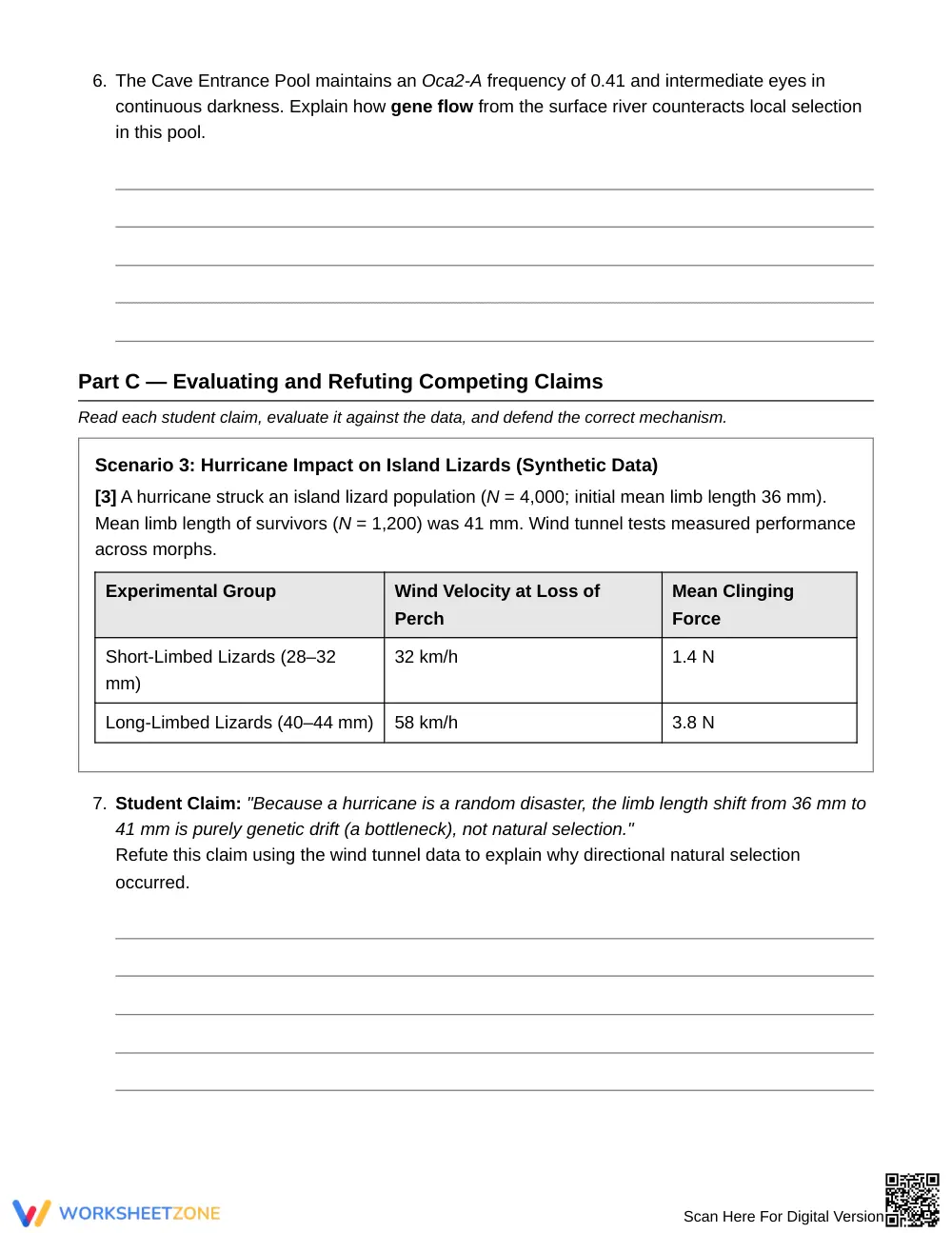
The 5-page worksheet contains a core reference summary of microevolutionary mechanisms, followed by 8 analytical tasks. Students interpret quantitative tables, population counts, and phenotypic frequencies across three synthetic scenarios (alpine beetles, valley grasshoppers, and hurricane-impacted island lizards), concluding with a complete 2-page answer key.
Skill Progression
- Guided Practice (Part A, 2 tasks): Students identify distinguishing empirical evidence between selection, drift, and gene flow using high-contrast multiple-choice scenarios with foundational reference definitions.
- Supported Practice (Part B, 4 tasks): Students construct structured written arguments interpreting multi-year population tables, reproductive outputs, and energy-cost metrics for grasshoppers and cave fish.
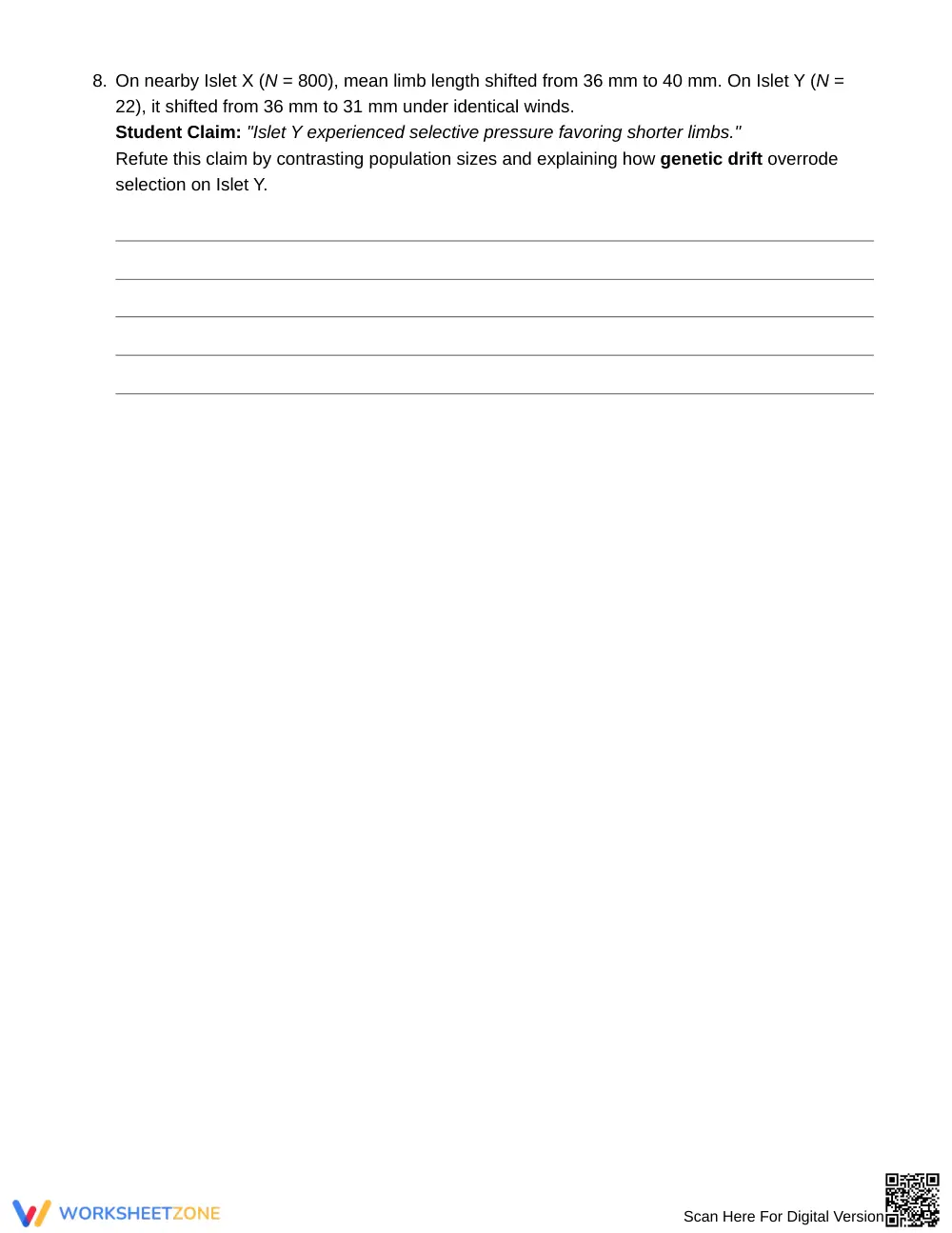
- Independent Practice (Part C, 2 tasks): Students evaluate and refute authentic student misconceptions regarding disaster bottlenecks versus directional selection on island lizard populations.
This sequence follows the gradual release of responsibility model, guiding learners from basic evidence selection to nuanced claim refutation.
Standards Alignment
This resource aligns to high school life science standards addressing evolutionary mechanisms, natural selection, and genetic drift. Students apply mathematical reasoning and quantitative evidence to justify how selective pressures and stochastic events influence phenotypic distributions. These curriculum connections can be integrated directly into lesson plans, IEP goals, or district curriculum mapping tools.
How to Use It
Assign this activity directly after completing direct instruction on population genetics and the Hardy-Weinberg equilibrium. During class, monitor Part B responses to confirm students differentiate small population sampling errors from adaptive fitness differences. Plan for 45 to 55 minutes of instructional time.
Who It's For
Designed for Grade 10 general biology and honors life science students studying evolution. Pair this resource with a physical natural selection simulation or population genetics anchor chart to maximize analytical retention.
According to Fisher and Frey (2014), structured argumentation from authentic data sets bridges the gap between conceptual recall and deep scientific literacy. This Grade 10 resource provides 8 targeted tasks that challenge students to evaluate competing evolutionary mechanisms, including natural selection, genetic drift, and gene flow, using quantitative population metrics and phenotypic distributions. Rather than treating evolution as an abstract principle, students actively analyze numerical evidence from controlled scenarios, such as reproductive output rates across morphs and bottleneck events in isolated subpopulations. By requiring students to refute common misconceptions regarding random environmental events and selective pressures, the worksheet reinforces rigorous evidentiary standards for high school science classrooms. The included 2-page answer key provides clear model responses and detailed explanations, making it an efficient, practical tool for formative assessment, small-group intervention, or direct curriculum reinforcement.


