































Essential Evolution Errors Worksheet | Grades 8-12 Science

Paste this activity's link or code into your existing LMS (Google Classroom, Canvas, Teams, Schoology, Moodle, etc.).
Students can open and work on the activity right away, with no student login required.
You'll still be able to track student progress and results from your teacher account.
This evolution error analysis worksheet trains secondary science students to evaluate, diagnose, and refute common evolutionary misconceptions. Across three authentic student claims, learners identify flawed logic regarding acquired traits, anatomical homology, and phylogenetic trees, then construct written scientific explanations that demonstrate mastery of natural selection and common ancestry.
At a Glance
- Grade: Grades 8–12 · Subject: Science
- Standard: Life Science — Construct explanations based on evidence for natural selection and common ancestry
- Skill Focus: Misconception and error analysis in evolution
- Format: 4 pages · 18 problems · Answer key included · PDF
- Best For: Formative assessment and concept review
- Time: 40–50 minutes
What's Inside
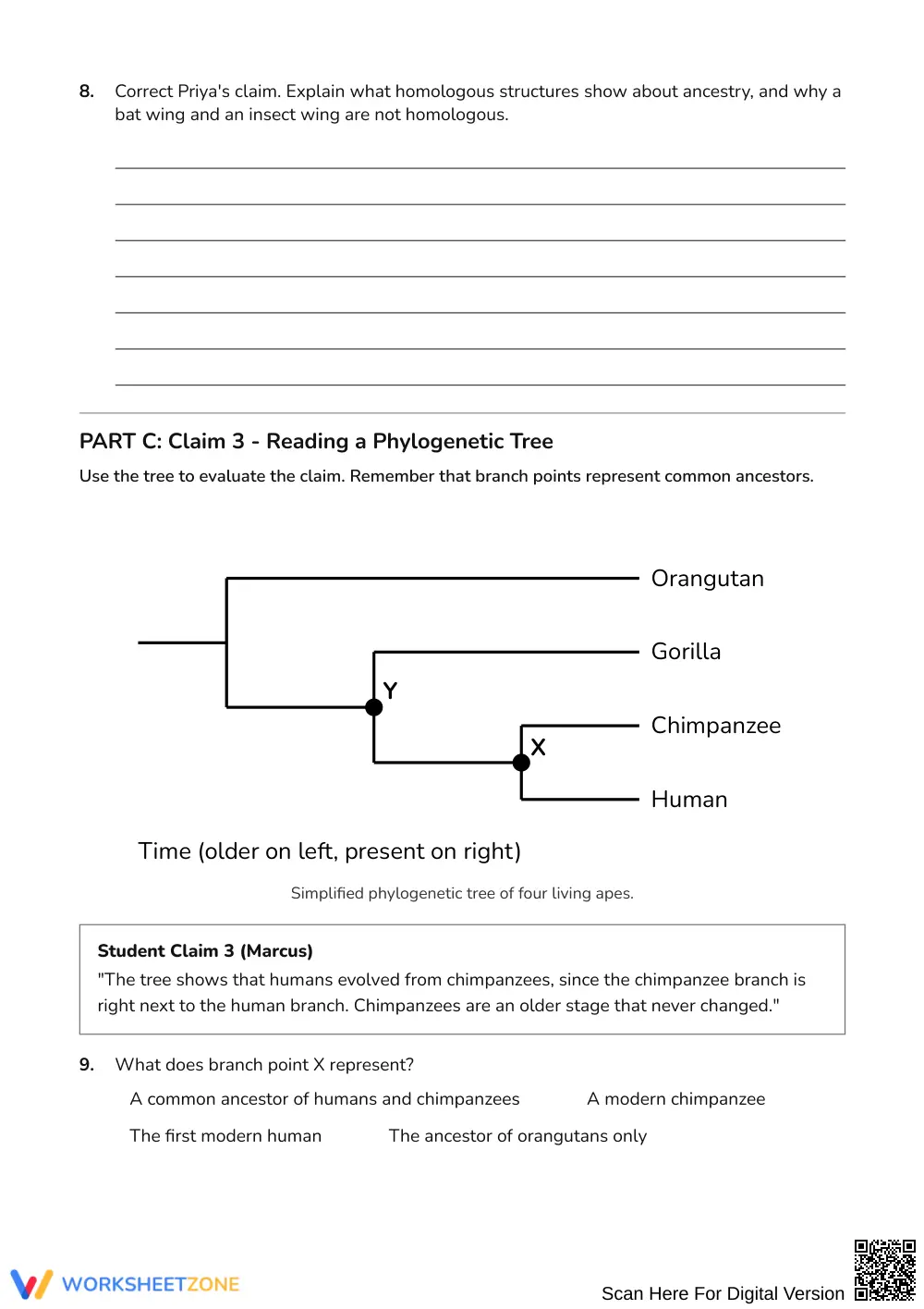
The four-page printable worksheet contains 18 total items organized across three multi-part investigation prompts. Tasks combine targeted multiple-choice identification with structured open-response writing prompts. Students analyze an anatomical forelimb bone diagram showing homologous structures (humerus, radius, ulna, carpals, metacarpals, phalanges) and interpret a four-species primate phylogenetic tree. A complete four-page teacher answer key provides exemplar rewritten responses with essential vocabulary highlighted.
Skill Progression
- Guided practice (Part A, 4 items): Students evaluate Lamarckian inheritance of acquired traits in giraffes, identifying faulty genetic assumptions using provided vocabulary prompts (variation, inherited, survive, reproduce).
- Supported practice (Part B, 6 items): Learners inspect forelimb bone diagrams to distinguish homologous structures from analogous adaptations, refuting claims based strictly on superficial function.
- Independent practice (Part C, 8 items): Students analyze cladogram branch points and node labels to disprove linear progression myths regarding modern apes and human ancestry.
This sequence follows a gradual-release framework, moving learners from scaffolded error detection to independent phylogenetic interpretation.
Standards Alignment
This worksheet targets core secondary life science concepts covering biological evolution, natural selection, and common descent. Students evaluate the role of genetic variation in population change over time and analyze anatomical and branching evidence for evolutionary relationships. Both standard codes can be copied directly into lesson plans, IEP goals, or district curriculum mapping tools.
How to Use It
Deploy this resource immediately after direct instruction on natural selection and evolutionary evidence, or use it as a mid-unit check for persistent misconceptions. During student work time, circulate to verify that learners identify branch points as shared ancestors rather than modern species. The activity takes approximately 40 to 50 minutes to complete.
Who It's For
This activity is designed for middle and high school life science or biology classrooms. It benefits students preparing for state assessments by targeting deceptive distractor concepts. Pair this worksheet directly with a comparative anatomy lab or a phylogenetic tree station activity.
Secondary science educators frequently encounter persistent student misunderstandings regarding natural selection, such as intentional trait adaptation and linear ape evolution. Research from Fisher & Frey (2014) highlights that structured error analysis and guided argumentative refutation produce significantly deeper conceptual retention than passive reading or direct vocabulary drill. By prompting students to pinpoint exact flaws in peer reasoning and rewrite claims with evidentiary terms such as variation and common ancestry, this 18-problem, 4-page evolution worksheet directly bridges the gap between surface memorization and scientific literacy. Learners confront Lamarckian ideas, dissect vertebrate limb homology, and accurately interpret cladogram nodes. The included 4-page exemplar answer key equips teachers to identify lingering misconceptions during formative checks, ensuring students build rigorous, evidence-based reasoning that supports high school biology mastery and meets state standardized expectations.


