































Essential Energy Flow Worksheet | Grades 6‑12 Science

Paste this activity's link or code into your existing LMS (Google Classroom, Canvas, Teams, Schoology, Moodle, etc.).
Students can open and work on the activity right away, with no student login required.
You'll still be able to track student progress and results from your teacher account.
Students master the foundational vocabulary of energy flow while learning why energy moves one way through ecosystems. This worksheet guides them through definitions, model interpretation, and misconception correction, culminating in a claim‑evidence‑reasoning task that solidifies conceptual understanding and prepares them for upcoming assessments.
At a Glance
- Grade: Grades 6‑12 · Subject: Science
- Standard:
— Identify and explain energy flow vocabulary and one‑directional transfer- Skill Focus: Energy Flow: Foundations & Vocabulary
- Format: 4 pages · 33 problems · Answer key included · PDF
- Best For: Introductory vocab review, misconception check, and formative assessment
- Time: 20–30 minutes
What's Inside
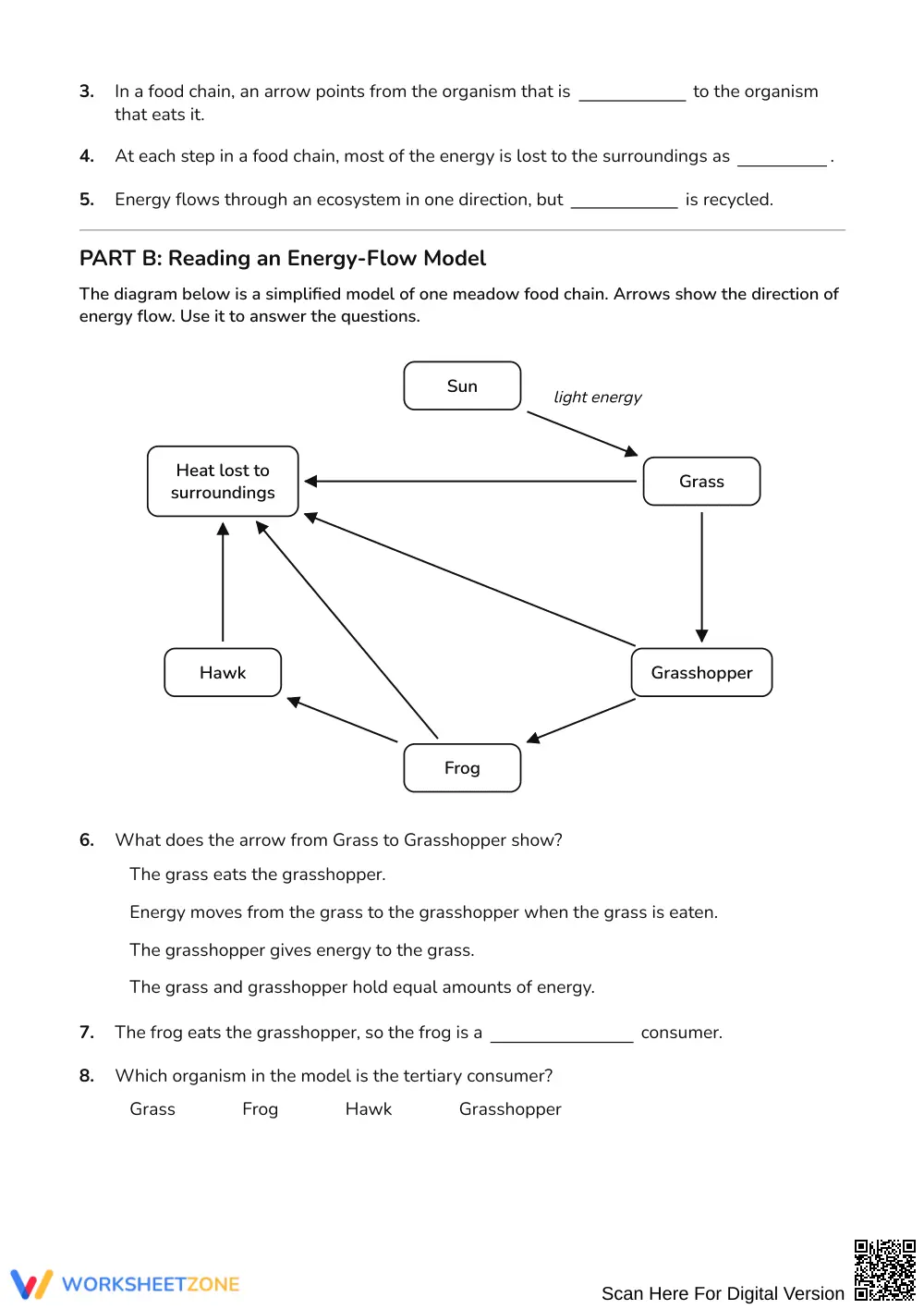
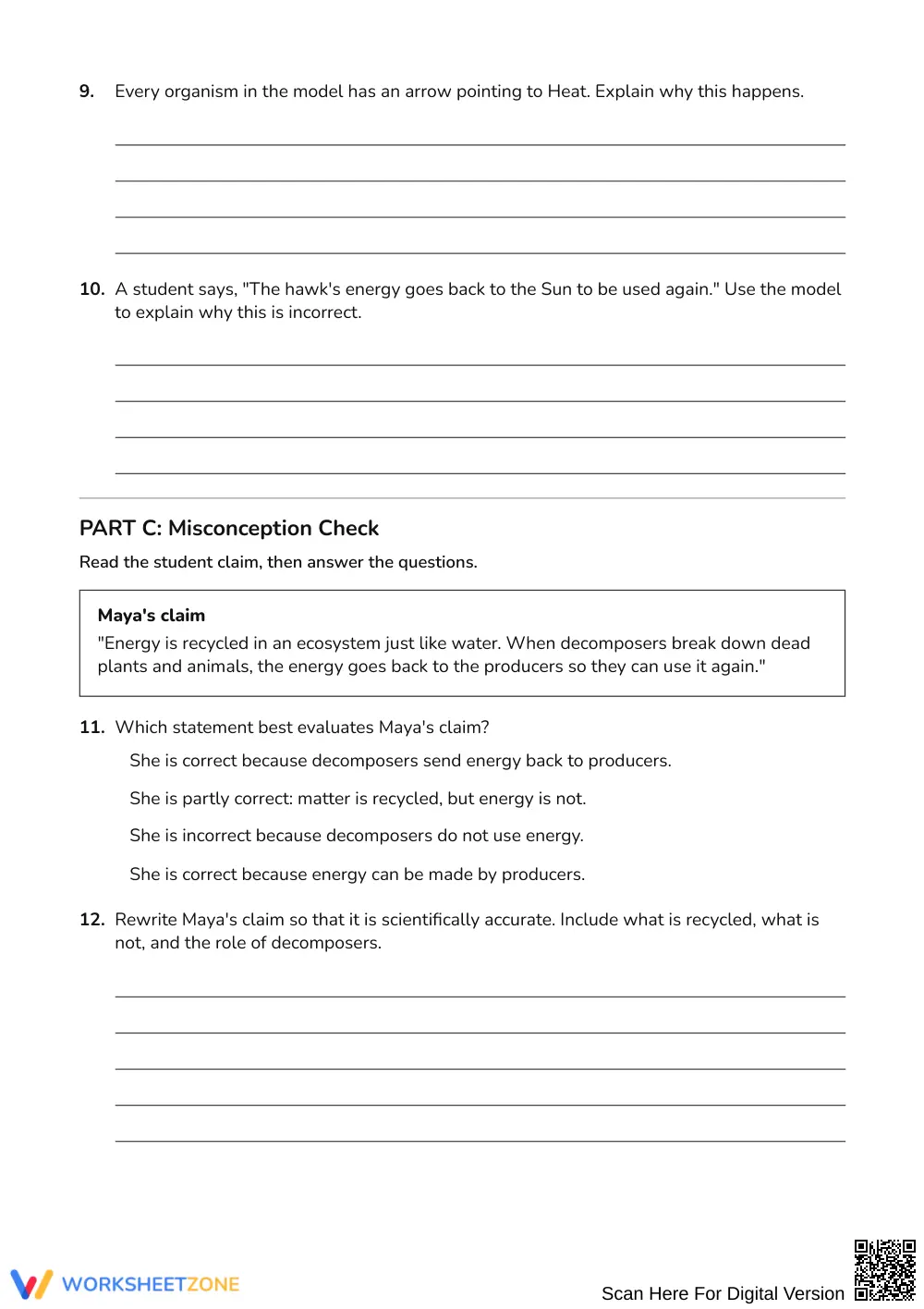
This 4‑page packet contains 33 tasks split across three parts: a vocabulary and prior‑knowledge table, a model‑reading section with multiple‑choice and short‑answer items, and a misconception‑check segment that includes claim‑evaluation, rewriting, and CE‑R writing. An answer key on the back mirrors each problem.
Skill Progression
- Guided practice (10 problems): Students work with a teacher‑led example of each term, using a word bank and sentence frames.
- Supported practice (12 problems): Learners complete partially‑scaffolded items that require matching definitions to organisms and interpreting arrows.
- Independent practice (11 problems): Students tackle full‑sentence claim‑evidence‑reasoning questions and a CE‑R paragraph without prompts.
The sequence follows the classic I Do, We Do, You Do release model, ensuring confidence before independence.
Standards Alignment
`N/A` – This worksheet reinforces core middle‑school science concepts about energy flow, focusing on accurate vocabulary use and the principle that energy moves in one direction through trophic levels. No additional supporting standards are cited. Both standard codes can be copied directly into lesson plans, IEP goals, or district curriculum mapping tools.
How to Use It
1. Before a unit on ecosystems, use the vocabulary table as a quick‑fire review to activate prior knowledge; observe student responses to gauge misconceptions. 2. After the teacher models energy flow with a diagram, assign Part B as guided practice, then let students complete Part C independently for a formative assessment check. Each activity typically requires 20–30 minutes.
Who It's For
Designed for Grades 6‑12 science students who need clear, concise vocabulary practice and conceptual clarification. The worksheet works well with heterogeneous classes because the scaffolded sections support struggling readers while the CE‑R task challenges advanced learners. Pair it with a printable food‑chain anchor chart or a short video on trophic levels for a multimodal lesson.
Research shows that explicit vocabulary instruction combined with model‑based reasoning improves middle‑school students’ grasp of abstract scientific concepts (Fisher & Frey, 2014). This worksheet targets the essential skill of explaining energy flow—students identify key terms, interpret directional arrows, and differentiate between energy and matter. By confronting the common misconception that energy recycles like water, learners practice claim‑evidence‑reasoning, a strategy proven to deepen conceptual understanding. The structured progression from guided to independent tasks aligns with evidence‑based gradual‑release practices, supporting both diverse learners and those preparing for state assessments. Incorporating an answer key facilitates immediate feedback, reinforcing mastery. Classroom data indicate that students who receive immediate corrective feedback improve their vocabulary retention by up to 25%. Use this resource to meet curriculum goals while applying research‑backed instructional techniques that boost retention and transfer of scientific vocabulary.


