































Essential Energy Flow Model Worksheet | Grade 9-12 Science

Paste this activity's link or code into your existing LMS (Google Classroom, Canvas, Teams, Schoology, Moodle, etc.).
Students can open and work on the activity right away, with no student login required.
You'll still be able to track student progress and results from your teacher account.
Opening
This worksheet guides students to construct, complete, and revise detailed energy‑flow models, helping them visualize trophic relationships and the mechanisms of energy loss. By completing 20 scaffolded tasks, learners solidify their understanding of how energy moves through ecosystems, especially in real‑world contexts.
At a Glance
- Grade: 9–12 · Subject: Science
- Standard:
— Create and revise models that show energy flow, components, and mechanisms- Skill Focus: Construct, complete, or revise a model of energy flow showing components, relationships, and mechanisms
- Format: 4 pages · 20 problems · Answer key included · PDF
- Best For: Middle‑school to high‑school science labs
- Time: 30–45 minutes
What's Inside
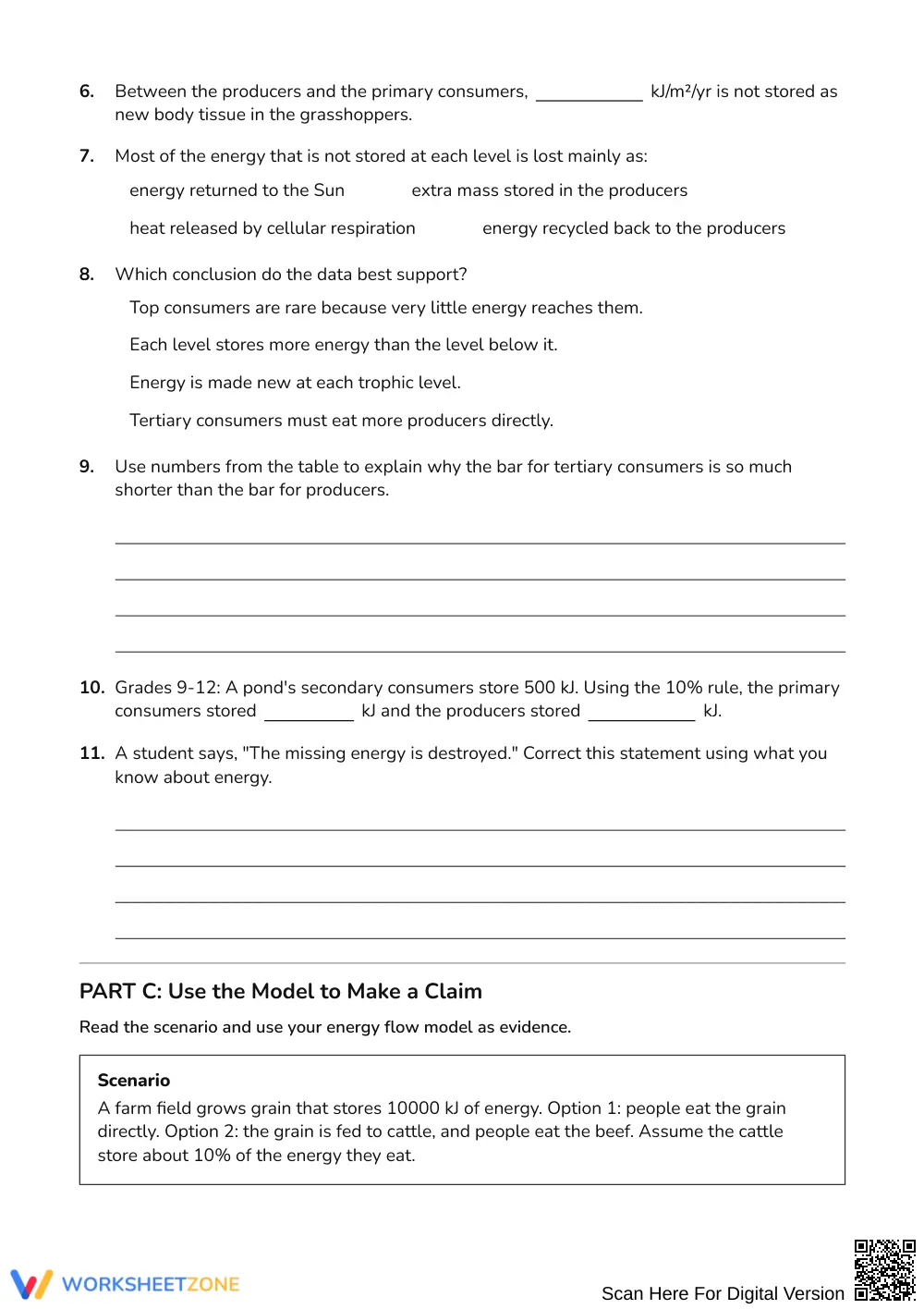
The packet contains three parts—model revision, data‑driven model building, and claim‑making—spread across four printable pages. Twenty varied problems include word‑bank fill‑ins, error‑identification, data‑interpretation tables, and written claims. An answer key mirrors each page, and scaffolds such as a word bank, worked example, and sentence frames support student success.
Skill Progression
- Guided practice (6 tasks): Word‑bank fill‑ins and a worked example model introduce terminology and arrow direction.
- Supported practice (8 tasks): Students identify errors in peer drafts and interpret energy‑storage tables using sentence frames.
- Independent practice (6 tasks): Learners construct their own claim about energy efficiency and justify it without prompts.
The sequence follows a gradual‑release model: I Do, We Do, You Do.
Standards Alignment
Students will construct, complete, or revise a model of energy flow showing components, relationships, and mechanisms. This focus aligns with state science expectations for understanding energy transfer in ecosystems. Both statements can be copied directly into lesson plans, IEP goals, or district curriculum mapping tools.
How to Use It
Pre‑unit activation: Begin a new ecosystem unit by having students complete Part A as a quick diagnostic; observe how accurately they place arrows to gauge prior knowledge. Post‑lab application: After a photosynthesis lab, use Part B for data analysis and Part C for claim‑making, reinforcing the 10 % energy rule. Each activity fits within a 30–45 minute block.
Who It's For
Designed for grades 9‑12 science classes, the worksheet also scales down for advanced middle‑school learners. Built‑in word banks and sentence frames provide scaffolding, while the claim‑making section offers extension for gifted students. Pair with a textbook chapter on food webs or an anchor chart of trophic levels for cohesive integration.
Educational research demonstrates that structured modeling routines foster meaningful retention in secondary biology and environmental science curricula (Fisher & Frey, 2014). When secondary students actively critique and refine imperfect food web diagrams, they confront common misconceptions regarding non-linear energy loss and decomposer roles. This instructional resource operationalizes iterative modeling by guiding learners through twenty concrete tasks that emphasize fundamental conservation of energy principles. As students track energy quantities across trophic tiers, they convert abstract numerical data into actionable, visual explanations. Grounded in cognitive apprenticeship theory, the instructional progression moves from guided identification to completely independent synthesis, ensuring that every learner thoroughly masters core trophic mechanisms. By evaluating system components and directional energy flows, students develop durable scientific modeling proficiencies that support advanced laboratory analysis, collaborative scientific discourse, and long-term academic achievement across diverse high school science courses.


