




























Views
Downloads



Essential Dialogue vs Narration Worksheet | Grade 6 ELA

Paste this activity's link or code into your existing LMS (Google Classroom, Canvas, Teams, Schoology, Moodle, etc.).
Students can open and work on the activity right away, with no student login required.
You'll still be able to track student progress and results from your teacher account.
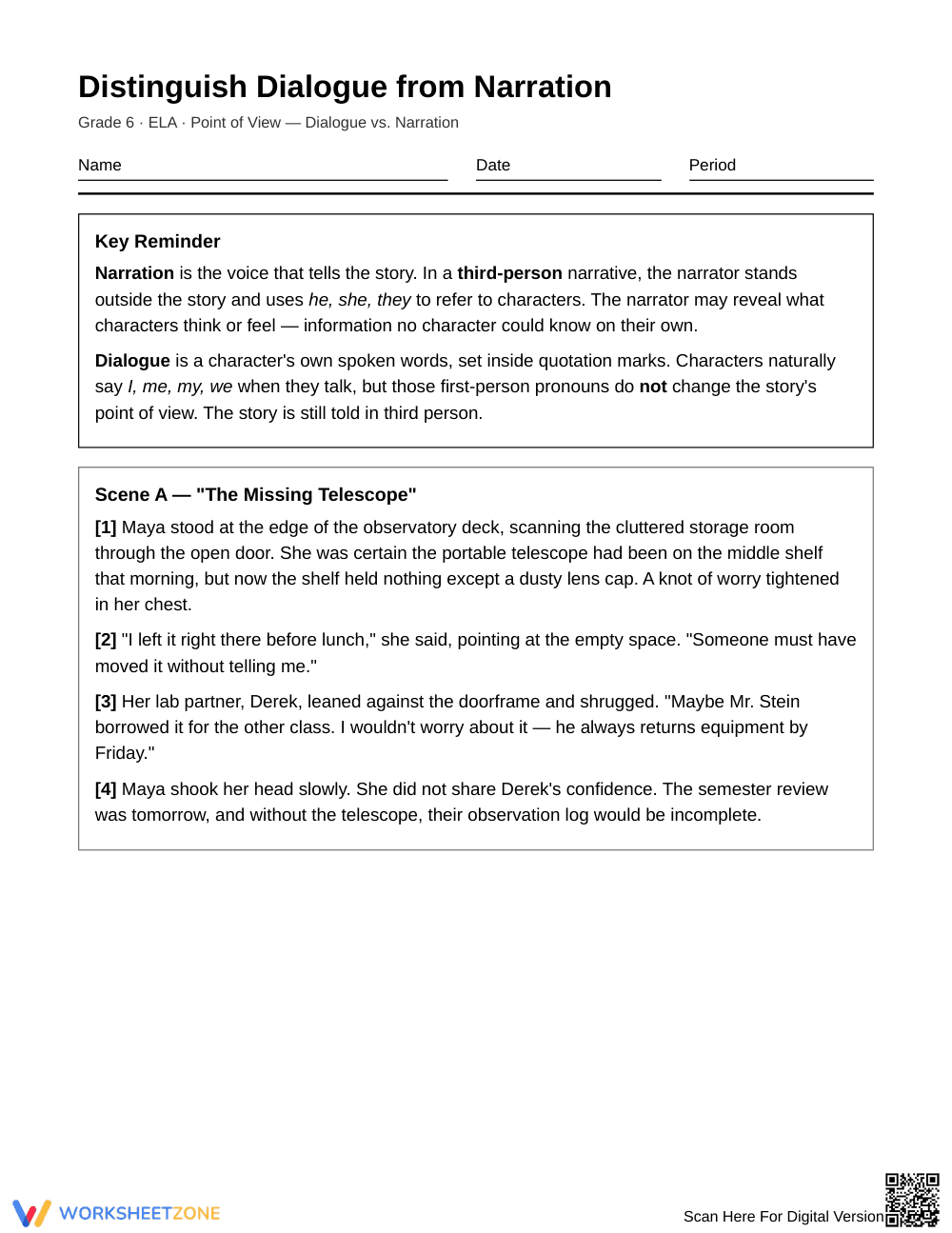
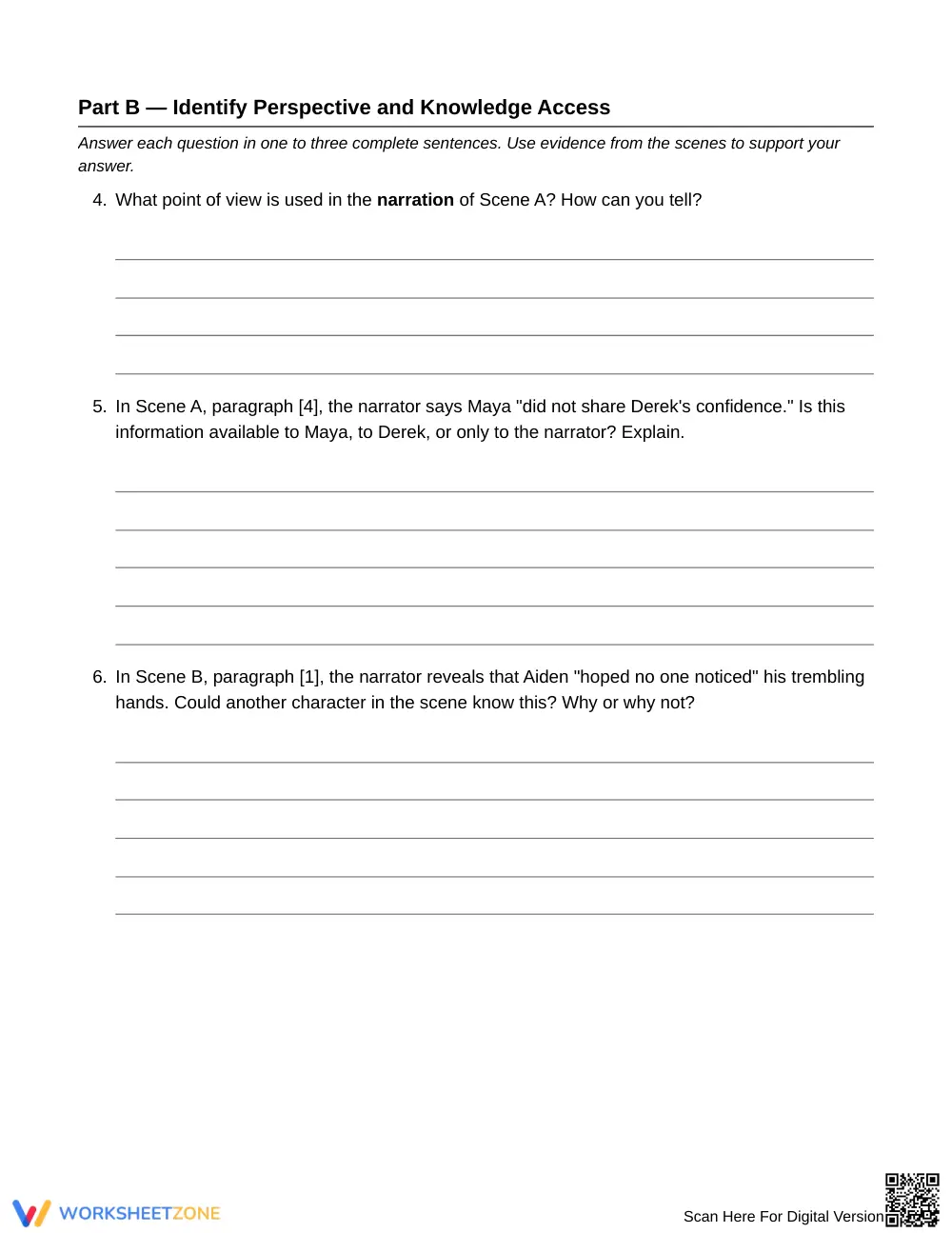
This Grade 6 ELA worksheet equips students to distinguish dialogue from narration. Through two narrative scenes, learners examine character speech, narrator access to thoughts, and misleading first-person pronouns. Students build critical reading precision, identifying point of view accurately even when spoken dialogue contains first-person language.
At a Glance
- Grade: 6 · Subject: ELA
- Standard:
RL.6.6— Explain how an author develops the narrator's point of view- Skill Focus: Distinguish Dialogue from Narration
- Format: 5 pages · 12 problems · Answer key included · PDF
- Best For: Point of view analysis practice
- Time: 30–45 minutes
What's Inside
This 5-page worksheet features a "Key Reminder" rule box defining third-person narration versus character dialogue, followed by two realistic reading scenes. Across 12 structured tasks, students categorize text excerpts, evaluate narrator knowledge access, and deconstruct pronoun traps. A 3-page answer key provides complete model responses for quick grading.
Skill Progression
- Guided practice (Part A, 3 problems): Students identify quotation markers and categorize excerpts as spoken dialogue or narration.
- Supported practice (Part B, 6 problems): Learners examine what characters know versus what the external narrator reveals about internal thoughts.
- Independent practice (Part C, 3 problems): Students explain in writing why first-person dialogue does not alter third-person narration.
This progression follows an I Do, We Do, You Do model, building from basic identification to deep perspective analysis.
Standards Alignment
This resource aligns directly with Common Core standard `RL.6.6`: "Explain how an author develops the point of view of the narrator or speaker in a text." It also supports `RL.6.1` through evidence-based analysis questions. Both standard codes can be copied directly into lesson plans, IEP goals, or district curriculum mapping tools.
How to Use It
Assign this worksheet directly after introducing third-person narrative points of view. During a 35-minute lesson, use Part A as a quick check for understanding before releasing students to complete Parts B and C. Formatively observe whether students mistakenly cite dialogue pronouns when identifying narrative voice. Expected completion time is 30 to 45 minutes.
Who It's For
This worksheet supports sixth-grade students learning point of view, particularly English language learners who confuse character dialogue with narrative perspective. Provide text highlighters for emerging readers or challenge advanced students to rewrite scenes from Maya's perspective. It pairs effectively with an anchor chart on narrative voice.
According to Fisher & Frey (2014), structured literacy practice targeting common reading misconceptions substantially accelerates comprehension and analytical fluency. In middle school English language arts, confusing character speech with narrator perspective represents a frequent barrier to mastering narrative point of view under standard `RL.6.6`. This 12-task worksheet directly addresses that instructional challenge by teaching sixth-grade students to distinguish dialogue from narration across structured narrative scenes. By evaluating knowledge access and disproving misleading first-person pronoun clues inside quoted speech, learners build metalinguistic awareness and critical textual evaluation skills. The systematic progression from identifying quotation boundaries to evaluating narrator omniscience provides educators with measurable evidence of student proficiency. When students learn to separate what characters say from what the narrator reveals, they gain the analytical foundation required for advanced literary analysis across diverse informational and narrative texts.


