


























Views
Downloads



Essential Delayed Response Worksheet | Grade 9 Biology
Paste this activity's link or code into your existing LMS (Google Classroom, Canvas, Teams, Schoology, Moodle, etc.).
Students can open and work on the activity right away, with no student login required.
You'll still be able to track student progress and results from your teacher account.
Opening
This worksheet guides Grade 9 biology students to explain delayed population responses to resource pulses, using real‑world data and multi‑step applications that build causal‑chain reasoning. Students will identify mechanisms, calculate time‑lag intervals, and synthesize management recommendations. The activities culminate in evidence‑based explanations aligned with ecological standards.
At a Glance
- Grade: 9 · Subject: Biology
- Standard:
— Explain delayed response to resource changes, classroom labs, test review, and project planning, and curriculum alignment for standards- Skill Focus: Explain a Delayed Response to a Resource Change
- Format: 5 pages · 14 problems · Answer key included · PDF
- Best For: Inquiry labs, assessment prep, data‑driven discussions, classroom labs, test review, and project planning, and curriculum alignment for standards
- Time: 45–60 minutes
What's Inside
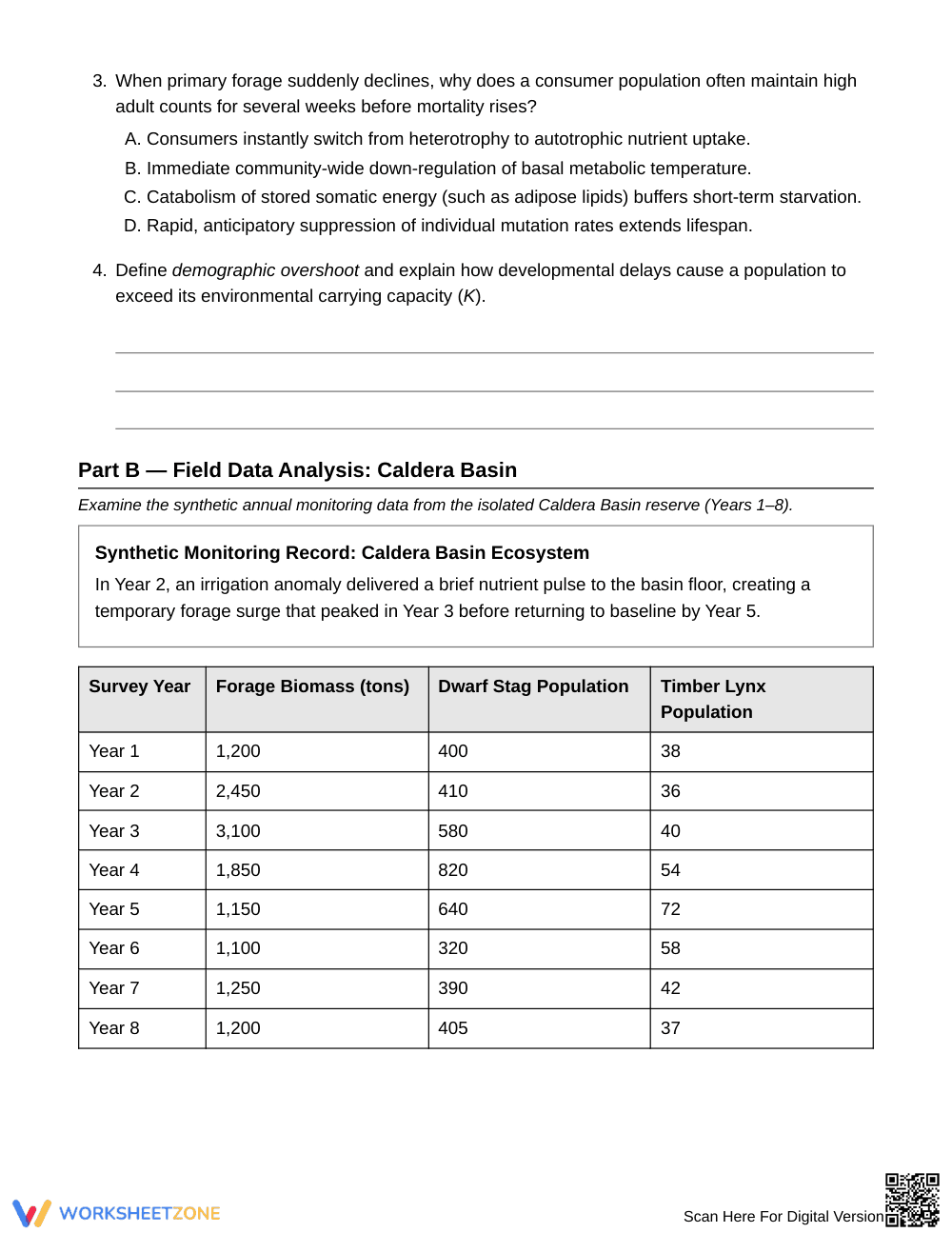
The worksheet contains three parts: Part A asks students to select biological mechanisms behind observed lags, Part B provides a synthetic eight‑year data set for students to chart peak years and calculate lag durations, and Part C challenges them with multi‑step applications, inverse problems, and model comparisons. All 14 tasks are presented across five printable pages, and an answer key spans three pages. Features include a word bank of life‑history terms, worked examples for the timeline calculations, and sentence frames for causal explanations.
Skill Progression
- Guided practice (4 problems): Students choose the correct mechanism from a provided list and receive immediate feedback via a worked example.
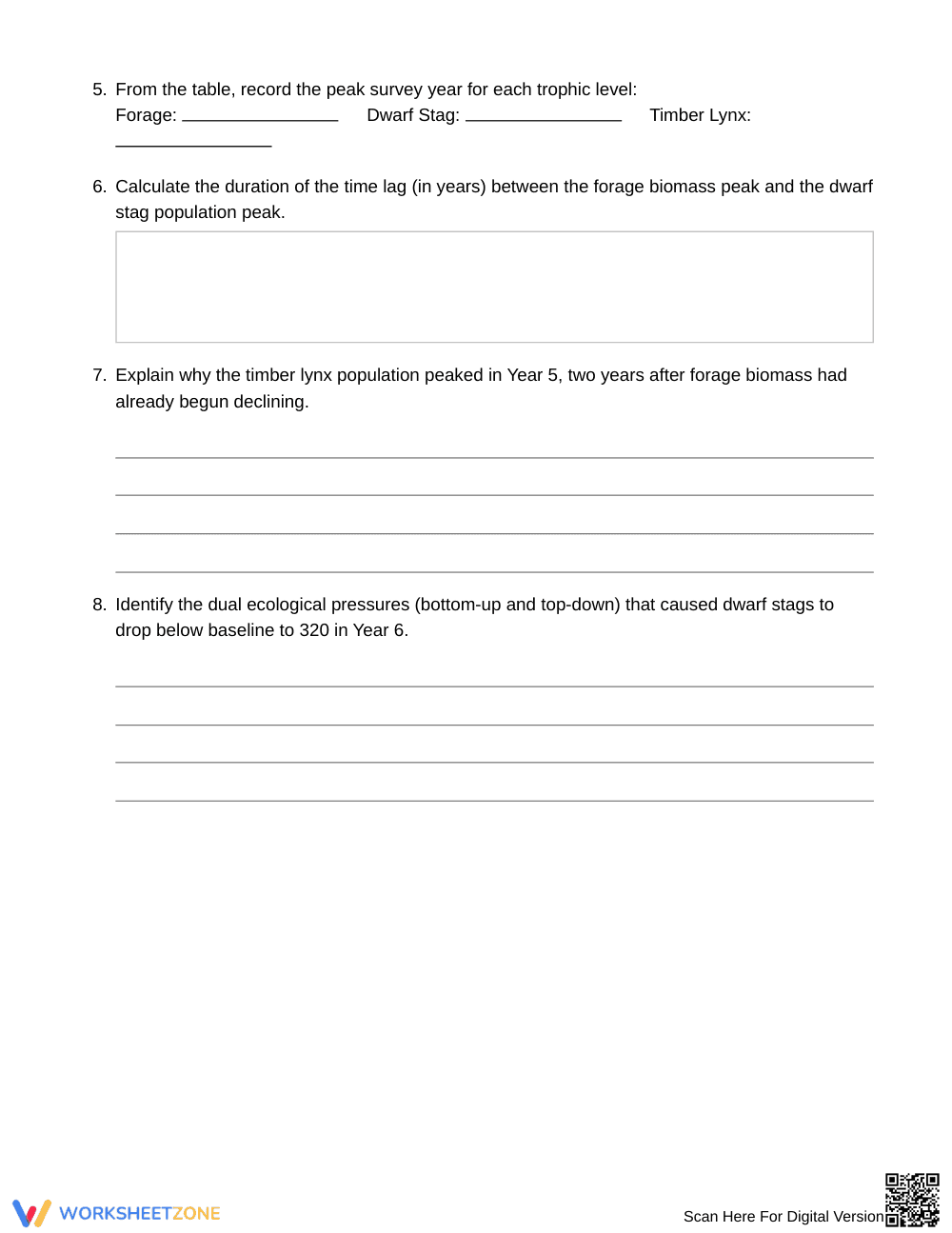
- Supported practice (5 problems): Students analyze the Caldera Basin table, calculate lag intervals, and write short explanations using sentence frames.
- Independent practice (5 problems): Students complete the constrained applications, inverse problem, and model‑evaluation tasks without scaffolds, synthesizing full causal chains.
The sequence follows the classic I Do, We Do, You Do release.
Standards Alignment
`` Students explain how delayed reproductive, developmental, and energetic processes cause populations to overshoot carrying capacity and create time‑lagged responses to resource pulses. This aligns with state ecology standards for high‑school biology. Both standard codes can be copied directly into lesson plans, IEP goals, or district curriculum mapping tools.
How to Use It
Use Case 1: Before a unit on population dynamics, teachers can assign Part A as a quick diagnostic. Students work in pairs to select mechanisms, allowing the teacher to gauge prior knowledge within a 10‑minute warm‑up.
Use Case 2: During data‑analysis labs, Part B serves as a guided inquiry where students plot the eight‑year record, calculate lag intervals, and discuss ecological pressures. The teacher observes formative evidence of students’ causal reasoning in a 20‑minute activity.
Who It's For
Designed for Grade 9 biology students, especially those studying ecology or preparing for state assessments. The worksheet supports mixed‑ability classes with built‑in scaffolds, and pairs well with a classroom anchor chart on time‑lag mechanisms and a video on resource pulses.
Citation Capsule
Research shows that explicit scaffolding of causal reasoning improves students’ ability to interpret delayed ecological responses (Fisher & Frey, 2014). This worksheet operationalizes that finding by providing word banks, worked examples, and sentence frames that guide learners through the step‑by‑step analysis of resource‑pulse effects. By aligning tasks with the skill “Explain a Delayed Response to a Resource Change,” educators can collect concrete evidence of mastery while reinforcing the underlying biology concepts. The inclusion of real‑world data sets mirrors authentic scientific inquiry, a practice linked to higher achievement on state biology assessments. Teachers can therefore assign this resource confidently, knowing it meets evidence‑based instructional standards and supports diverse learners in developing robust ecological reasoning. Furthermore, the multi‑step application section encourages transfer of knowledge to novel scenarios, a key predictor of long‑term retention according to the RAND AIRS 2024 report.


