


























Views
Downloads




Essential Compensation Limits Worksheet | Grade 10 Biology
Paste this activity's link or code into your existing LMS (Google Classroom, Canvas, Teams, Schoology, Moodle, etc.).
Students can open and work on the activity right away, with no student login required.
You'll still be able to track student progress and results from your teacher account.
This Grade 10 biology worksheet guides students to explain how physiological compensation limits fail across interacting feedback loops. Through six data-driven problems, learners analyze effector saturation, competing homeostatic priorities, and multi-system collapse. Students move from evaluating biochemical thresholds to explaining lethal positive feedback cascades in exertional heat stroke.
At a Glance
- Grade: 10 · Subject: Biology
- Standard: Feedback Systems — Explain how feedback mechanisms maintain dynamic equilibrium under stress
- Skill Focus: Explain compensation limits in interacting systems
- Format: 5 pages · 6 problems · Answer key included · PDF
- Best For: Advanced homeostatic loop analysis
- Time: 45–60 minutes
The 5-page student worksheet features six analytical problems organized across three parts, beginning with a core concepts reference box on sensors, integrators, and effectors. Students evaluate quantitative data tables detailing sweat rates, cutaneous perfusion, glucose clearance kinetics, and muscle glycogen depletion, accompanied by a complete 3-page teacher answer key.
Skill Progression
- Guided practice (Part A, 2 problems): Structured data analysis where students evaluate physical constraints, such as vapor pressure limits in evaporative cooling and GLUT4 transporter saturation, using explicit sensor-effector prompts.
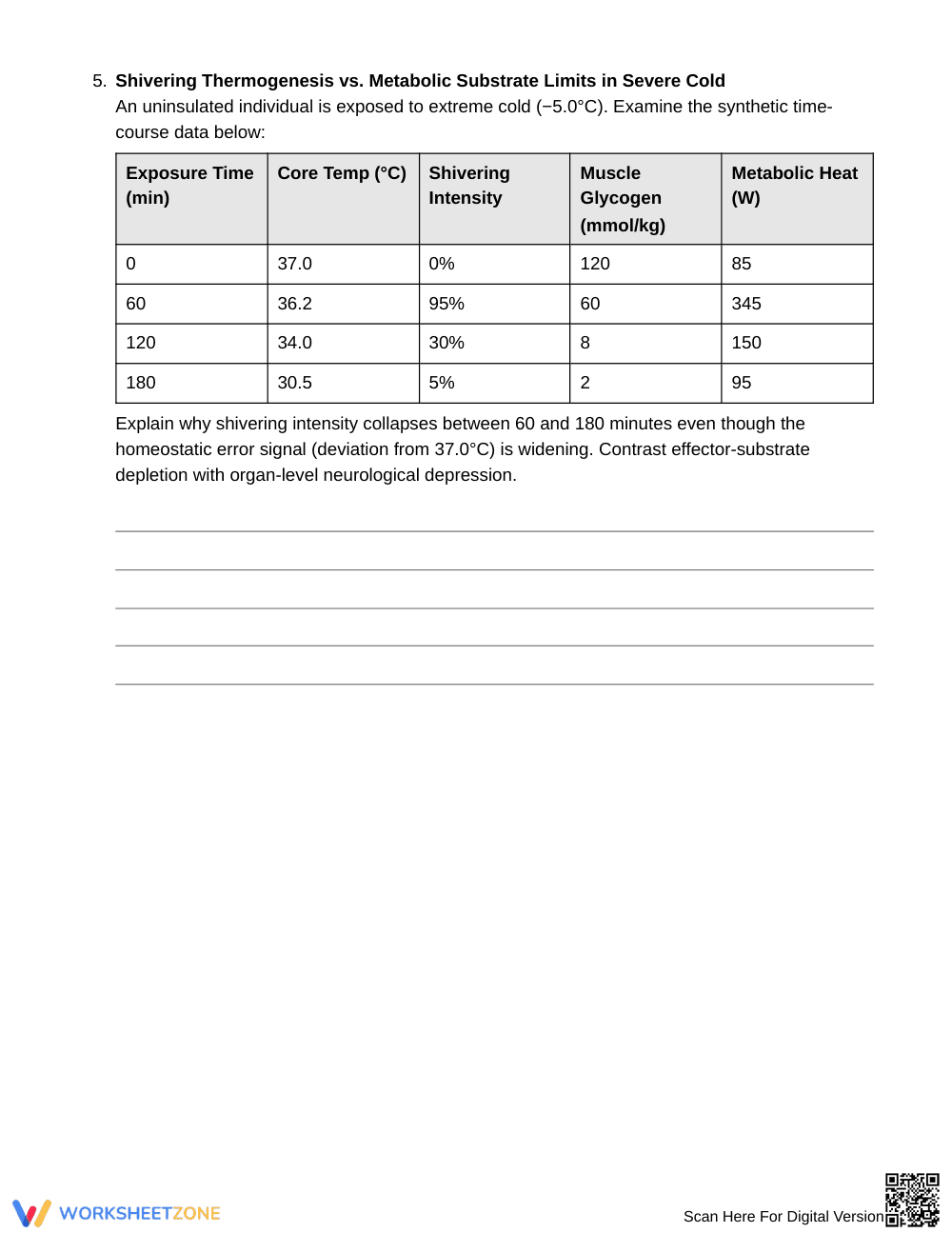
- Supported practice (Part B, 3 problems): Competing-model problems where learners resolve physiological trade-offs between blood pressure and thermoregulation, substrate depletion in fasting, and shivering collapse during hypothermia.
- Independent practice (Part C, 1 problem): A defended synthesis task requiring students to construct a model detailing how multi-loop breakdowns transition negative feedback into positive feedback during heat stroke.
This sequence follows a gradual-release framework, moving students systematically from targeted interpretation to comprehensive systems synthesis.
Standards Alignment
This resource aligns with high school biology standards requiring students to explain how feedback mechanisms maintain dynamic equilibrium under environmental stress. A supporting standard addresses how interacting organ systems coordinate physiological processes during metabolic exertion. Both standard codes can be copied directly into lesson plans, IEP goals, or district curriculum mapping tools.
How to Use It
Assign this worksheet after direct instruction on negative feedback loops. Use Part A for collaborative mid-lesson practice to solidify effector saturation concepts before assigning Parts B and C for independent summative evaluation. For formative assessment, check whether students distinguish between effector engagement and actual cooling efficacy in the humidity scenario. Expect completion within 45 to 60 minutes.
Who It's For
This worksheet serves Grade 10 biology and physiology students mastering homeostatic control mechanisms. Structured data tables scaffold developing learners, while competing models provide critical rigor for advanced students. Pair this activity with an interactive thermoregulation lab or a diagram illustrating glycogenolysis and cellular energy pathways.
According to Fisher & Frey (2014), structuring instructional tasks through a gradual release of responsibility enables secondary science students to master complex physiological phenomena by shifting cognitive accountability from guided data analysis to independent mechanistic modeling. In this resource, high school biology students explain compensation limits in interacting systems across six structured multi-part problems. By progressing from quantitative calculations of evaporative cooling failure and GLUT4 transporter saturation to competing feedback trade-offs between baroreceptor signaling and thermoregulation, students synthesize how homeostatic loops fail when effector mechanisms saturate. The defended synthesis task in exertional heat stroke requires learners to articulate how negative feedback transitions into positive feedback collapse under metabolic exhaustion. Grounded in evidence-based pedagogical frameworks, this progression equips tenth-grade biology learners to master state life science standards through quantitative data interpretation, critical evaluation of physiological models, and systems-level scientific argumentation.


