




























Essential Comic Timing Word Search | Grades 6–7 ELA
Paste this activity's link or code into your existing LMS (Google Classroom, Canvas, Teams, Schoology, Moodle, etc.).
Students can open and work on the activity right away, with no student login required.
You'll still be able to track student progress and results from your teacher account.
This Grades 6–7 drama word search strengthens students' command of comic timing and stage performance terminology through clue-based discovery. Middle school learners read 16 theater definitions, deduce the comedic techniques, and locate each term in an intricate puzzle grid, reinforcing performing arts vocabulary without a passive word bank.
At a Glance
- Grade: Grades 6–7 · Subject: English Language Arts (ELA)
- Standard: Not standards-assessed — theater vocabulary enrichment and conceptual recall
- Skill Focus: Comic timing and theatrical performance terminology
- Format: 3 pages · 16 words · Full answer key included · Printable PDF
- Best For: Middle school drama vocabulary reinforcement
- Time: 25–35 minutes
What's Inside
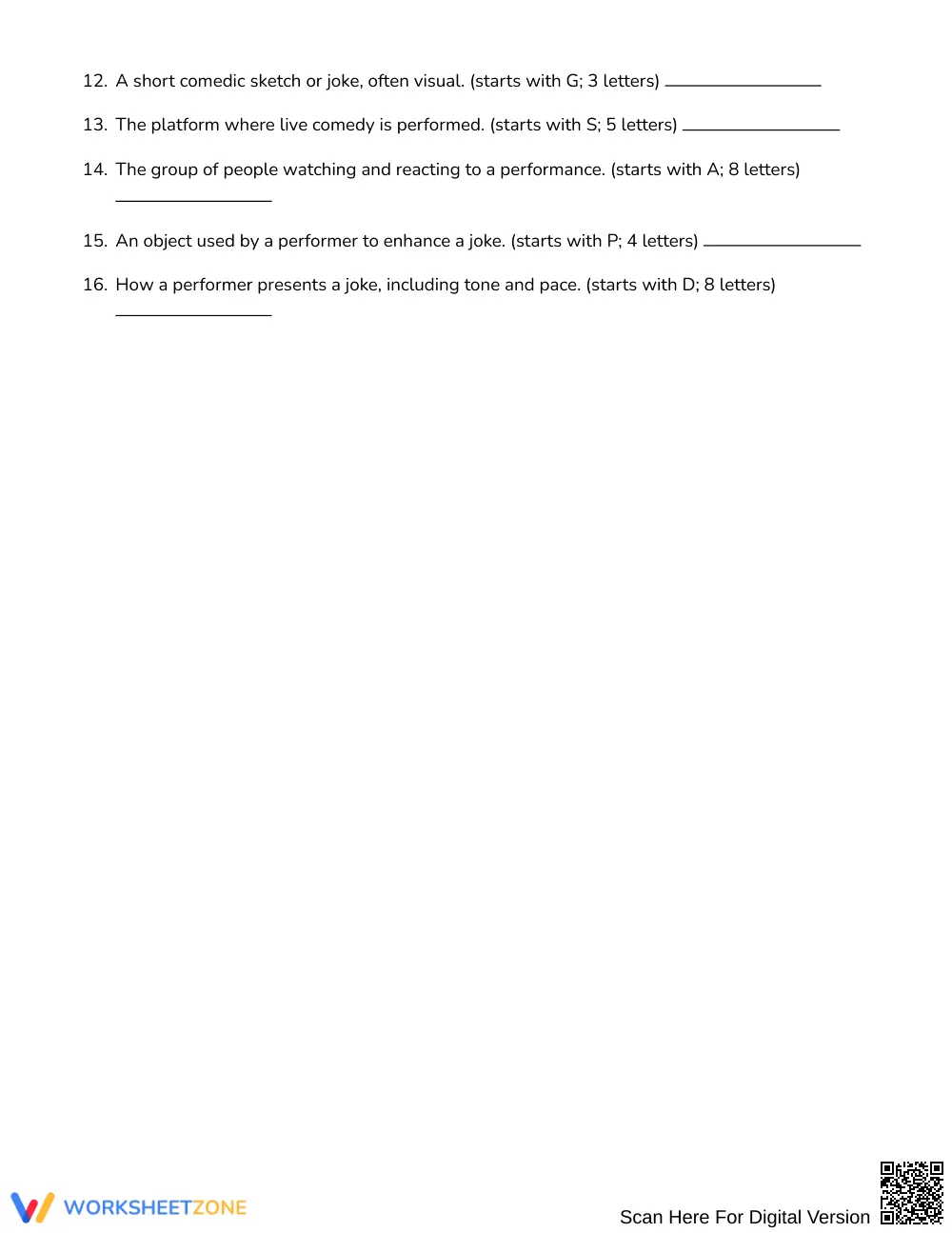
This 3-page printable pack features a theatrical word search accompanied by a complete 3-page answer key showing circled solutions. Rather than presenting a word bank, the activity provides 16 clues defining comedic concepts such as punchline, pause, slapstick, and improvisation. Students read each definition, identify the target term, and locate the hidden vocabulary within the grid.
Puzzle Mechanics
The activity challenges learners through deliberate puzzle design:
- Grid Dimensions: The puzzle is constructed on an 18 x 18 letter grid that distributes letters across 324 spaces.
- Search Directions: Target vocabulary words run in all 8 directions: north, northeast, east, southeast, south, southwest, west, and northwest, requiring diagonal and reverse scanning.
- Clue-Based Discovery: With no word bank provided, students must interpret the 16 definitions to identify which words to find.
Standards Alignment
This resource serves as targeted vocabulary enrichment and is not aligned to a specific state or national academic standard. It supports middle school drama and speech units by establishing domain-specific language for Grades 6–7 learners.
How to Use It
Introduce this activity during a drama unit after direct instruction on comedic performance or as an April Fools' Day lesson on humor. Alternatively, deploy the puzzle as an independent station task or sub plan following introductory stagecraft lessons. During work time, observe whether students deduce terms directly from definitions or need assistance identifying theater vocabulary before searching the grid. Most learners complete the search within 20 to 30 minutes.
Who It's For
This resource is designed for Grades 6–7 English Language Arts and drama students exploring comedic literature and performance. Teachers can differentiate for striving readers by encouraging peer pairs or providing initial letter hints. Pair this word search with a script-reading workshop or a scene-study anchor chart highlighting comic timing.
According to Fisher & Frey (2014), intentional domain-specific vocabulary acquisition relies on structured retrieval opportunities that connect technical definitions to active linguistic contexts. This Grades 6–7 drama resource strengthens comic timing and theatrical performance vocabulary by engaging learners in definition retrieval without relying on passive word lists. When students analyze sixteen performance clues covering concepts like punchlines, pauses, comedic beats, and slapstick, they exercise semantic memory before scanning the complex letter grid. Research from Fisher & Frey (2014) emphasizes that requiring students to generate target terms from conceptual definitions builds significantly deeper cognitive pathways than rote memorization or surface copying. By integrating multi-directional word location with rigorous technical drama analysis, the activity reinforces foundational terminology essential for authentic script interpretation, live theatrical performance, and comedic analysis across middle school language arts classrooms.


