


























Views
Downloads



Essential Carrying Capacity Worksheet | Grade 10 Biology
Paste this activity's link or code into your existing LMS (Google Classroom, Canvas, Teams, Schoology, Moodle, etc.).
Students can open and work on the activity right away, with no student login required.
You'll still be able to track student progress and results from your teacher account.
This dynamic carrying capacity worksheet trains tenth-grade biology students to identify and dismantle the widespread misconception that carrying capacity is a static, unchanging geographic constant. Through targeted error analysis, learners examine quantitative ecological shifts, diagnose flawed explanations, and write mechanistic corrections demonstrating how environmental disruptions alter sustainable equilibrium levels.
At a Glance
- Grade: 10 · Subject: Biology
- Standard: Population Ecology — Evaluate limiting factors and model how resource shifts alter carrying capacity dynamically
- Skill Focus: Correcting Carrying-Capacity-Is-Fixed Ecological Claims
- Format: 5 pages · 8 problems · Answer key included · PDF
- Best For: High school ecology error analysis and formative assessment
- Time: 45–60 minutes of active classroom instruction
What's Inside
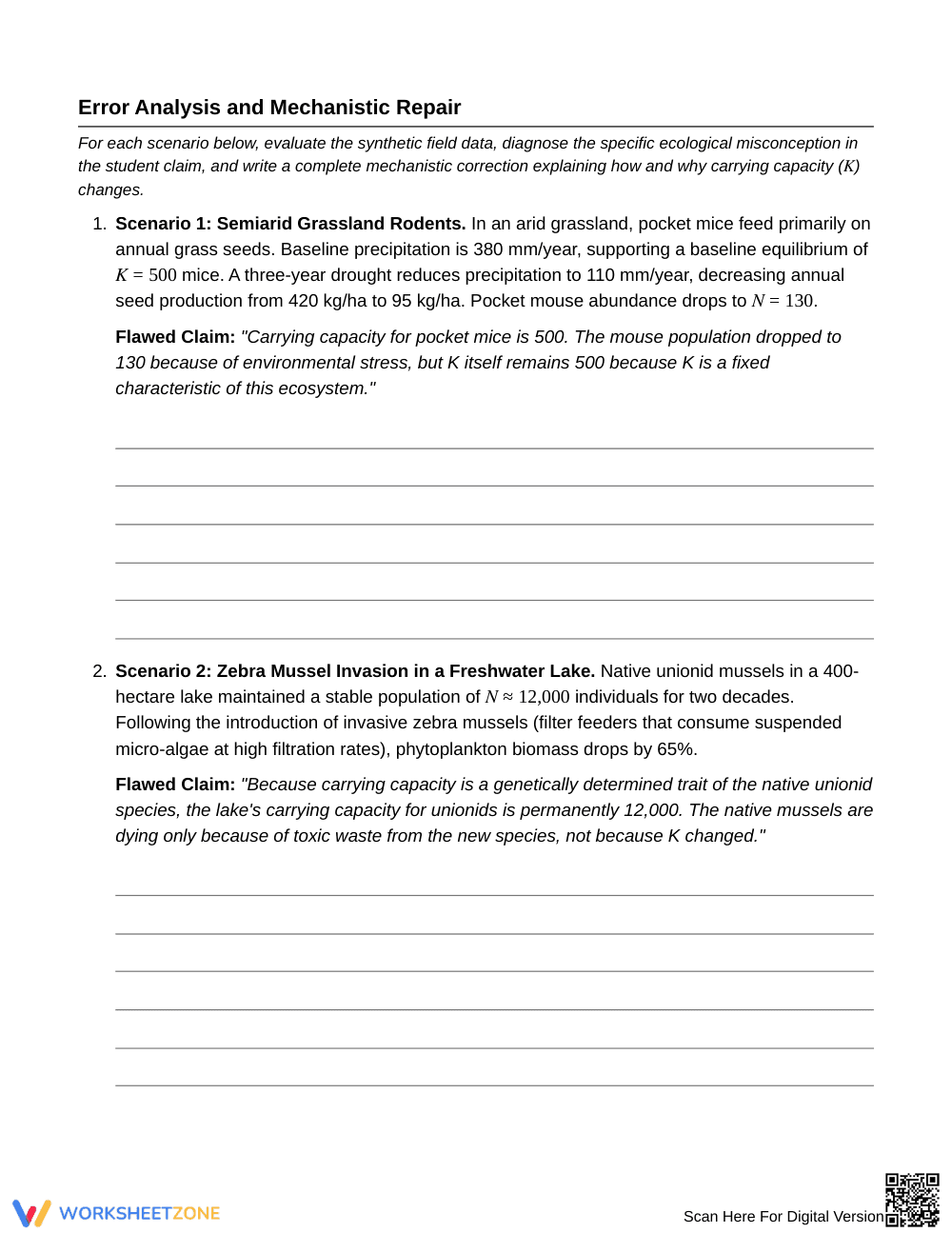
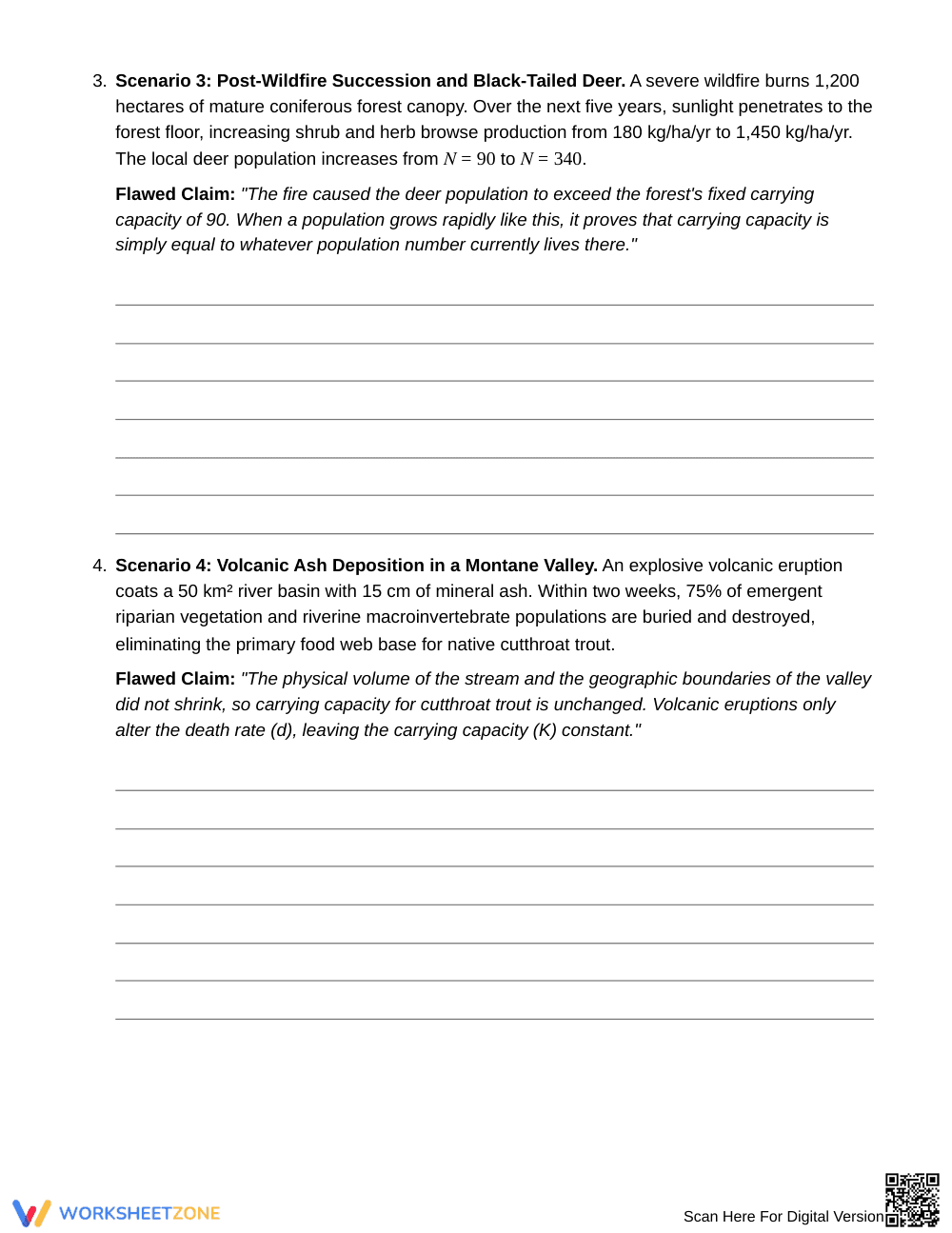
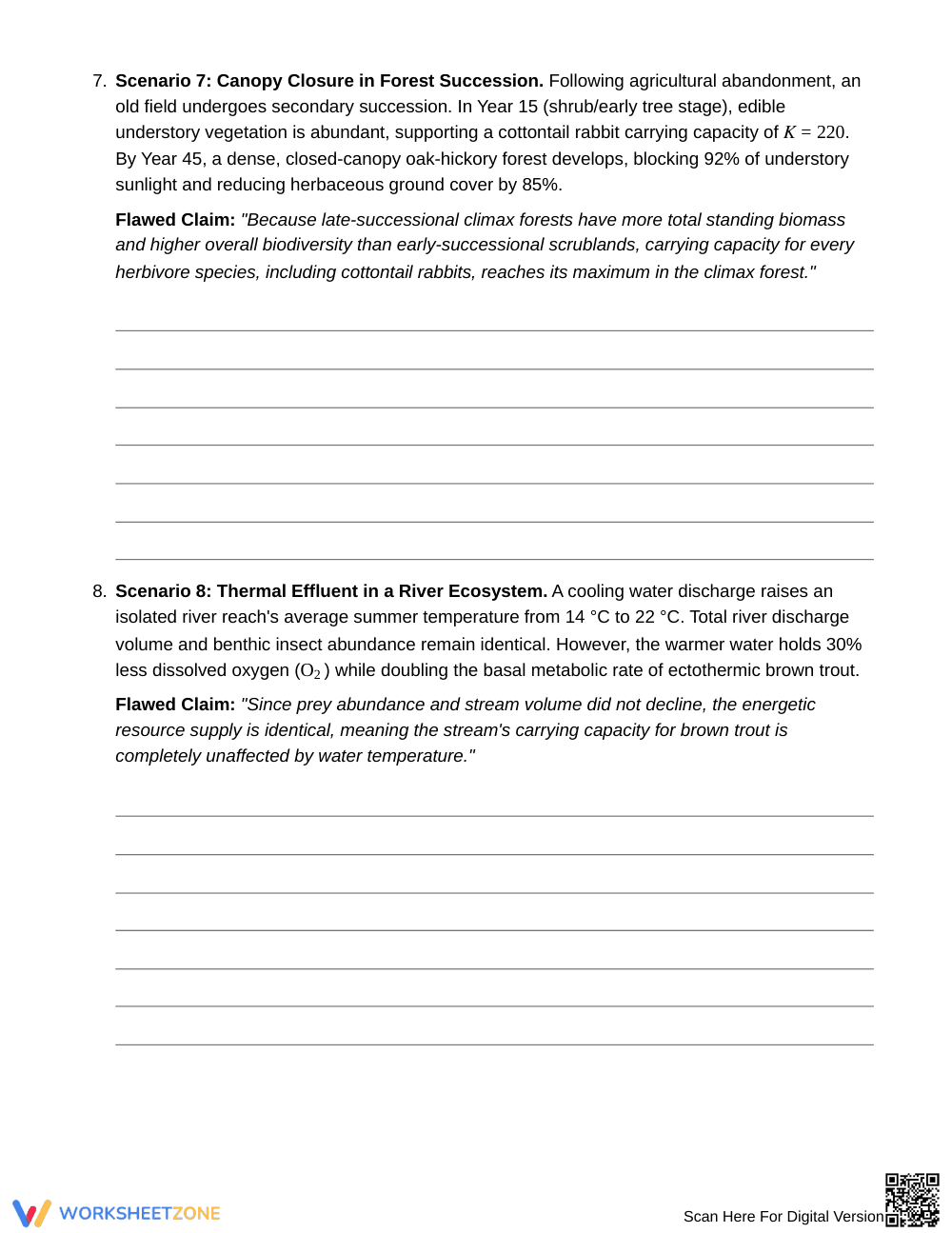
This 5-page printable resource includes an introductory framework defining carrying capacity, a modeled error-repair exemplar, and eight scenario-based analysis tasks. Each scenario provides synthetic field data detailing ecological disruptions, such as drought, fire, and invasive species. Students evaluate a flawed student claim, diagnose the misconception, and write a complete mechanistic explanation supported by a 3-page answer key.
Skill Progression
The worksheet follows a structured progression to guide students toward diagnostic mastery:
- Guided practice: A complete modeled exemplar analyzes a subalpine meadow scenario, diagnosing spatial-constant misconceptions and modeling an explicit mechanistic correction.
- Supported practice: Scenarios 1 through 4 present structured prompts covering drought and invasive competitors, guiding students as they diagnose flawed claims using provided field data.
- Independent practice: Scenarios 5 through 8 require autonomous synthesis across complex ecological contexts, including forest succession and thermal pollution.
This gradual release of responsibility equips learners to independently evaluate real-world population data and refute oversimplified ecological assumptions.
Standards Alignment
This resource aligns with high school life science standards requiring students to use mathematical and conceptual representations to explain factors affecting carrying capacity. Supporting standards focus on analyzing ecosystem responses to environmental disruptions. Both standard codes can be copied directly into lesson plans, IEP goals, or district curriculum mapping tools.
How to Use It
Deploy this worksheet after direct instruction on population dynamics and logistic growth. It works effectively as collaborative partner practice where student pairs evaluate flawed peer claims before drafting written repairs. During work time, check that students reference specific limiting resources rather than general ecosystem health. The 8 problems take approximately 45 to 60 minutes to complete.
Who It's For
This assignment serves tenth-grade general and honors biology students learning population ecology. It provides targeted remediation for students who mistakenly view carrying capacity as a fixed geographic constant. Pair this worksheet with an introductory population dynamics lesson or an interactive population growth simulation.
In secondary life science education, student misconceptions regarding carrying capacity frequently stem from viewing ecosystems as rigid, static containers rather than dynamic living networks. Grounded in the gradual release of responsibility instructional model established by Fisher & Frey (2014), this Grade 10 biology worksheet addresses population dynamics by requiring students to actively detect, diagnose, and correct erroneous claims about ecological carrying capacity. By evaluating authentic synthetic field data across eight diverse environmental scenarios—including invasive species introductions, wildfire succession, and hydrological alterations—learners articulate exactly how limiting factors govern sustainable population thresholds. The instructional progression transitions smoothly from modeled exemplar analysis to autonomous scientific reasoning, reinforcing that carrying capacity continually fluctuates alongside consumable resources and abiotic shifts. Educational research confirms that structured error-refutation tasks generate deeper conceptual retention than passive definition recall, making this printable activity an effective tool for high school biology classrooms.


