




























Views
Downloads



Essential Boundary Evidence Worksheet | Grade 8 Science

Paste this activity's link or code into your existing LMS (Google Classroom, Canvas, Teams, Schoology, Moodle, etc.).
Students can open and work on the activity right away, with no student login required.
You'll still be able to track student progress and results from your teacher account.
This worksheet teaches Grade 8 students to explain what a single boundary observation cannot establish about Earth's layers. Students work from seismic wave speeds, station records, and density data, then separate what the evidence supports from what it only suggests.
At a Glance
- Grade: 8 · Subject: Science
- Standard: None specified — judge what seismic and density evidence does and does not establish
- Skill Focus: Explain what a boundary observation cannot establish
- Format: 5 pages · 6 problems · Answer key included · PDF
- Best For: Evidence reasoning after Earth's layers instruction
- Time: 40–50 minutes
What's Inside
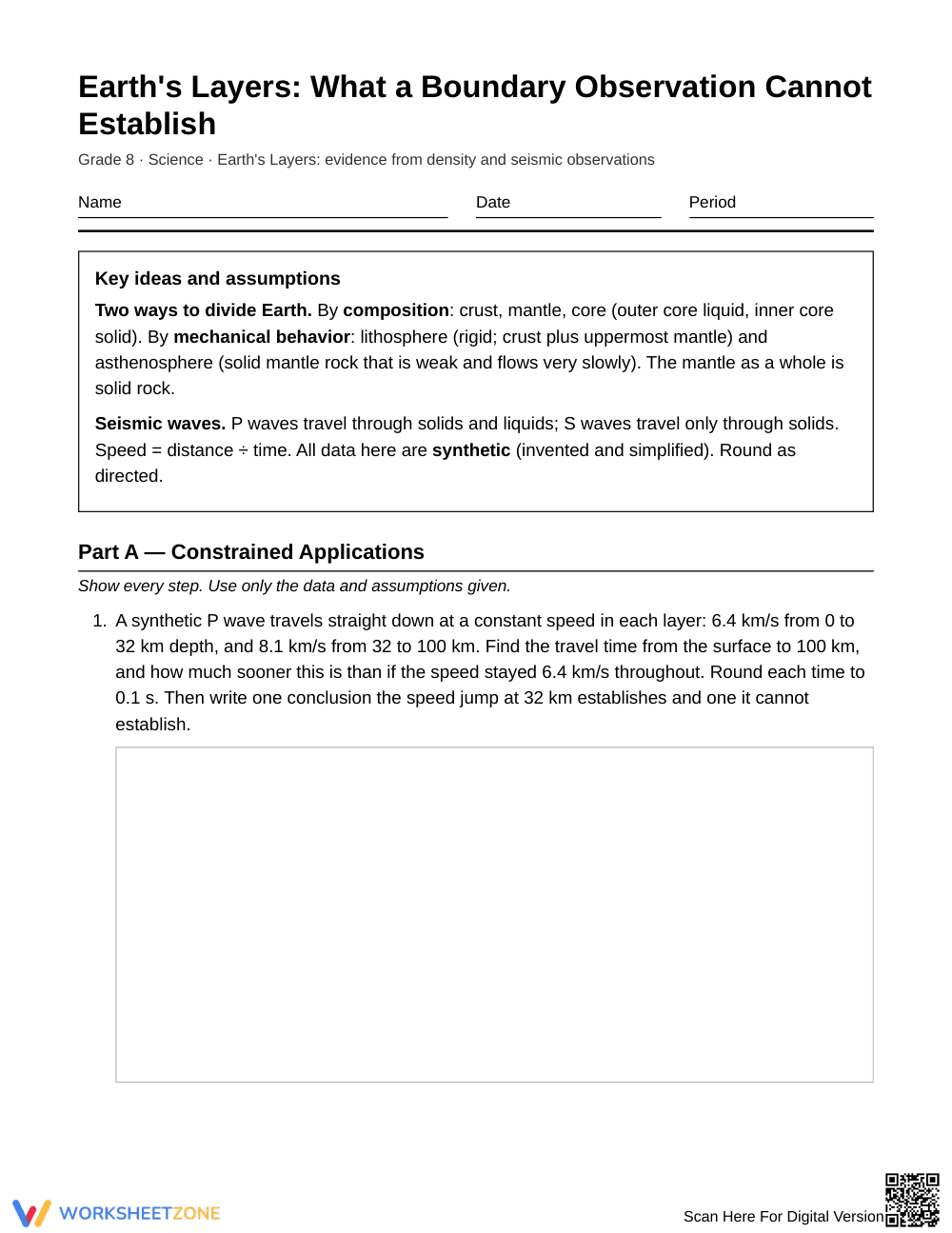
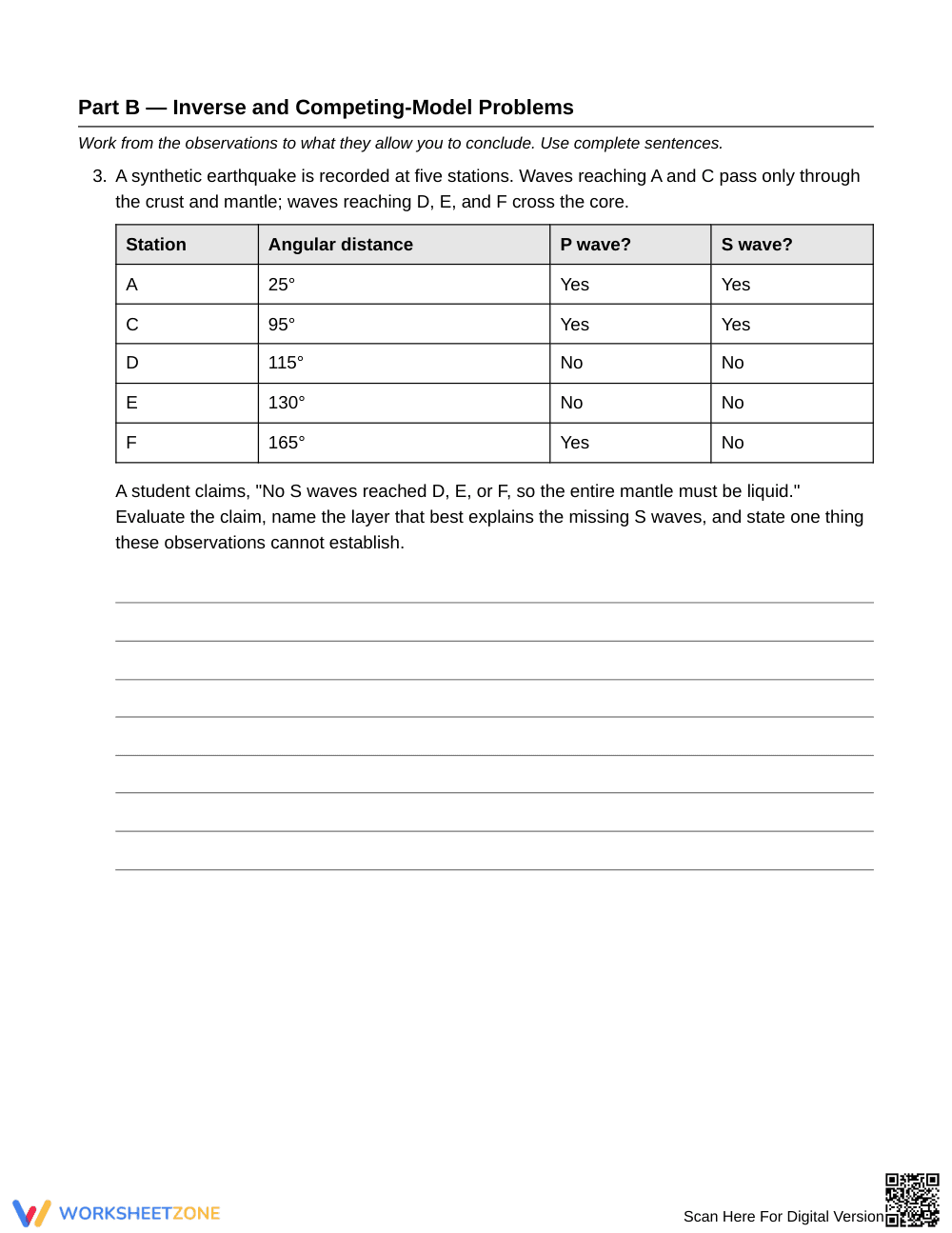
Six tasks across three parts fill 5 pages. Part A has two constrained calculations (wave travel time and uniform density). Part B has three inverse or competing-model problems built on a station table, two boundary models, and a depth profile. Part C is one defended synthesis. A key-ideas box states the compositional and mechanical divisions of Earth, and a complete answer key is included.
Skill Progression
- Guided practice (Part A, 2 tasks): Constrained calculations with all data and assumptions given; the key-ideas box is the scaffold.
- Supported practice (Part B, 3 tasks): Students evaluate a flawed claim, compare two competing models, and test a classmate's statement against a depth profile.
- Independent practice (Part C, 1 task): Students write a defended verdict, citing at least three earlier items.
The sequence follows gradual release: I Do, We Do, You Do.
Standards Alignment
No standard code was supplied for this worksheet, so none is listed. The work centers on using evidence about Earth's interior, including seismic waves and density, to judge what conclusions are justified. Add your local standard code when copying into lesson plans, IEP goals, or curriculum mapping tools.
How to Use It
- After direct instruction: Assign Parts A and B as independent work, then discuss Part C as a class.
- Formative check: Assign the whole sheet and watch whether students state a limit, not just a conclusion.
Expect 40–50 minutes.
Who It's For
Grade 8 science students who have met crust, mantle, and core, and the lithosphere and asthenosphere. Students who struggle with the arithmetic can start with the Part A calculations. Pair it with a seismic shadow zone diagram or an anchor chart on P and S waves.
In this Grade 8 Earth's Layers worksheet, students practice explaining what a boundary observation cannot establish. Across 6 tasks, they use synthetic P-wave speeds, S-wave station records, and density calculations to separate compositional boundaries from mechanical ones. The skill is evidence-based reasoning: stating what data establish, what they leave open, and which added observation would close the gap. The sequence follows the gradual-release model described by Fisher & Frey (2014), moving from constrained calculations to competing-model problems and a defended written synthesis. No standard code was supplied, so none is cited. The worksheet runs 5 pages and includes a complete answer key, making it suitable for formative assessment after direct instruction on Earth's internal structure. Students must defend a verdict using at least three cited observations, which makes their reasoning visible and scorable. Every data set is synthetic and simplified.


