



























Essential Bone Labeling Worksheet | Grades 6‑12 Science
Paste this activity's link or code into your existing LMS (Google Classroom, Canvas, Teams, Schoology, Moodle, etc.).
Students can open and work on the activity right away, with no student login required.
You'll still be able to track student progress and results from your teacher account.
Students use this 4‑page Science worksheet to conduct a hands‑on bone labeling investigation, identify the research question, variables, control, and make predictions, then interpret data to draw evidence‑based conclusions. The activity reinforces anatomy knowledge while developing scientific reasoning skills essential for middle‑school curricula.
At a Glance
- Grade: Grades 6‑12 · Subject: Science
- Standard:
— Identify variables, controls, and predictions in a bone investigation- Skill Focus: Conducting a bone labeling investigation
- Format: 4 pages · 30 problems · Answer key included · PDF
- Best For: Classroom labs and inquiry units
- Time: 15–30 minutes
What’s Inside – The packet contains a labeled femur model activity, a step‑by‑step investigation guide, data tables, and a set of 30 mixed‑format tasks. Answer keys are provided on a separate 4‑page section. Scaffolds include a word bank for anatomical terms, worked examples for data analysis, and sentence frames for writing predictions.
- Guided practice: 10 scaffolded labeling tasks with a word bank and model diagram support.
- Supported practice: 10 data‑analysis questions that use sentence frames to help students interpret mass‑change and bend‑angle results.
- Independent practice: 10 open‑ended investigation prompts requiring students to write a testable question, list independent and dependent variables, state the control, make a prediction, and draw a conclusion.
The sequence follows the gradual‑release model: I Do, We Do, You Do.
Standards Alignment – No specific national standard is assigned to this worksheet, allowing flexible use across varied state and district science curricula focusing on inquiry skills and experimental procedures.
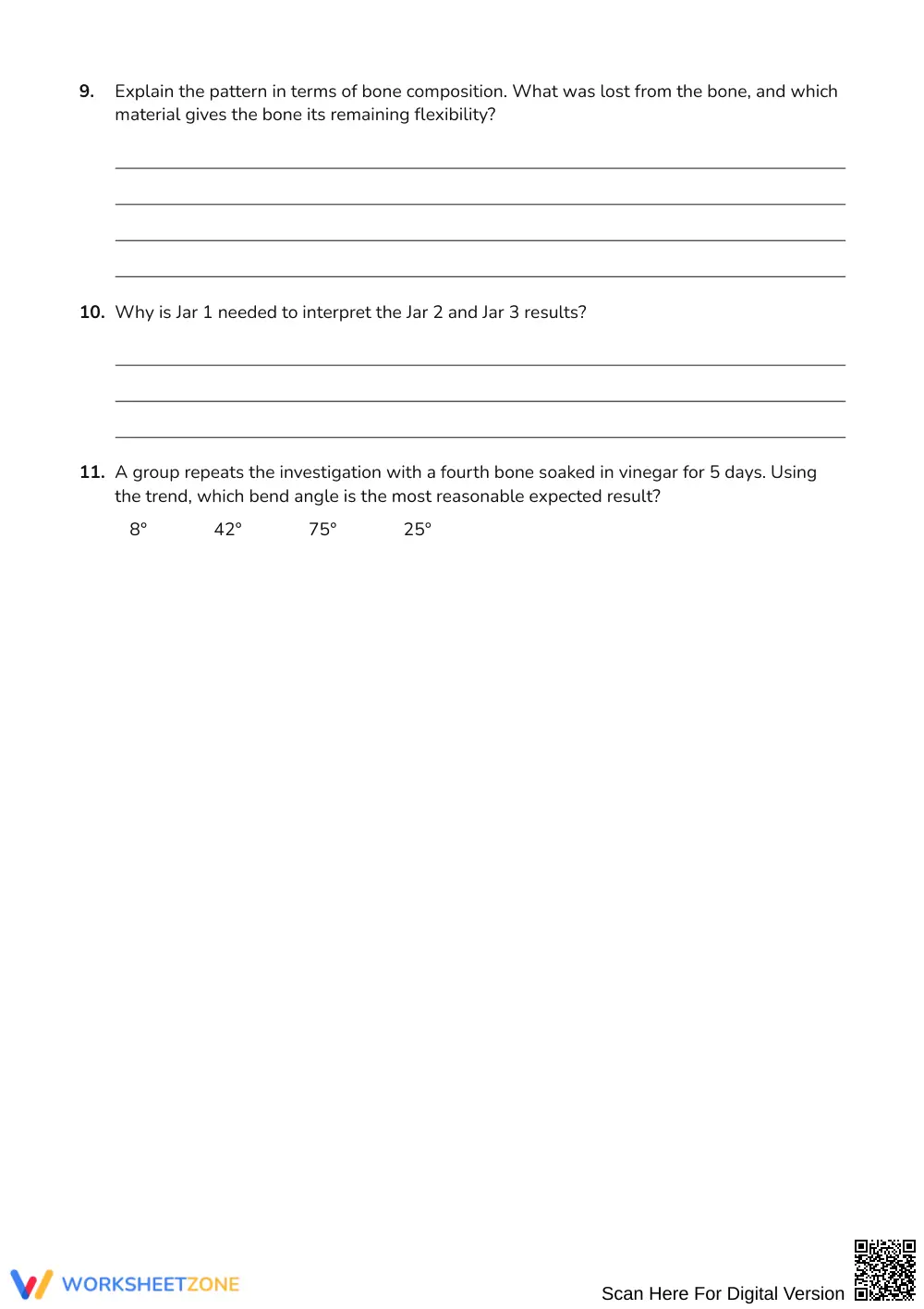
How to Use It – Before a unit on human anatomy, teachers can preview the labeled femur activity as a hook, then assign the investigation during the inquiry phase to let students collect real data. After the experiment, use the data‑interpretation questions as a formative check; observe whether students correctly link mineral loss to increased flexibility. The entire worksheet can be completed in 15–30 minutes.
Who It’s For – Ideal for middle‑school science students (Grades 6‑12) who need concrete practice with experimental design. The built‑in scaffolds support English‑language learners and students requiring additional structure, while the open‑ended prompts challenge advanced learners. Pair it with a short video on bone composition or an anchor chart of variables for smooth integration.
Educational research demonstrates that explicit instruction in scientific inquiry substantially strengthens learner achievement across foundational science curricula (Fisher & Frey, 2014). This structured worksheet operationalizes that finding by guiding learners methodically through each core phase of a bone-labeling investigation. Students actively formulate testable questions, identify independent and dependent variables, maintain experimental controls, articulate reasoned predictions, and evaluate observational evidence. By connecting hands-on anatomical identification with rigorous investigative routines, the resource bridges conceptual understanding and analytical thinking. Teachers can incorporate this lesson during introductory laboratory modules, targeted skill-building sessions, or formative review periods to promote disciplined, evidence-based reasoning. Supplying students with systematic opportunities to manipulate models and interpret structural data solidifies anatomical concepts while cultivating practical research competencies. Implement this comprehensive activity to deepen student familiarity with skeletal structure while developing authentic scientific competence across diverse classroom settings.


