




























Views
Downloads


Essential Body Systems Word Search | Grades 6–7 Science

Paste this activity's link or code into your existing LMS (Google Classroom, Canvas, Teams, Schoology, Moodle, etc.).
Students can open and work on the activity right away, with no student login required.
You'll still be able to track student progress and results from your teacher account.
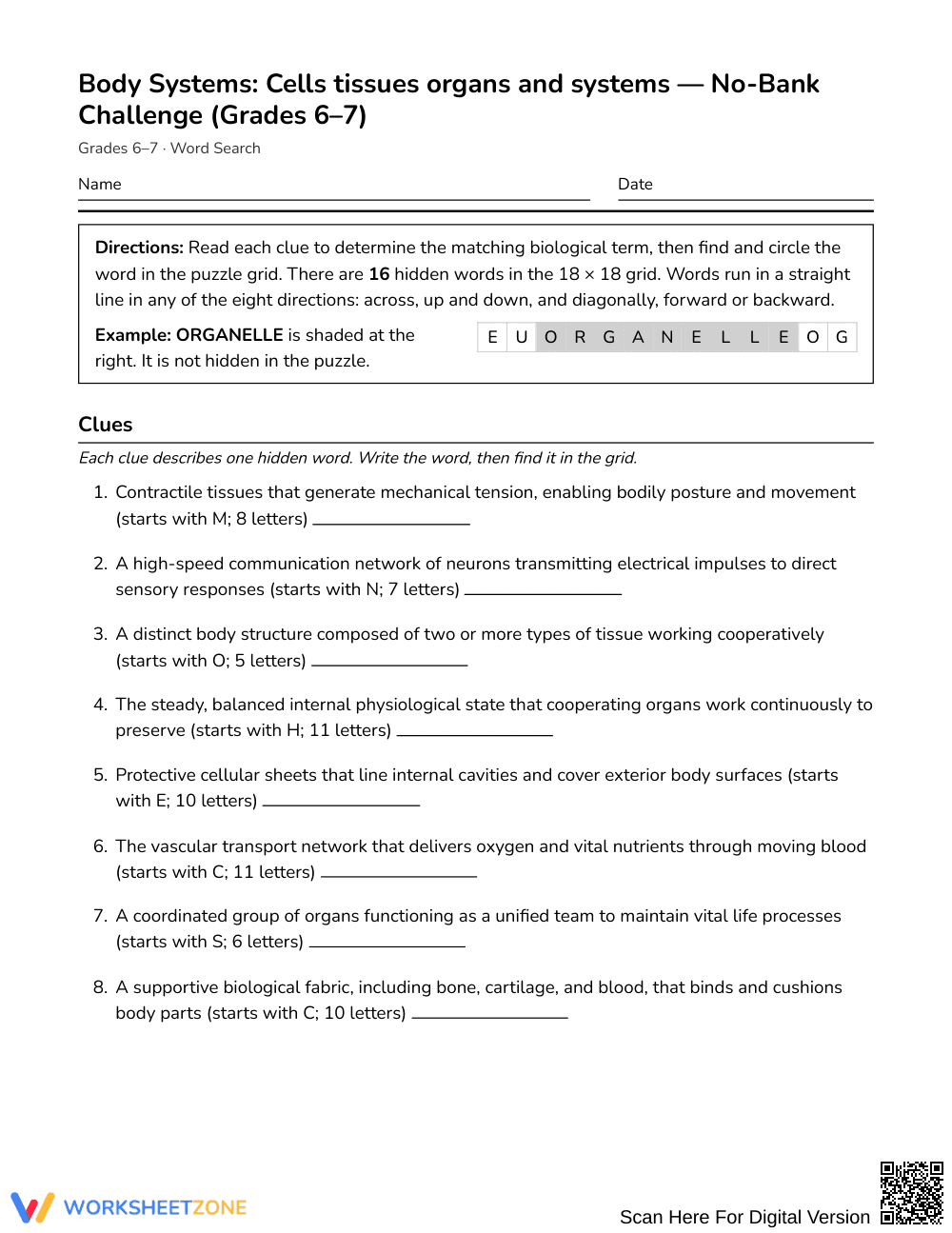
This body systems word search strengthens life science vocabulary by challenging Grades 6–7 students to identify and locate 16 foundational terms across cellular, tissue, organ, and systemic levels. By deciphering descriptive clues rather than scanning a basic word bank, learners actively recall biological structures and consolidate conceptual comprehension.
At a Glance
- Grade: Grades 6–7 · Subject: Science
- Standard: Not standards-assessed — vocabulary enrichment
- Skill Focus: Hierarchical biological organization of cells, tissues, organs, and organ systems
- Format: 3 pages · 16 words · Complete 4-page answer key included · Printable PDF
- Best For: Middle school vocabulary review, sub plans, early finishers, and organ system unit reinforcement
- Time: 20–35 minutes
What's Inside
This 3-page science resource features an 18-by-18 letter grid containing 16 hidden anatomy terms. Instead of using a standard word bank, students read 16 scientific clues covering cell structures, tissues, and major body systems to determine each search term. A 4-page answer key provides clear letter grid solutions and highlighted word placements for quick self-checking or grading.
Puzzle Structure & Mechanics
This puzzle operates as a clue-based challenge designed to strengthen vocabulary recall. Learners scan an 18 × 18 grid containing 16 terms hidden in all eight directions: North, Northeast, East, Southeast, South, Southwest, West, and Northwest. With no word bank provided, students must analyze each biological clue to identify target terms before locating them within the letter grid.
Standards Alignment
This resource serves as targeted vocabulary enrichment and is not formally aligned to a specific state or national science standard. It is designed to reinforce essential domain-specific terminology across cells, tissues, organs, and organ systems, supporting general life science curricula and strengthening scientific literacy across middle school classrooms.
How to Use It
Use this puzzle as a mid-unit checkpoint during instruction on body systems or as a post-lesson review before an exam. During independent or partner work, observe which clues require extra reference support, highlighting terms like homeostasis or epithelial for quick review. Students typically finish in 20 to 35 minutes, making it ideal for classwork or sub plans.
Who It's For
Designed for Grades 6–7 life science classes, this activity also supports upper elementary enrichment or Grade 8 vocabulary intervention. Teachers can differentiate by offering a supplemental glossary for English learners. For best results, pair this word search directly with a body systems anchor chart or an introductory lesson on cellular organization.
According to Fisher & Frey (2014), intentional domain-specific vocabulary acquisition relies on structured retrieval opportunities that connect academic definitions to conceptual frameworks. This Grades 6–7 science word search reinforces knowledge of cells, tissues, organs, and organ systems by requiring learners to decode descriptive biological clues rather than simply matching isolated letter strings. Engaging students in clue-driven retrieval prompts deeper cognitive processing, ensuring that anatomical terms such as connective tissue, homeostasis, and integumentary mechanisms are actively reconstructed in memory. By removing the traditional word bank and integrating an 18-by-18 grid spanning all eight compass directions, the puzzle transforms routine vocabulary practice into an active inquiry exercise. Research confirms that pairing explicit scientific definitions with puzzle-based retrieval strengthens retention, assists diverse middle school learners in mastering foundational terminology, and establishes an enduring conceptual basis for advanced life science studies.


