































Essential Biological Fitness Worksheet | Grade 10 Biology

Paste this activity's link or code into your existing LMS (Google Classroom, Canvas, Teams, Schoology, Moodle, etc.).
Students can open and work on the activity right away, with no student login required.
You'll still be able to track student progress and results from your teacher account.
This high school biology worksheet trains students to debunk the common misconception that biological fitness equals physical strength, fighting prowess, or lifespan. Students analyze quantitative biological data across eight structured scenarios to define fitness accurately as relative reproductive success and distinguish natural selection from genetic drift and gene flow.
At a Glance
- Grade: 10 · Subject: Biology
- Standard: Evaluate evidence showing that biological fitness measures reproductive success rather than physical strength.
- Skill Focus: Correcting fitness-means-strength misconceptions
- Format: 5 pages · 8 problems · Answer key included · PDF
- Best For: Evolution concept review and misconception repair
- Time: 40–50 minutes
What's Inside
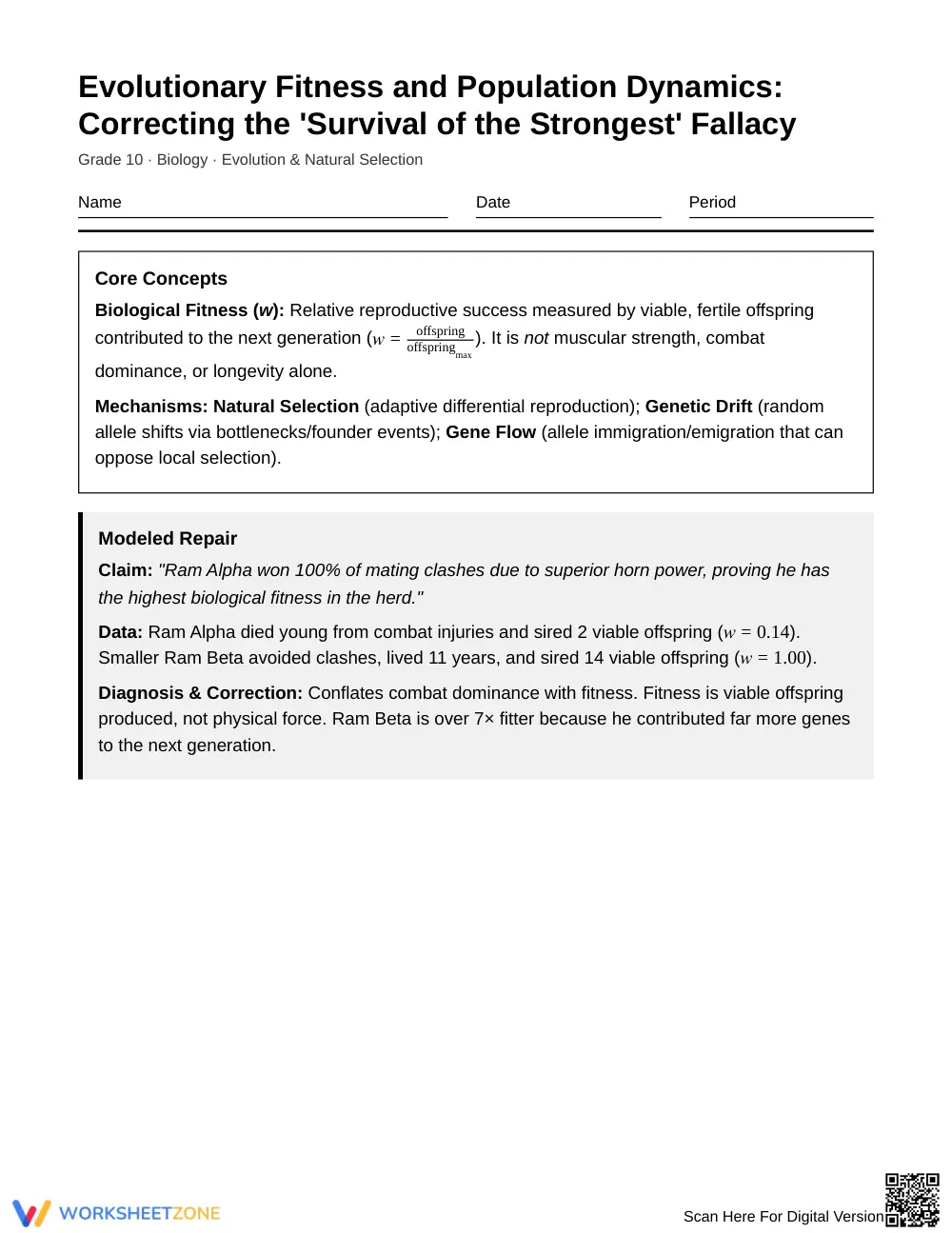
The 5-page resource includes a concise reference box defining biological fitness alongside core evolutionary mechanisms, a fully worked repair model analyzing horn clashes in bighorn rams, 8 data-rich scenario tasks with structured correction prompts, and a comprehensive 2-page teacher answer key providing diagnostic explanations and quantitative sample responses.
Skill Progression
- Guided Practice: Students review the core reference box and analyze a fully modeled repair demonstrating how to calculate relative fitness from reproductive data rather than combat dominance.
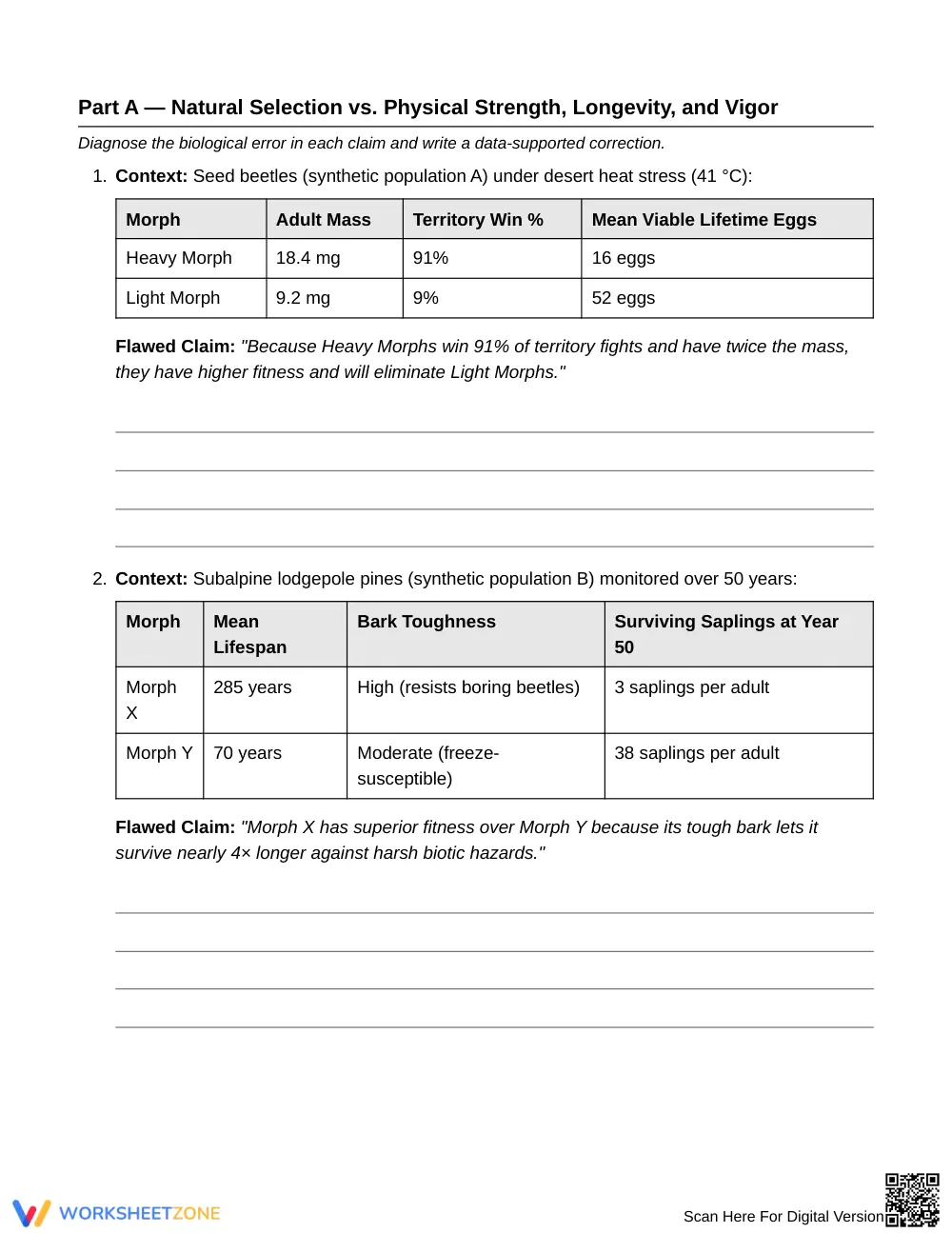
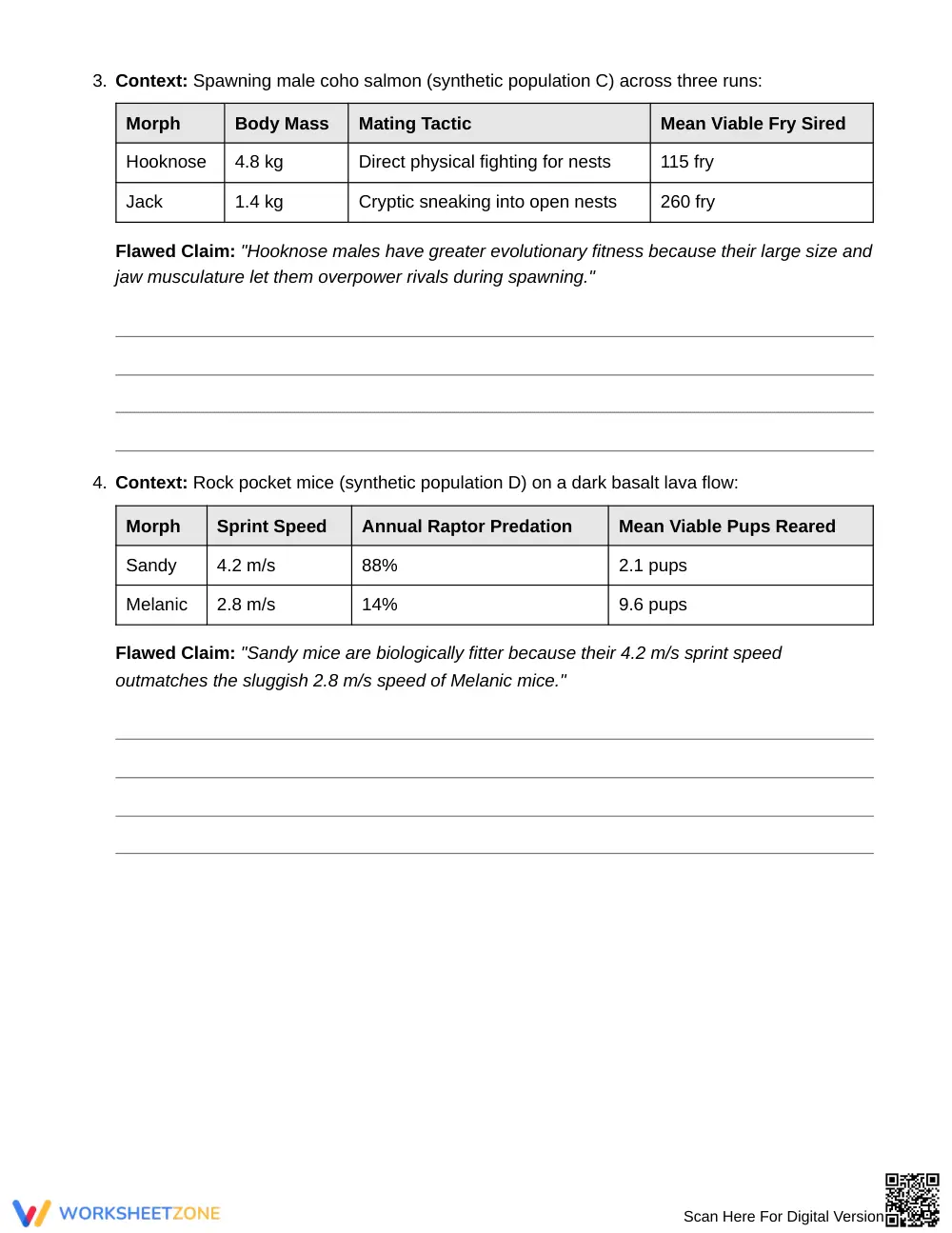
- Supported Practice (Part A, Problems 1–4): Students examine synthetic datasets comparing morph mass, lifespan, mating tactics, and speed against offspring counts to diagnose and rewrite flawed fitness claims.
- Independent Practice (Part B, Problems 5–8): Students evaluate complex ecological disruptions—including bottleneck events, pollen gene flow, and founder effects—to untangle natural selection from genetic drift.
This structured progression follows a gradual-release model that builds analytical rigor before requiring independent diagnosis of evolutionary mechanisms.
Standards Alignment
This activity aligns with high school life science standards focusing on natural selection and adaptation. Students evaluate empirical evidence showing that traits enhancing survival and reproduction increase in frequency over generations, while identifying non-adaptive evolutionary mechanisms such as genetic drift and gene flow. These concepts can be copied directly into lesson plans, IEP goals, or district curriculum mapping tools.
How to Use It
Deploy this worksheet after direct instruction on natural selection to solidify the definition of evolutionary fitness. During class, conduct a quick formative check during Part A by ensuring students cite offspring numbers rather than survival percentages in their written justifications. The activity also functions effectively as a collaborative partner task where pairs debate and refute the flawed claims before drafting written corrections. Expected completion time is 40 to 50 minutes.
Who It's For
This resource is designed for Grade 10 general biology and honors life science students studying evolution and population genetics. To differentiate, provide struggling learners with sentence starters focused on relative offspring ratios. Pair this printable with a direct instruction slide deck on natural selection or a population genetics simulation lab.
Secondary science educators frequently observe that high school students conflate colloquial definitions of fitness with biological adaptation, an error documented in the ScienceDirect TpT Analysis of high school evolutionary biology curricula. When learners view survival of the fittest purely through physical dominance, their comprehension of microevolutionary processes and non-adaptive mechanisms becomes compromised. This 5-page instructional resource addresses that persistent barrier by engaging students in eight targeted analytical tasks across 40 to 50 minutes of instructional time. By confronting explicit flawed claims and evaluating quantitative reproductive output, students construct rigorous scientific explanations grounded in empirical data. The structured transition from guided models to independent evaluation of genetic drift and gene flow ensures learners develop durable conceptual mastery aligned with standards-based life science expectations.


