




























Essential Author's Purpose Worksheet | Grade 8 ELA
Paste this activity's link or code into your existing LMS (Google Classroom, Canvas, Teams, Schoology, Moodle, etc.).
Students can open and work on the activity right away, with no student login required.
You'll still be able to track student progress and results from your teacher account.
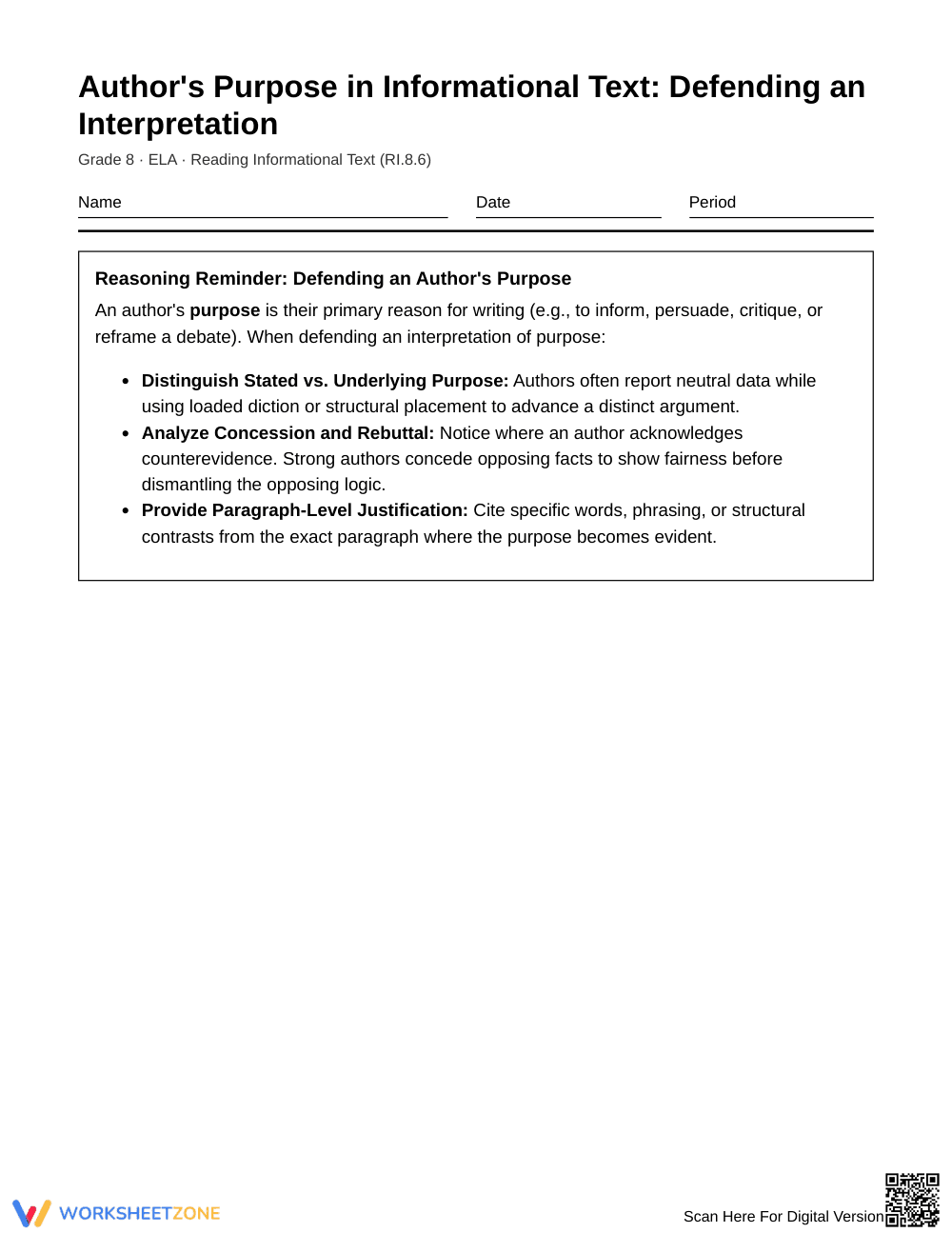
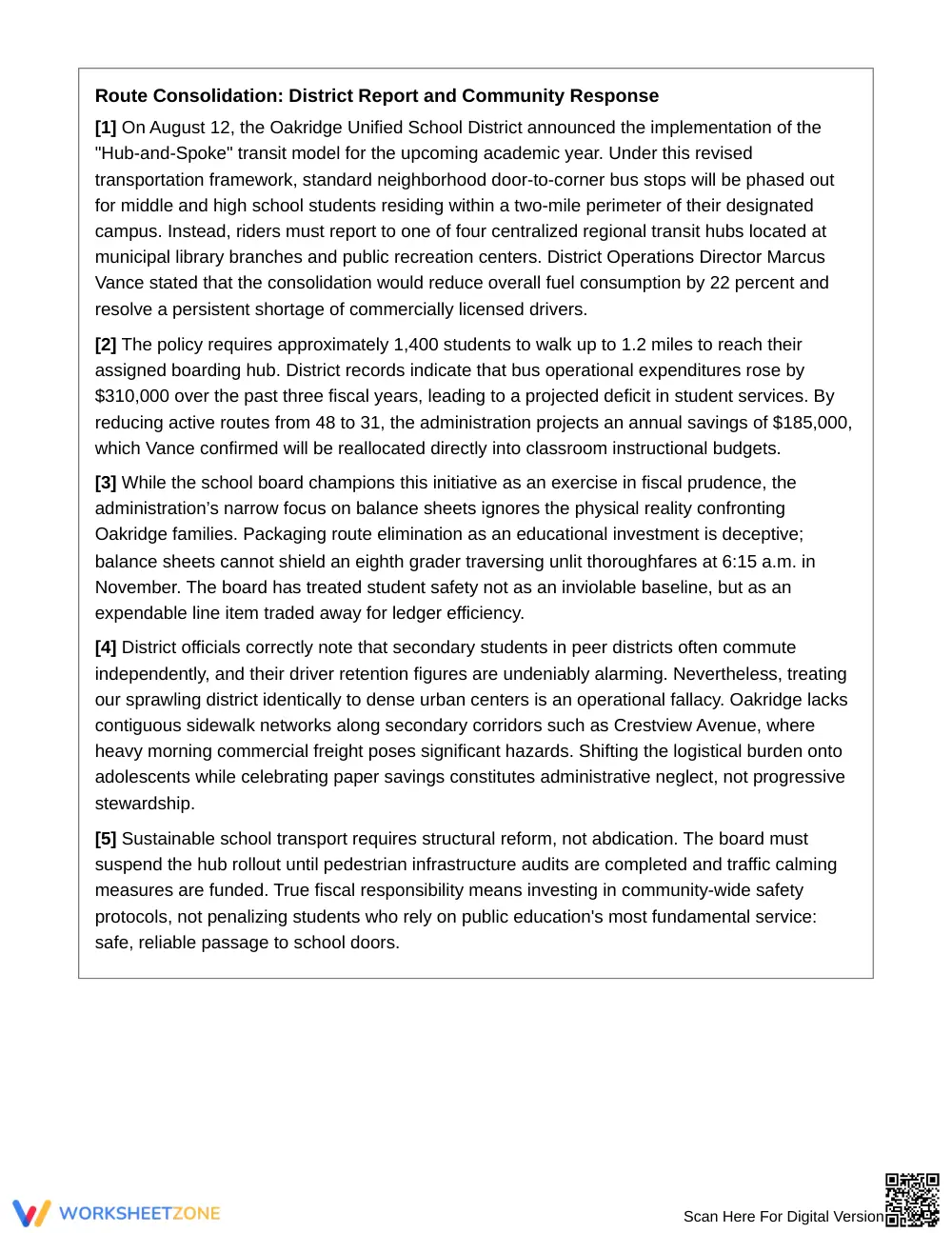
This Grade 8 informational text worksheet equips students to evaluate rhetoric and defend nuanced interpretations of an author's purpose. By examining an editorial on school transit policy, eighth graders distinguish administrative objectives from underlying arguments, cite precise textual evidence, and evaluate concession-rebuttal structures.
At a Glance
- Grade: 8 · Subject: ELA
- Standard:
RI.8.6— Determine an author's purpose and analyze how the author responds to conflicting evidence- Skill Focus: Defend a Purpose Interpretation
- Format: 5 pages · 8 problems · Answer key included · PDF
- Best For: Close reading and rhetorical analysis practice
- Time: 40–50 minutes
What's Inside
This resource contains a 5-paragraph informational editorial on school transit consolidation and a reasoning reminder scaffold. Across 8 structured prompts, students evaluate competing claims, analyze diction choices, and deconstruct counterarguments. The comprehensive 3-page answer key provides detailed exemplar defenses and paragraph-level citations for every task.
Skill Progression
- Guided practice (Tasks 1–2): Students identify explicit textual evidence, contrasting official statements with editorial viewpoints to establish baseline textual facts.
- Supported practice (Tasks 3–6): Students evaluate competing interpretations of author intent, justifying their analytical choices through diction analysis and rhetorical framing.
- Independent practice (Tasks 7–8): Students independently evaluate the author's concession-rebuttal structure and conflicting definitions of core concepts.
This sequence mirrors the gradual-release model, moving from foundational evidence retrieval to independent rhetorical critique.
Standards Alignment
The worksheet targets `RI.8.6`: Determine an author's point of view or purpose in a text and analyze how the author acknowledges and responds to conflicting evidence or viewpoints. It also supports `RI.8.1` by requiring students to cite strong and thorough textual evidence to support analytical inferences. Both standard codes can be copied directly into lesson plans, IEP goals, or district curriculum mapping tools.
How to Use It
Deploy this resource during informational text units following direct instruction on author's point of view. Have students complete Parts A and B in pairs before writing individual responses for Part C. For formative assessment, examine Task 3 responses to verify whether learners cite specific loaded diction rather than general topic summaries. Expected completion time is 40 to 50 minutes.
Who It's For
This activity is designed for Grade 8 ELA classrooms, advanced Grade 7 readers, and secondary intervention groups. Scaffolded prompts support diverse learners through structured binary choices in Part B before requiring unassisted analysis. Pair this activity with an anchor chart on rhetorical appeals or a direct instruction lesson on author bias.
According to research by Fisher & Frey (2014) on text-dependent questioning, middle school literacy gains accelerate when students engage in structured argumentation around complex informational passages. Grade 8 standard `RI.8.6` requires learners to determine an author's purpose and analyze how writers navigate conflicting viewpoints and counterevidence. Rather than selecting simplistic labels such as informing or persuading, proficient readers must isolate charged diction, evaluate structural concessions, and justify interpretive claims with explicit paragraph citations. This worksheet operationalizes that instructional model across 8 progressive tasks tied to a civic transit policy passage, prompting students to resolve competing analytical interpretations. By requiring written defenses grounded in concrete textual evidence, the resource solidifies rhetorical evaluation habits essential for secondary informational reading and assessment mastery.


