





























Essential Author's Purpose Worksheet | Grade 7 ELA
Paste this activity's link or code into your existing LMS (Google Classroom, Canvas, Teams, Schoology, Moodle, etc.).
Students can open and work on the activity right away, with no student login required.
You'll still be able to track student progress and results from your teacher account.
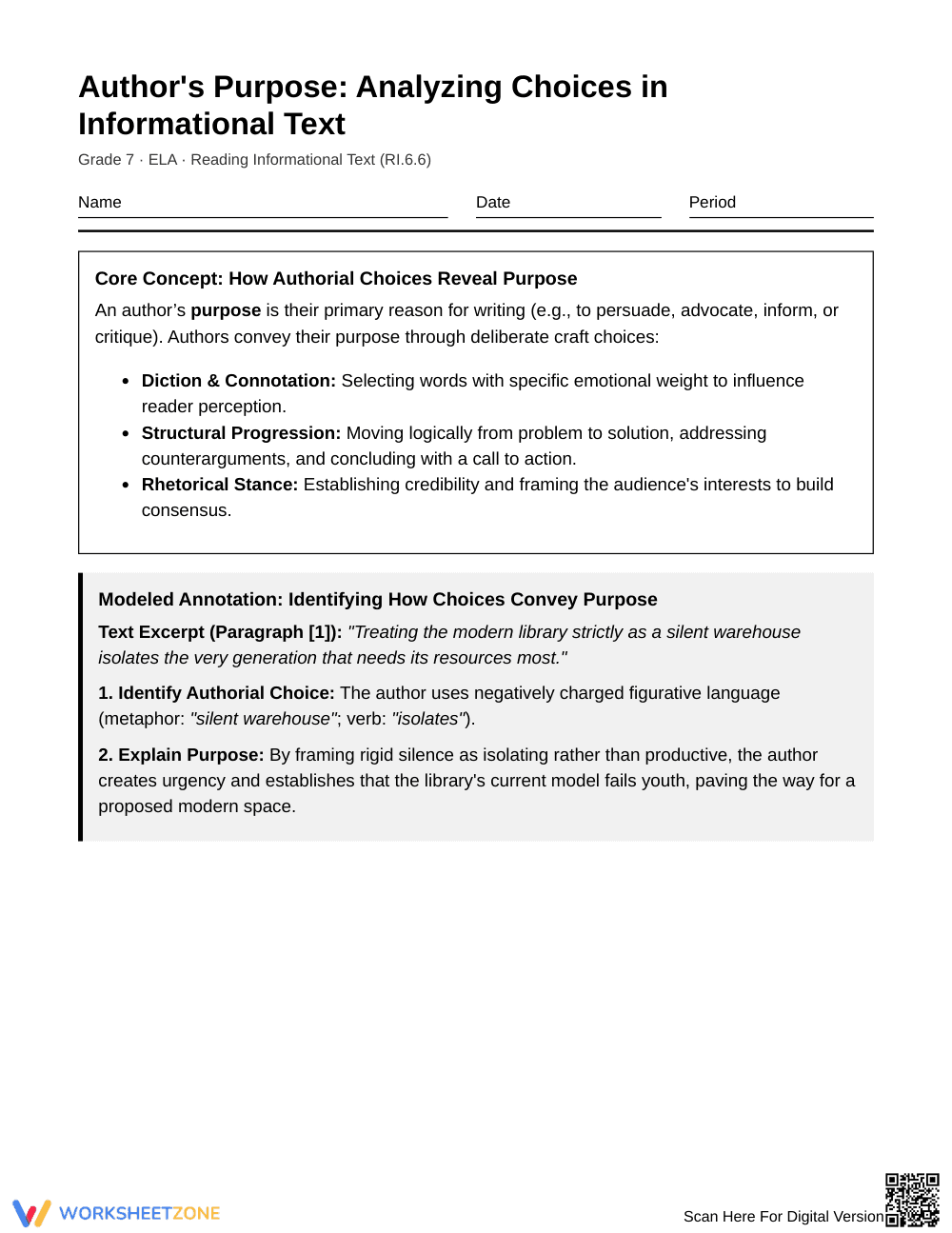
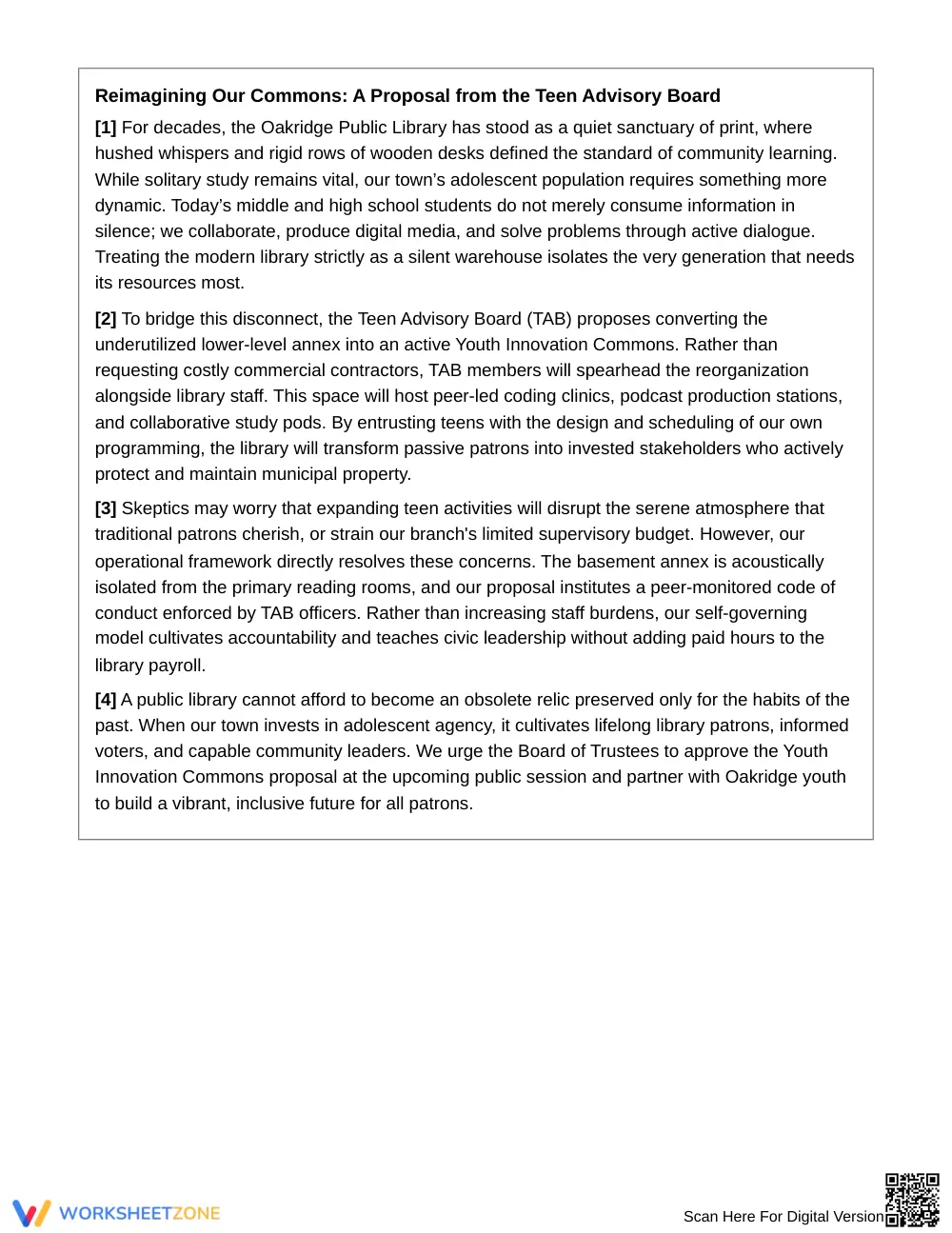
This informational text worksheet equips middle school readers to evaluate authorial craft and rhetoric. Students read a community proposal and examine how specific choices in diction, structural progression, and framing reveal the author's purpose. Designed for direct analysis, this resource empowers learners to move from basic comprehension to critical textual deconstruction.
At a Glance
- Grade: 7 · Subject: ELA
- Standard:
RI.6.6— Determine author's purpose and analyze how craft conveys perspective- Skill Focus: Annotate Choices That Reveal Purpose
- Format: 5 pages · 10 problems · Answer key included · PDF
- Best For: Close reading and rhetorical craft analysis
- Time: 40–50 minutes
What's Inside
This 5-page printable includes an original proposal, "Reimagining Our Commons," accompanied by a core concept box and an annotated mentor model. Students complete 10 analytical tasks divided across three sections: scaffolded structural transitions, in-depth analyses of connotation and counterarguments, and synthesis checks. A thorough 3-page answer key provides complete exemplar responses.
Skill Progression
- Guided practice (Tasks 1–3): Students trace structural links across paragraphs, citing evidence to show how problem statements justify proposed solutions.
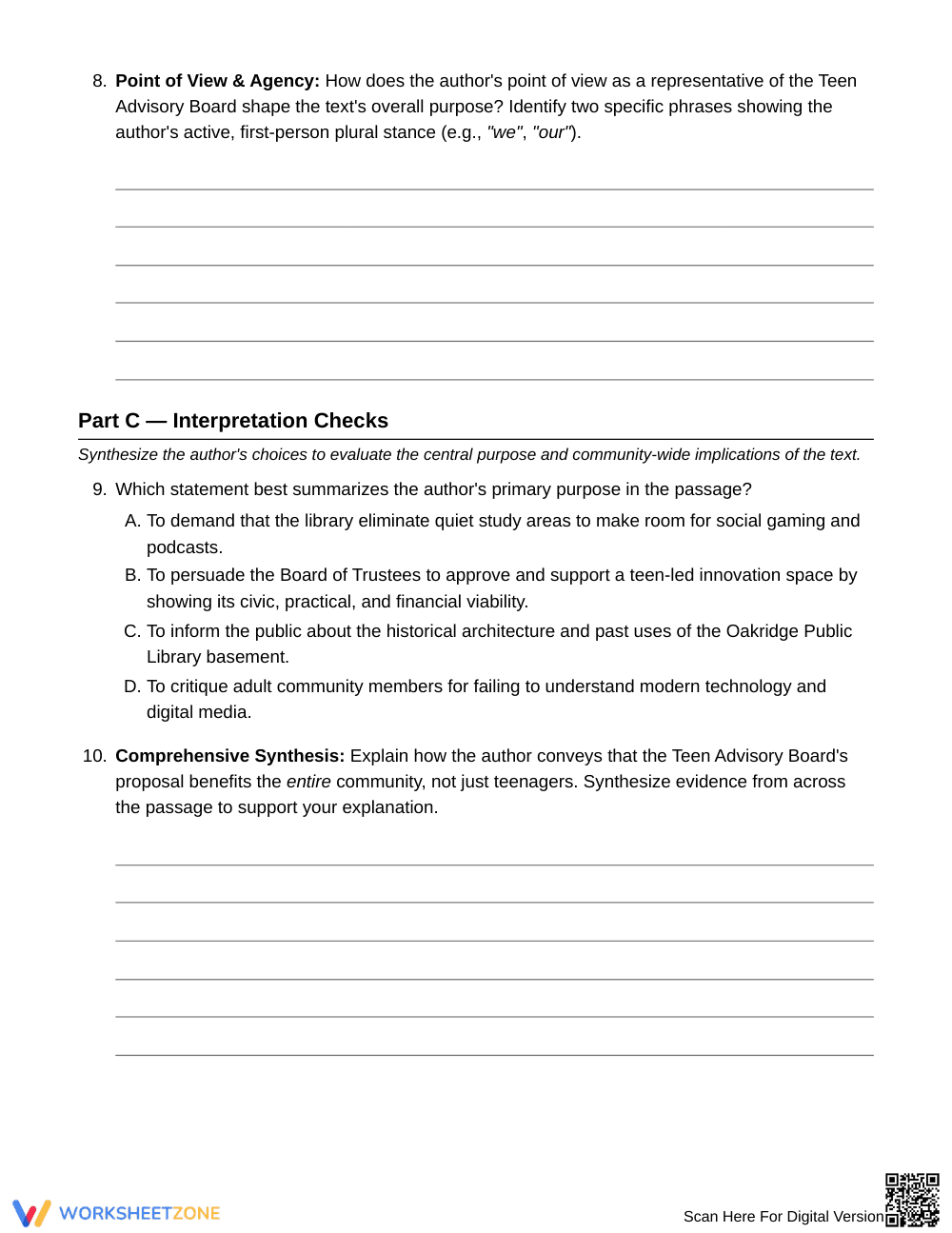
- Supported practice (Tasks 4–8): Learners independently analyze specific rhetorical moves, examining charged diction, counterargument refutations, and first-person plural perspective.
- Independent practice (Tasks 9–10): Students synthesize text-wide craft choices through a multiple-choice purpose check and an evaluative written response.
This sequence follows the gradual release of responsibility model, guiding students toward unassisted rhetorical deconstruction.
Standards Alignment
This worksheet directly aligns to `RI.6.6`: Determine an author's point of view or purpose in a text and explain how it is conveyed in the text. It also reinforces standard `RI.7.5` through structural paragraph analysis. Both standard codes can be copied directly into lesson plans, IEP goals, or district curriculum mapping tools.
How to Use It
Use this activity during the guided application phase of an author's craft unit, right after direct instruction on rhetorical choices. It also functions effectively as a mid-unit formative assessment. During Part B, check student annotations to assess understanding of connotation. Expected completion time is 40 to 50 minutes.
Who It's For
This printable suits Grade 7 general classrooms, Tier 2 reading interventions, and advanced Grade 6 groups targeting informational text standards. Pair this activity with an anchor chart on author's craft or a shared mentor text analysis.
Mastering standard `RI.6.6` requires middle school students to recognize that informational texts reflect deliberate craft choices rather than neutral data delivery. To annotate choices that reveal purpose effectively, learners must analyze how diction, structure, and tone convey an author's central stance. According to Fisher & Frey (2014), systematic close reading paired with scaffolded text-dependent questioning significantly strengthens an adolescent reader's capacity to deconstruct complex authorial intent and rhetorical arguments. When students inspect word choice, structural transitions, and audience positioning within an authentic civic proposal, they internalize how writers actively influence public perception. This worksheet provides ten rigorously sequenced analytical tasks that operationalize this critical cognitive routine, bridging foundational text comprehension and mature evaluative synthesis. By examining how counterarguments and connotations reinforce persuasive goals, learners cultivate transferable reading habits essential for secondary literacy achievement.


