


























Views
Downloads



Essential ATP & Gas Data Worksheet | Grade 10 Biology
Paste this activity's link or code into your existing LMS (Google Classroom, Canvas, Teams, Schoology, Moodle, etc.).
Students can open and work on the activity right away, with no student login required.
You'll still be able to track student progress and results from your teacher account.
This Grade 10 biology worksheet equips students to analyze quantitative bioenergetics data from isolated mitochondria and algal suspensions. Learners evaluate physiological respirometry measurements, calculate respiratory states, and connect electron transport chain mechanisms to ATP synthesis, building a robust understanding of chemiosmotic coupling.
At a Glance
- Grade: 10 · Subject: Biology
- Standard:
Cellular Respiration & Photosynthesis— Analyze quantitative respirometry and gas-exchange data to evaluate cellular bioenergetics- Skill Focus: Interpret Relative ATP-and-Gas Data
- Format: 5 pages · 10 problems · Answer key included · PDF
- Best For: High school bioenergetics practice
- Time: 45–60 minutes
What's Inside
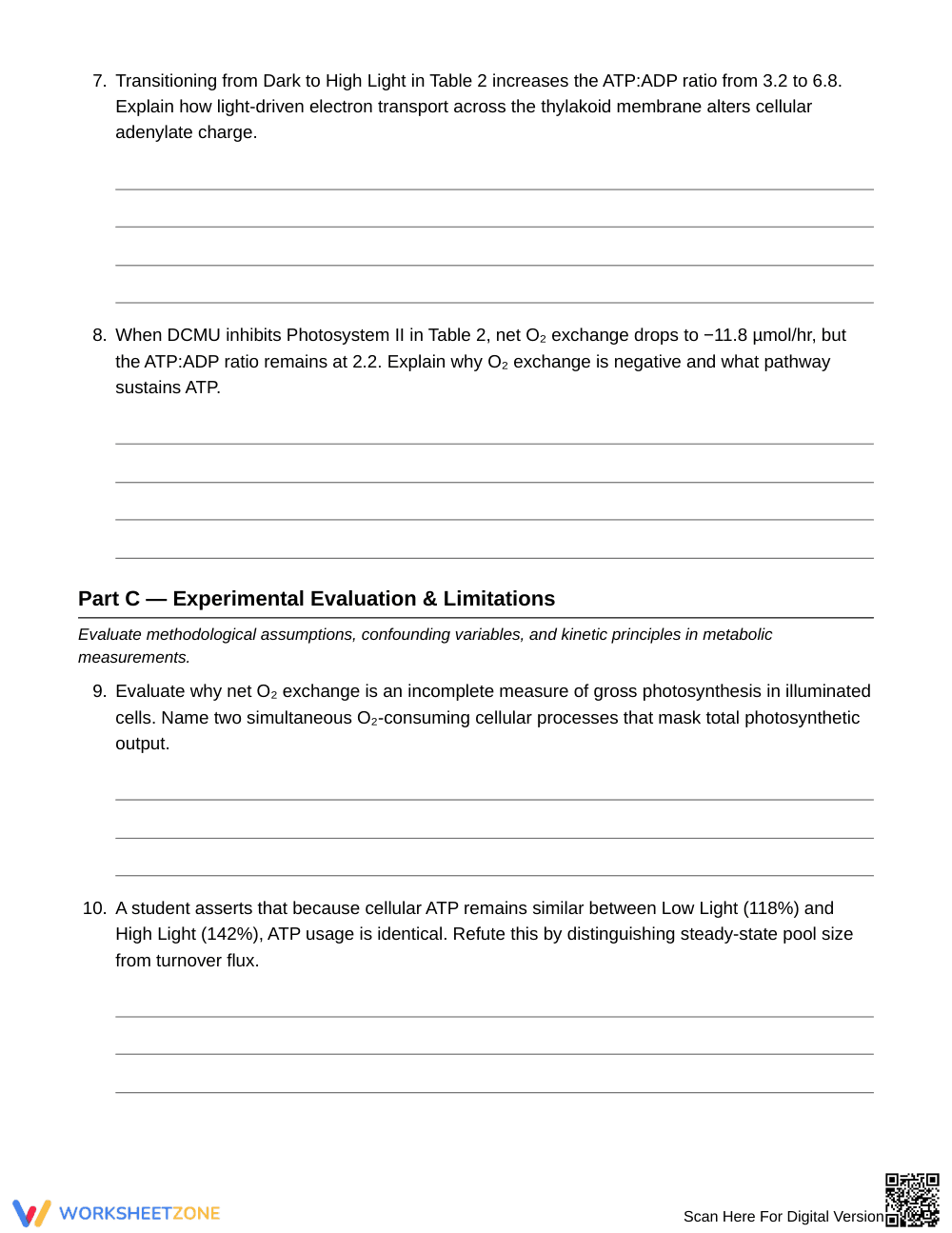
This 5-page worksheet provides a theoretical overview alongside two synthetic data tables covering mitochondrial respirometry and algal gas flux. Students complete 10 analytical problems across three parts, supported by a 3-page answer key detailing biochemical mechanisms, stoichiometric calculations, and sample explanations.
Skill Progression
- Guided practice (Part A — 2 tasks): Direct data extraction identifying baseline oxygen consumption rates and gas exchange metrics from provided tables.
- Supported practice (Part B — 6 tasks): Mechanistic analysis explaining how metabolic inhibitors and uncouplers alter membrane potential, ATP yields, and adenylate ratios.
- Independent practice (Part C — 2 tasks): Complex experimental evaluation critiquing gas-exchange assumptions and distinguishing steady-state pool sizes from turnover rates.
This gradual release of responsibility model supports student mastery of complex bioenergetic concepts.
Standards Alignment
This resource aligns with high school life science expectations for modeling how cellular respiration and photosynthesis transform energy and matter across cellular membranes. Both standard codes can be copied directly into lesson plans, IEP goals, or district curriculum mapping tools.
How to Use It
Assign this worksheet following direct instruction on electron transport chains and photophosphorylation. It also functions well as an inquiry activity before introducing metabolic inhibitors. Formatively assess student explanations in Part B regarding why uncouplers accelerate oxygen consumption while abolishing ATP synthesis. Expected completion time is 45 to 60 minutes.
Who It's For
This activity suits Grade 10 biology students studying cellular energy. Provide labeled diagrams of mitochondrial cristae for developing learners, or assign extension questions on artificial proton gradients for advanced students. Pair this resource with a laboratory investigation measuring cellular respiration.
According to EdReports 2024, secondary science students demonstrate significantly deeper conceptual mastery when instruction directly pairs theoretical bioenergetics models with multi-variable data interpretation. This worksheet supports Grade 10 learners in developing scientific data literacy by prompting them to analyze quantitative gas flux and adenylate metrics across varied respiratory and photosynthetic conditions. By evaluating the structural effects of metabolic inhibitors like oligomycin, rotenone, and DCMU, students move beyond rote memorization of generalized chemical formulas toward a functional understanding of chemiosmotic coupling, proton-motive force, and metabolic regulation. The structured progression ensures that students systematically bridge quantitative evidence with underlying biological phenomena, meeting high school science standards for complex systems analysis and empirical reasoning in cell biology.


