




























Views
Downloads
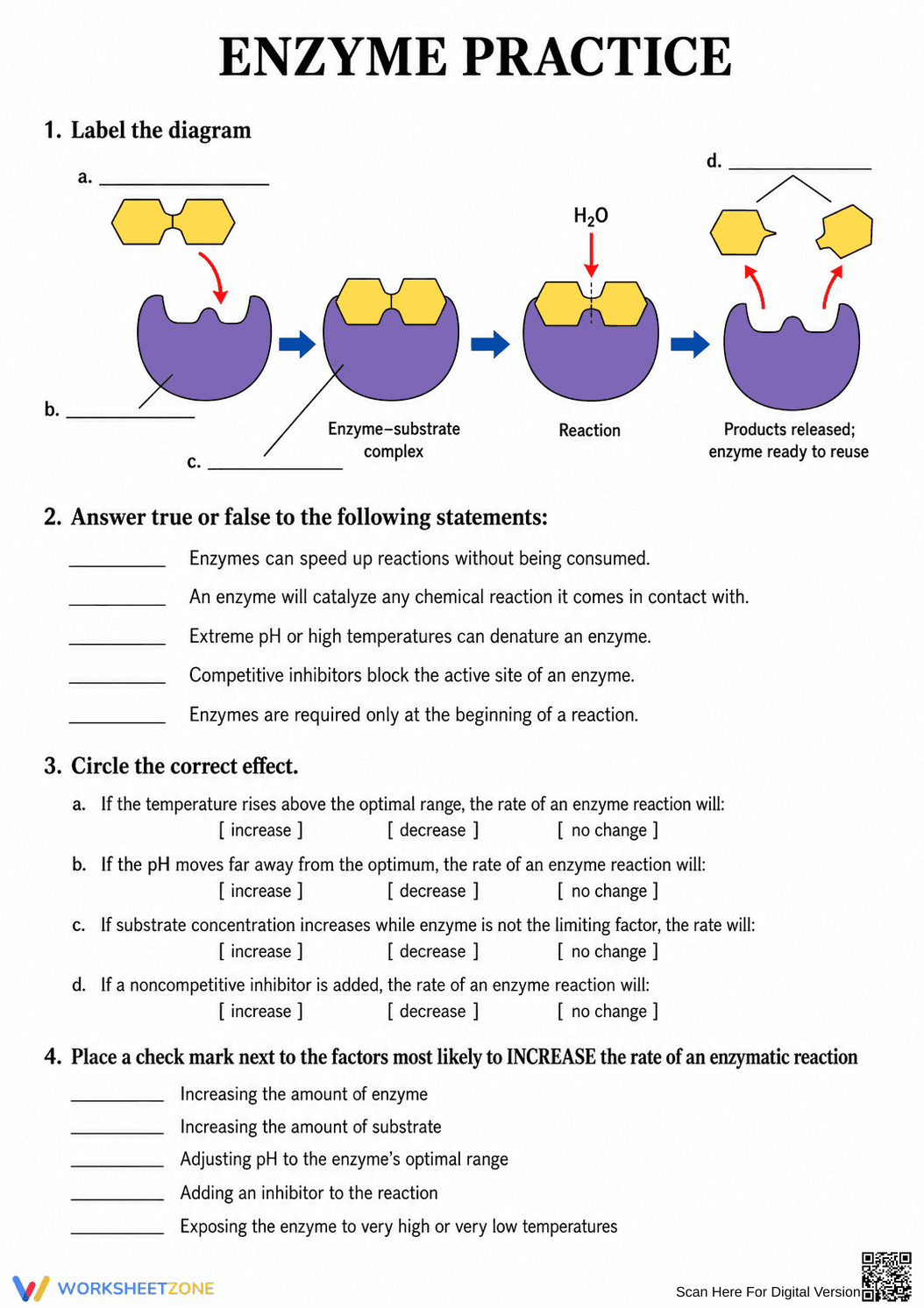

Grade 10 Enzyme Practice — Printable No-Prep Worksheet

Paste this activity's link or code into your existing LMS (Google Classroom, Canvas, Teams, Schoology, Moodle, etc.).
Students can open and work on the activity right away, with no student login required.
You'll still be able to track student progress and results from your teacher account.
This high school biology worksheet provides targeted practice on enzyme structure and function, helping students understand how biological catalysts accelerate chemical reactions. Learners will solidify their comprehension of active sites, substrates, and environmental factors that influence reaction rates. By engaging with visual models and conceptual questions, students develop a robust mental framework for biochemical processes.
At a Glance
- Grade: 10 · Subject: Biology
- Standard:
HS-LS1-1— Explain how protein structures carry out essential life functions.- Skill Focus: Enzyme kinetics and factors affecting reaction rates
- Format: 1 page · 18 problems · Answer key included · PDF
- Best For: Independent practice or review
- Time: 15–20 minutes
What's Inside
This single-page resource features four task types to assess understanding of enzymatic processes. It begins with a diagram labeling exercise focusing on the enzyme-substrate complex. Students then tackle true/false questions addressing enzyme specificity. The worksheet also includes multiple-choice selections regarding temperature and pH effects, concluding with a checklist identifying conditions that increase reaction rates. A complete answer key is provided.
Zero-Prep Workflow
Designed for immediate classroom implementation, this resource requires minimal preparation. Print (1 minute): Download the PDF and print a class set. Distribute (1 minute): Hand out the assignment for a focused independent practice session. Review (3 minutes): Use the included answer key to quickly check responses. With under two minutes of total teacher prep time, this worksheet is highly suitable for emergency sub plans.
Standards Alignment
This activity aligns with HS-LS1-1, requiring students to construct an explanation based on evidence for how proteins carry out the essential functions of life. By focusing on enzymes, students connect molecular structure to biological function. Both standard codes can be copied directly into lesson plans, IEP goals, or district curriculum mapping tools.
How to Use It
Teachers can deploy this worksheet during direct instruction as a formative assessment tool. After introducing the lock-and-key model, assign the diagram section to verify comprehension. Alternatively, use it as a post-lab reinforcement activity. Observe responses to the true/false section; misconceptions about enzyme consumption often surface here, providing an opportunity for real-time correction. Expected completion time is 15 to 20 minutes.
Who It's For
This practice sheet is designed for high school biology students. For students requiring accommodations, teachers might pre-fill one diagram label. It pairs perfectly with a visual anchor chart detailing the effects of inhibitors on active sites. This resource is also effective for remedial review in upper-level anatomy or chemistry courses.
Effective science instruction requires students to interact with multiple representations of biological processes. This resource supports mastery of HS-LS1-1 by asking learners to explain how protein structures carry out essential life functions through both visual diagramming and analytical questioning. According to a ScienceDirect TpT Analysis, integrating visual models with targeted questioning significantly improves retention of complex biochemical concepts compared to text-based reading alone. By requiring students to evaluate how variables like temperature and pH alter reaction rates, this worksheet moves beyond rote memorization into applied critical thinking. The structured format ensures that learners systematically process the mechanics of biological catalysts, reinforcing the foundational principles of cellular metabolism. Regular practice with these specific task types builds the analytical stamina necessary for success on standardized science assessments and advanced coursework.


