


























Views
Downloads

Printable Bee Life Cycle Worksheet | Grade 3 Science
Paste this activity's link or code into your existing LMS (Google Classroom, Canvas, Teams, Schoology, Moodle, etc.).
Students can open and work on the activity right away, with no student login required.
You'll still be able to track student progress and results from your teacher account.
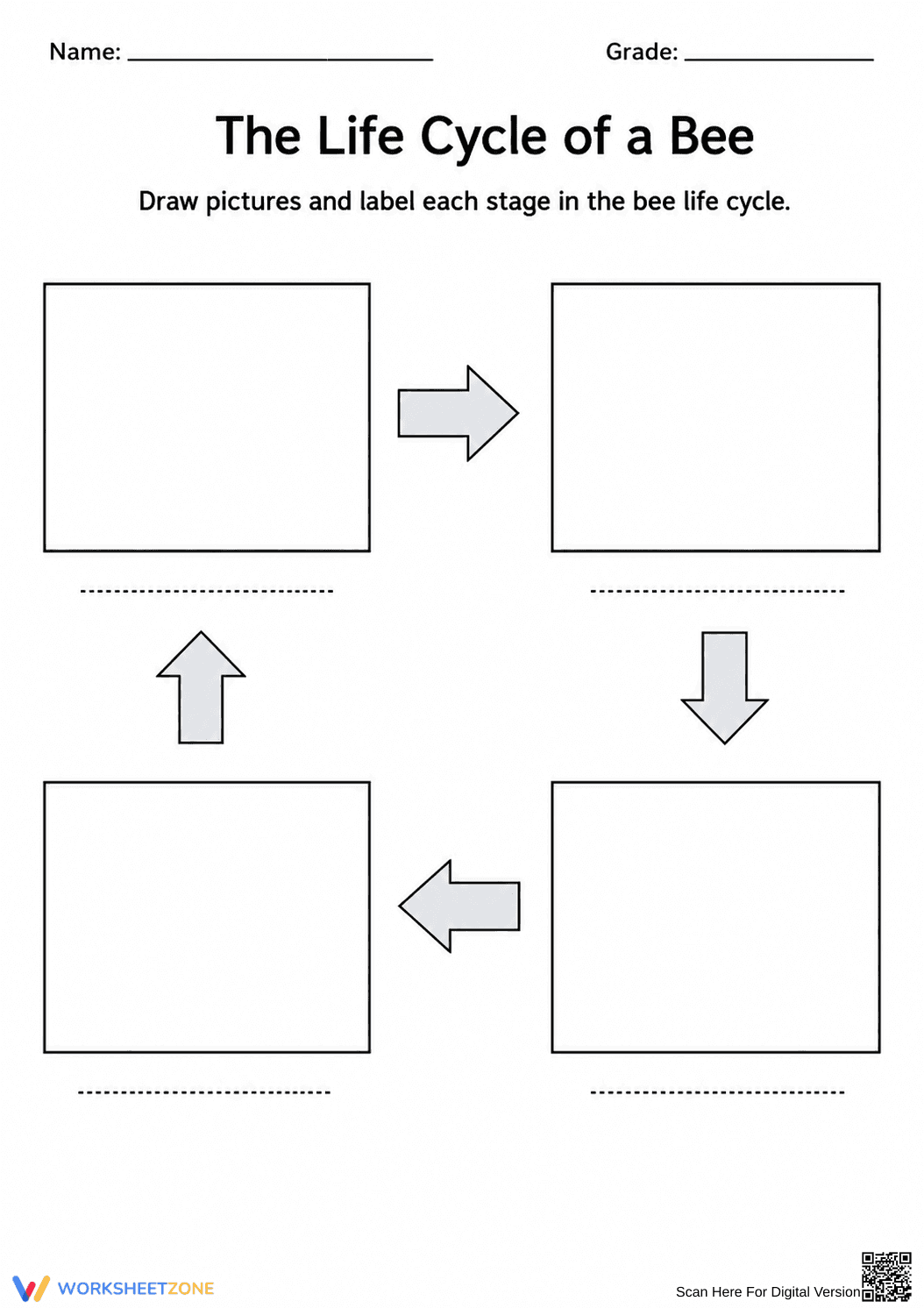
This printable bee life cycle worksheet helps students visualize and sequence the developmental stages of a honeybee. By drawing and labeling each phase, learners reinforce their understanding of biological growth while practicing scientific modeling skills. It is an excellent tool for solidifying foundational life science concepts.
At a Glance
- Grade: 3 · Subject: Science
- Standard:
3-LS1-1— Develop models to describe organism life cycles- Skill Focus: Sequencing and modeling biological stages
- Format: 1 page · 4 tasks · PDF
- Best For: Independent practice or science centers
- Time: 15–20 minutes
This single-page resource features a circular graphic organizer with four blank panels connected by arrows. Beneath each panel is a dotted line for vocabulary labeling. Students illustrate the egg, larva, pupa, and adult stages, then write the corresponding term. The intuitive layout guides students naturally through the biological sequence.
Designed for immediate classroom implementation, this resource requires minimal preparation:
- Print (1 minute): Download the PDF and print a class set.
- Distribute (1 minute): Hand out the worksheets along with drawing supplies.
- Review (3 minutes): Briefly discuss the four stages before letting students work independently.
With under two minutes of total prep time, this activity is highly effective for educators and serves as an ideal addition to any substitute plan.
This activity aligns with 3-LS1-1: Develop models to describe that organisms have unique and diverse life cycles but all have in common birth, growth, reproduction, and death. By illustrating the sequence, students create a scientific model. Both standard codes can be copied directly into lesson plans, IEP goals, or district curriculum mapping tools.
Use it as an independent formative assessment after a direct instruction lesson on insect life cycles. Alternatively, place it in a science center alongside reference books, allowing students to research and complete the diagrams. Teachers can observe drawings to ensure students differentiate between larva and pupa stages. Expected completion time is 15 to 20 minutes.
Designed for third-grade science students, this is adaptable for first and second graders with vocabulary support. For students needing scaffolding, provide a word bank or anchor chart. It pairs perfectly with an introductory reading passage about honeybees.
Integrating visual modeling into early science education is a highly effective strategy for deepening conceptual understanding. When students engage with standard 3-LS1-1 to develop models to describe organism life cycles, they move beyond rote memorization and begin to internalize complex biological processes. According to Fisher & Frey (2014), instructional tasks that require students to translate concepts from one modality to another—such as converting verbal knowledge about a bee's development into a self-generated illustration—significantly enhance cognitive retention and academic vocabulary acquisition. This drawing and labeling exercise provides a structured yet creative avenue for learners to demonstrate their grasp of sequential scientific phenomena. By actively constructing the cycle, young learners build a stronger foundation for future biological studies, ensuring they grasp the universal patterns of growth and reproduction found throughout the natural world.


