




























Views
Plays
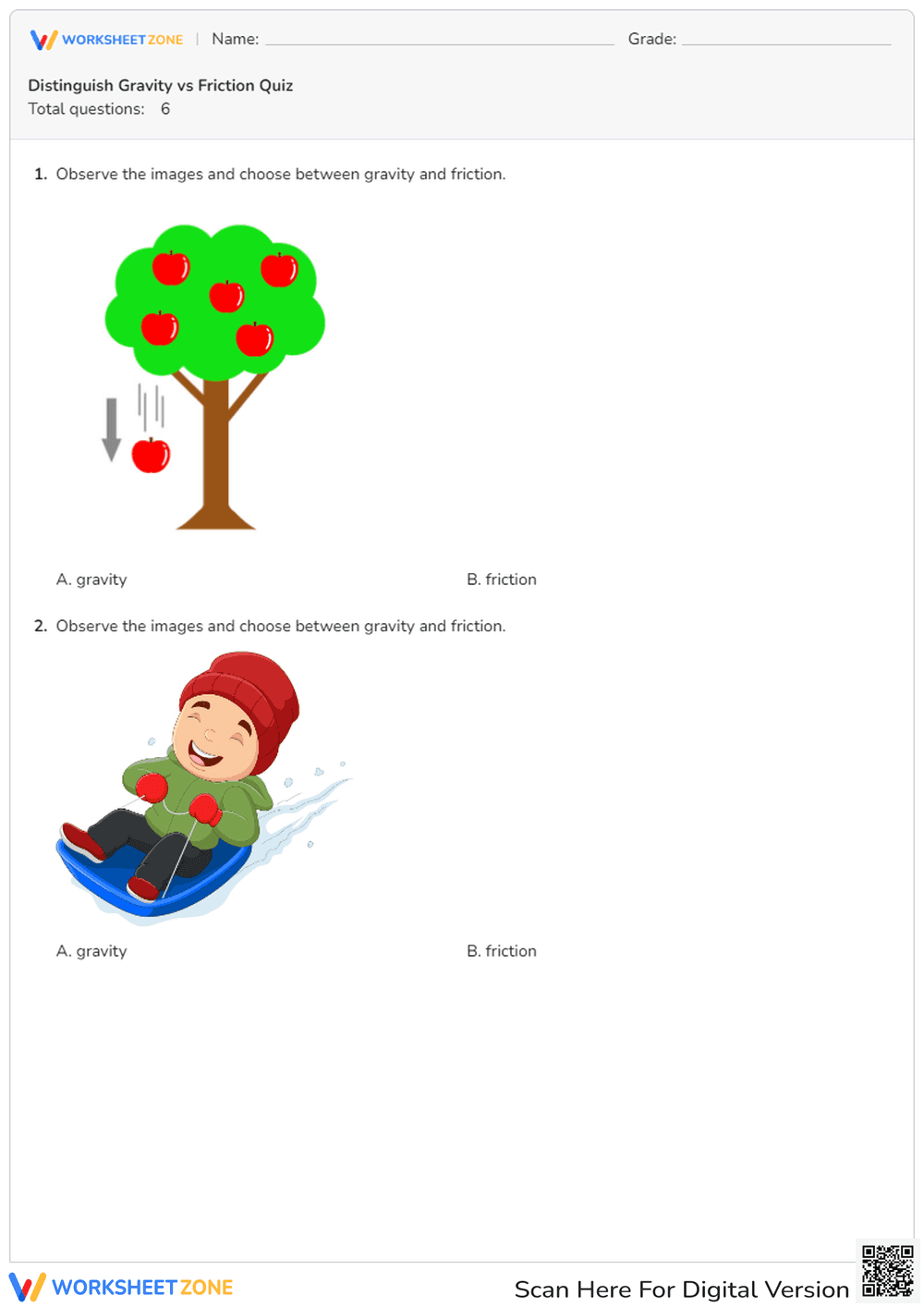


Gravity vs Friction Quiz | Grade 3 Printable Science

Paste this activity's link or code into your existing LMS (Google Classroom, Canvas, Teams, Schoology, Moodle, etc.).
Students can open and work on the activity right away, with no student login required.
You'll still be able to track student progress and results from your teacher account.
This Grade 3 science worksheet helps students master the fundamental concepts of forces by distinguishing between gravity and friction. By observing real-world scenarios like falling apples and sliding children, learners develop the critical thinking skills necessary to identify which force is acting upon an object in motion. It provides immediate visual feedback for conceptual clarity.
At a Glance
- Grade: 3 · Subject: Science
- Standard:
3-PS2-1— Plan and conduct investigations to provide evidence of the effects of forces on motion- Skill Focus: Distinguishing gravity vs. friction
- Format: 3 pages · 6 problems · Answer key included · PDF
- Best For: Quick formative assessment or exit ticket
- Time: 10–15 minutes
The resource consists of a 3-page quiz featuring 6 high-quality visual prompts. Each question presents a specific physical interaction—such as a bowling ball hitting pins or a skydiver in mid-air—and asks students to choose the dominant force involved. The layout is clean and spacious, ensuring that students can focus on the imagery without being overwhelmed by text. A full answer key is provided for rapid grading.
This resource is designed for a zero-prep classroom environment. First, print the 3-page PDF for your class, which takes less than 1 minute. Second, distribute the worksheets as a quiet independent activity or a timed quiz; students typically finish in about 12 minutes. Finally, review the answers as a whole group to address misconceptions immediately. Total teacher preparation time is under 2 minutes, making it an ideal sub-plan or morning work activity.
This worksheet is primarily aligned with 3-PS2-1, which requires students to provide evidence of the effects of balanced and unbalanced forces on the motion of an object. It also supports 5-PS2-1 by illustrating that gravitational force is directed downward toward the center of the Earth. Both standard codes can be copied directly into lesson plans, IEP goals, or district curriculum mapping tools to ensure compliance with state frameworks.
Use this quiz as a formative assessment mid-way through your unit on forces and motion. It is particularly effective after a hands-on lab where students have experimented with ramps or falling objects. Teachers should observe if students struggle with the "sledding" or "sliding" images, as these often require a deeper understanding of surface resistance versus downward pull. It serves as a perfect bridge between direct instruction and independent mastery.
This worksheet is ideal for 3rd through 5th-grade students who are beginning their study of physics. The heavy reliance on visual cues makes it an excellent resource for English Language Learners (ELLs) and students with reading difficulties who need to demonstrate science proficiency without heavy text barriers. It pairs naturally with an anchor chart detailing the definitions of contact and non-contact forces or a short video on Newton's Laws.
The "Distinguish Gravity vs Friction Quiz" provides a structured approach to identifying physical forces, directly supporting the 3-PS2-1 standard. By requiring students to interpret visual evidence to categorize forces, the worksheet aligns with the gradual release of responsibility. According to Fisher & Frey (2014), visual literacy in science is a prerequisite for higher-order analysis of physical systems. This resource bridges the gap between abstract definitions and concrete observations by presenting 6 distinct scenarios that isolate gravity and friction. Research from the NAEP suggests that students who can successfully categorize forces in varied contexts demonstrate a higher retention rate of physics concepts compared to those who only memorize definitions. This printable tool ensures that Grade 3 learners develop the observational precision needed for future engineering and physical science standards while providing teachers with clear data on student understanding.


