


























Views
Downloads
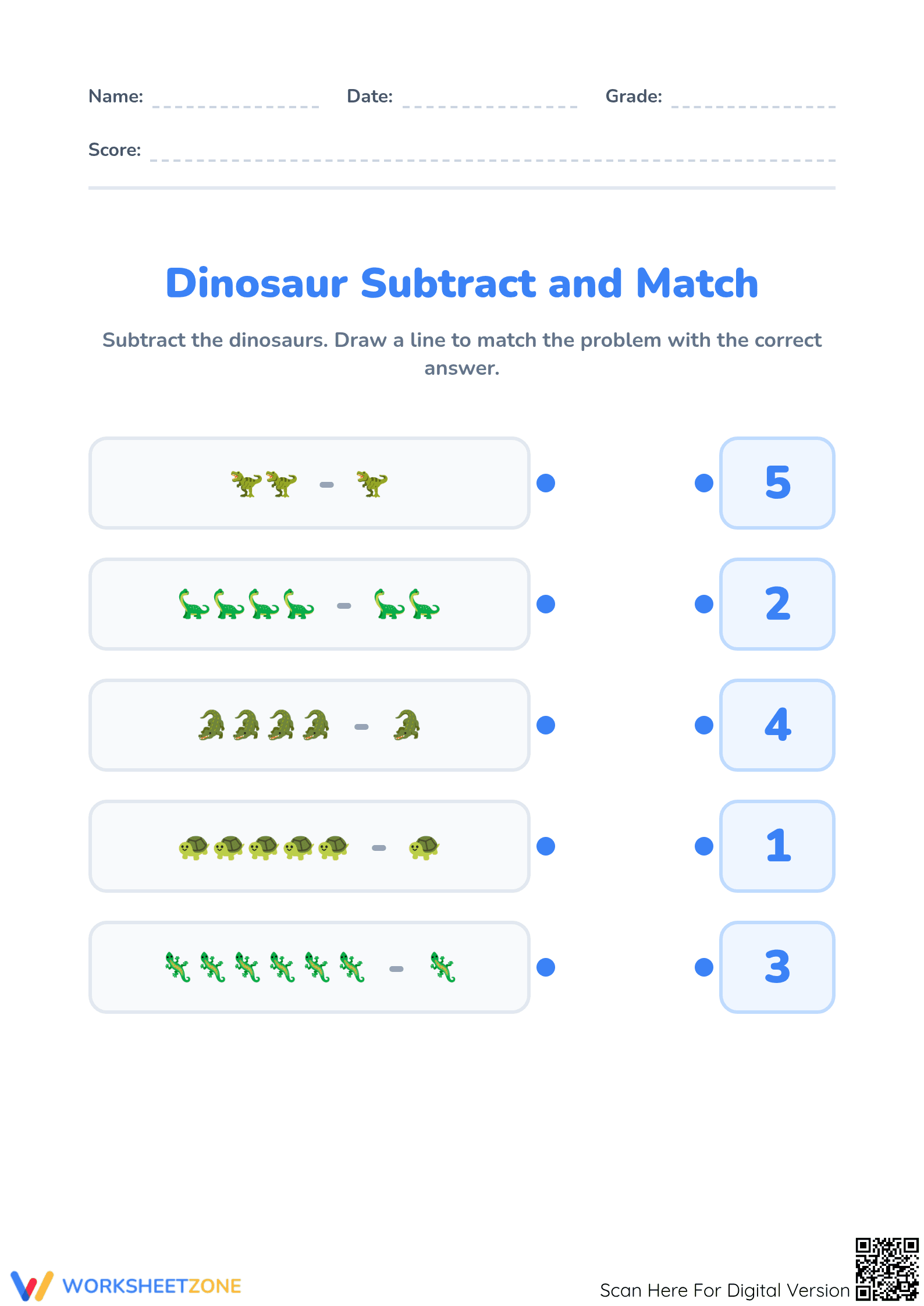

Kindergarten Dinosaur Subtraction — Printable Worksheet
Paste this activity's link or code into your existing LMS (Google Classroom, Canvas, Teams, Schoology, Moodle, etc.).
Students can open and work on the activity right away, with no student login required.
You'll still be able to track student progress and results from your teacher account.
This engaging Kindergarten math worksheet helps early learners master basic subtraction through visual representation. By counting and subtracting colorful dinosaur illustrations, students build foundational numeracy skills and connect concrete images to numerical values. The matching format provides immediate visual feedback to reinforce early mathematical concepts.
At a Glance
- Grade: Kindergarten · Subject: Math
- Standard:
CCSS.MATH.CONTENT.K.OA.A.1— Represent subtraction with objects or drawings- Skill Focus: Visual subtraction within 10
- Format: 1 page · 5 problems · Answer key included · PDF
- Best For: Independent practice or math centers
- Time: 10–15 minutes
This single-page resource features five distinct subtraction problems using engaging dinosaur themes. Each row presents a visual equation where students must subtract the second group of dinosaurs from the first. On the right side, a column of numbers from one to five awaits matching. Students simply draw a line connecting the visual problem to the correct numerical difference. A complete answer key is provided for quick grading or self-checking.
This resource is designed for immediate classroom implementation:
- Print (1 minute): Generate the PDF and answer key with one click.
- Distribute (1 minute): Hand out worksheets. No extra manipulatives are required.
- Review (3 minutes): Use the answer key to quickly check matches.
Total teacher preparation takes under two minutes, making this an excellent option for sub plans or morning work.
This worksheet is directly aligned to CCSS.MATH.CONTENT.K.OA.A.1, which requires students to represent addition and subtraction with objects, fingers, mental images, drawings, sounds, acting out situations, verbal explanations, expressions, or equations. By using dinosaur illustrations to model the subtraction process, students bridge the gap between concrete objects and abstract numbers. Both standard codes can be copied directly into lesson plans, IEP goals, or district curriculum mapping tools.
Deploy this worksheet during independent practice after a direct instruction lesson on basic subtraction. It serves as an excellent formative assessment tool; observe whether students are crossing out the subtracted dinosaurs with their pencils or attempting to calculate the difference mentally. Alternatively, place it in a math center for a quiet, self-directed activity. Most kindergarteners will complete the five matching problems within 10 to 15 minutes.
This activity is ideal for Kindergarten and early first-grade students who are just beginning to explore subtraction. The visual scaffolds make it highly accessible for visual learners and students who need concrete representations before moving to standard numerical equations. Pair this worksheet with physical dinosaur manipulatives or a read-aloud book about dinosaurs to create a cohesive, cross-curricular math lesson.
Aligning early math instruction with CCSS.MATH.CONTENT.K.OA.A.1 ensures students can accurately represent subtraction with objects or drawings before transitioning to abstract equations. According to a recent EdReports 2024 analysis of foundational math curricula, integrating visual models and thematic elements significantly increases student engagement and retention of basic arithmetic concepts. When young learners interact with familiar, appealing visuals—such as dinosaurs—they are more likely to persist through the cognitive demands of counting and subtracting. This visual matching approach reduces working memory load, allowing students to focus entirely on the mathematical operation rather than decoding complex instructions. By providing clear, one-to-one correspondence tasks within a structured format, educators can effectively build the conceptual groundwork necessary for future fluency in single-digit subtraction and broader algebraic thinking. This method bridges the gap between concrete play and formal mathematics.


