




























Views
Downloads
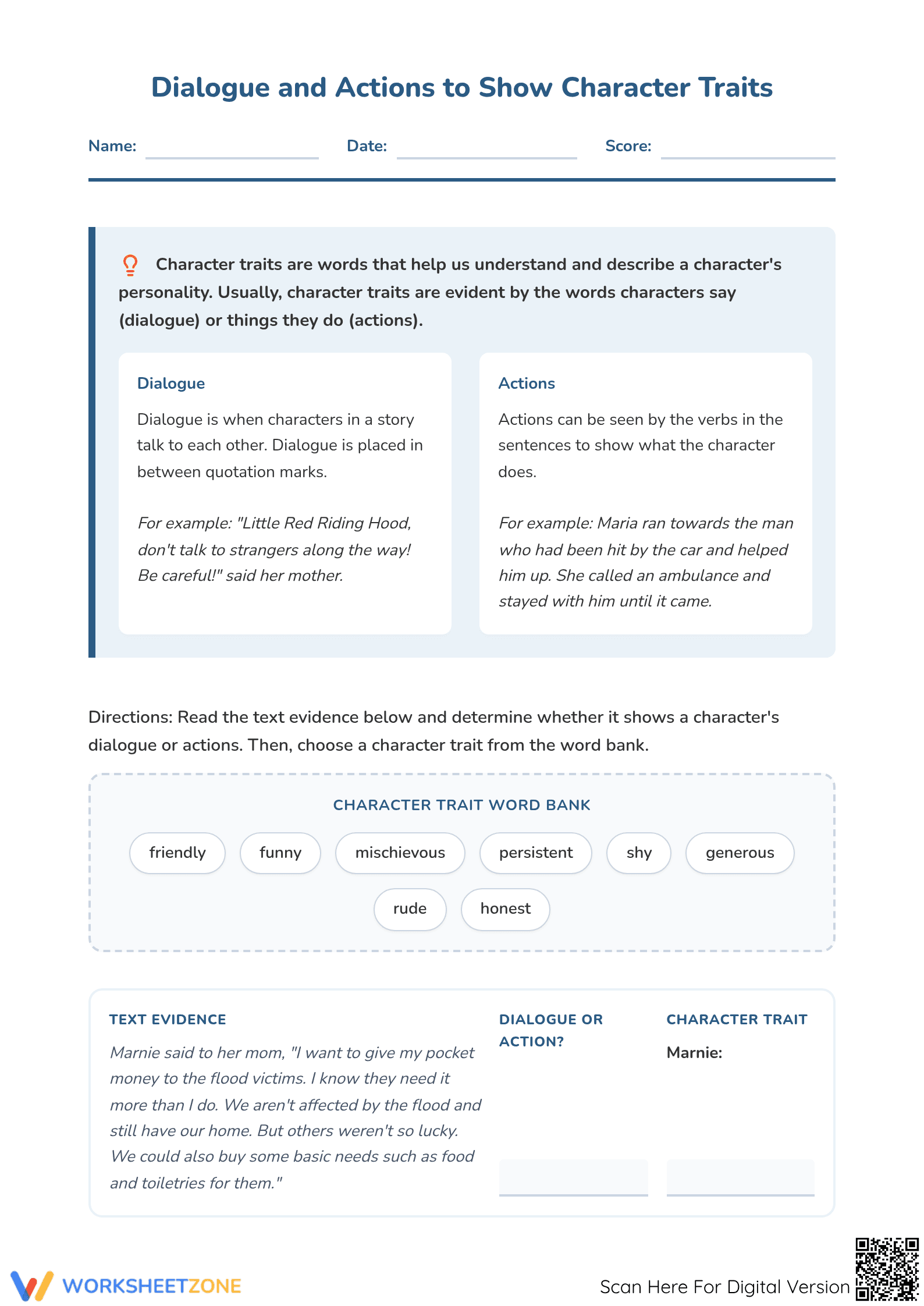



Character Traits Printable Worksheet | Grade 4 ELA

Paste this activity's link or code into your existing LMS (Google Classroom, Canvas, Teams, Schoology, Moodle, etc.).
Students can open and work on the activity right away, with no student login required.
You'll still be able to track student progress and results from your teacher account.
This Grade 4 reading comprehension worksheet helps students identify character traits by analyzing text evidence. Before reading complex chapter books, learners need to understand how a character's words and actions reveal their personality. This resource provides clear examples and targeted practice to build this essential literary analysis skill.
At a Glance
- Grade: 4 · Subject: ELA
- Standard:
CCSS.ELA-LITERACY.RL.4.3— Describe a character using specific details from the text.- Skill Focus: Analyzing Character Traits
- Format: 3 pages · 8 problems · Answer key included · PDF
- Best For: Independent practice, homework, and reading centers
- Time: 15–20 minutes
This three-page resource begins with an instructional box defining dialogue and actions with clear examples. Students use a word bank of eight adjectives—like mischievous and generous—to evaluate short passages. For all eight problems, learners read the evidence, identify it as dialogue or action, and select the accurate trait. A complete answer key is included.
- Guided practice: The worksheet opens with explicit definitions and modeled examples of dialogue and actions.
- Supported practice: Initial problems allow students to use the vocabulary bank to match traits to obvious clues.
- Independent practice: Students progress through remaining scenarios, synthesizing context clues to justify selections.
This gradual-release approach builds confidence from the instructional phase to independent application.
This resource is directly aligned to CCSS.ELA-LITERACY.RL.4.3, which requires students to describe in depth a character, setting, or event in a story or drama, drawing on specific details in the text (e.g., a character's thoughts, words, or actions). By isolating the specific mechanics of dialogue and physical actions, students learn exactly how authors construct complex personalities. Both standard codes can be copied directly into lesson plans, IEP goals, or district curriculum mapping tools.
Deploy this worksheet during your reading block immediately following direct instruction on character development. It serves as an excellent independent center activity while the teacher pulls small guided reading groups. Alternatively, assign it as a meaningful homework task to reinforce classroom learning. As a formative assessment tip, observe whether students struggle more with identifying the action/dialogue distinction or with understanding the vocabulary in the word bank. Most students will complete this activity in 15 to 20 minutes.
This activity is designed for fourth-grade general education students, though it works well for third graders needing enrichment or fifth graders requiring foundational review. For students who need additional scaffolding, consider pre-teaching the vocabulary words in the word bank or allowing them to work with a peer partner. Pair this worksheet with a whole-class read-aloud, pausing to ask students to apply these same analytical skills to the main characters in your current novel study.
Mastering the ability to describe a character using specific details from the text is a critical milestone in elementary literacy. According to Fisher & Frey (2014), explicit instruction in close reading strategies—such as analyzing specific dialogue tags and character movements—significantly improves overall reading comprehension and analytical writing skills. When students practice with targeted resources aligned to CCSS.ELA-LITERACY.RL.4.3, they transition from passive readers to active text investigators. This specific skill focus ensures learners do not just guess a character's feelings, but rather point directly to the textual evidence that proves their inference. By consistently evaluating these narrative elements, young readers develop the cognitive habits necessary for tackling more rigorous middle school literature. Providing structured, evidence-based practice opportunities is essential for building long-term reading proficiency and fostering a deeper appreciation for authorial craft.


