


























Views
Downloads

D'Nealian Handwriting Sentences | Grade 1-2 Ready
Paste this activity's link or code into your existing LMS (Google Classroom, Canvas, Teams, Schoology, Moodle, etc.).
Students can open and work on the activity right away, with no student login required.
You'll still be able to track student progress and results from your teacher account.
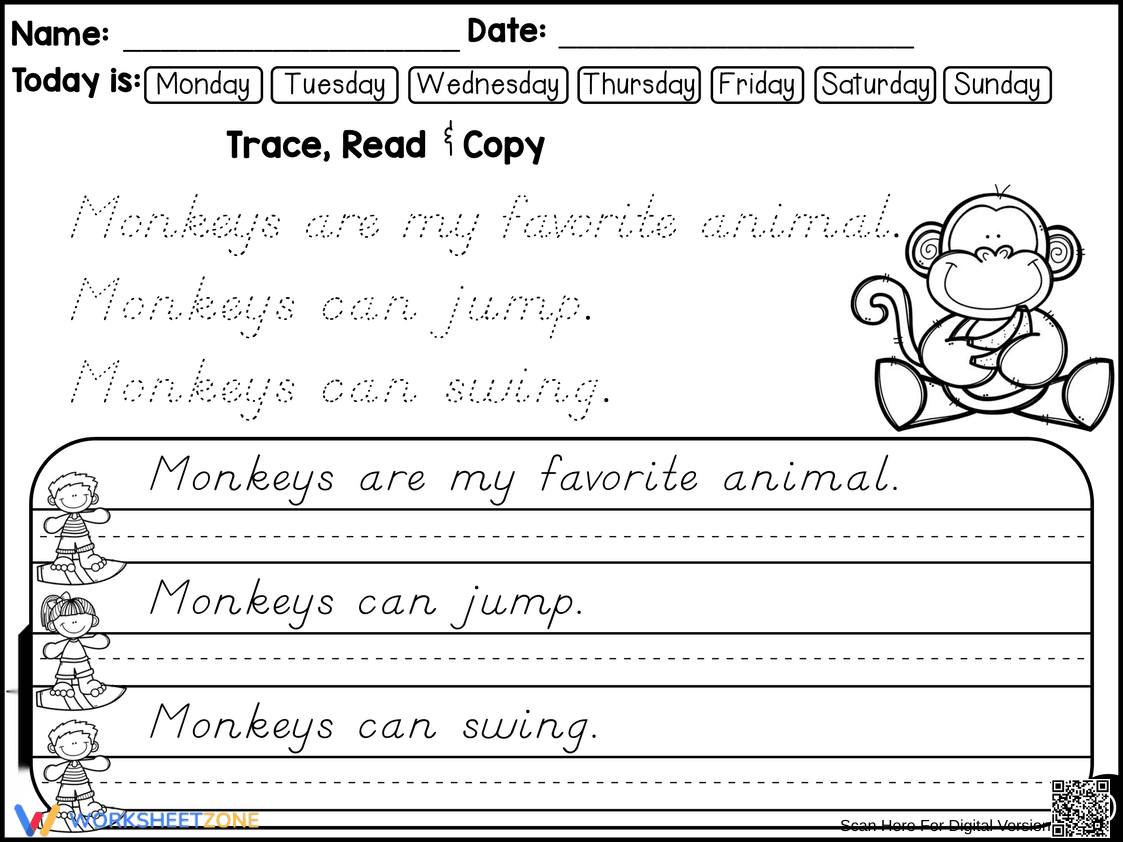
This Grade 1-2 D'Nealian handwriting worksheet helps students master letter formation and sentence structure through a themed monkey activity. Students engage in a multi-sensory approach by tracing, reading, and copying sentences to build muscle memory. It provides immediate practice for young learners developing fine motor control and legibility in their daily writing.
At a Glance
- Grade: 1-2 · Subject: Handwriting
- Standard:
CCSS.ELA-LITERACY.L.1.1.A— Print all upper- and lowercase letters correctly in D'Nealian style- Skill Focus: D'Nealian sentence formation
- Format: 1 page · 6 tasks · No answer key needed · PDF
- Best For: Morning work or literacy centers
- Time: 10–15 minutes
The worksheet features three specific sentences about monkeys, each presented in a dotted D'Nealian font for tracing. Below the tracing section, students find primary-ruled lines with a midline to copy the sentences independently. The page includes a date and day-of-the-week tracker at the top, along with a friendly monkey illustration to keep students engaged during the task.
Zero-Prep Workflow
- Print (1 min): Select the single-page PDF and print enough copies for your literacy block or morning work folders.
- Distribute (30 sec): Hand out the sheets during arrival or as a transition activity between subjects.
- Review (30 sec): Quickly scan student work for proper letter slant, spacing, and adherence to the midline.
This resource is ideal for emergency sub plans or as a quiet independent activity during small-group rotations, requiring less than two minutes of total teacher preparation.
Standards Alignment
This resource aligns with `CCSS.ELA-LITERACY.L.1.1.A`, which requires students to print all upper- and lowercase letters. By practicing full sentences, students also touch upon basic capitalization and punctuation conventions. Both standard codes can be copied directly into lesson plans, IEP goals, or district curriculum mapping tools.
How to Use It
Use this worksheet during the independent practice phase of a handwriting lesson to reinforce the specific curves of D'Nealian script. It also serves as a functional formative assessment tool; observe students as they write to identify common errors in letter directionality or pencil grip. Completion typically takes 10 to 15 minutes depending on student proficiency.
Who It's For
This activity is designed for first and second-grade students who are transitioning from individual letter practice to full sentence construction. It is particularly helpful for students requiring extra fine motor support or those following a D'Nealian-specific curriculum. Pair this with a monkey-themed read-aloud or a science lesson on primates for a cross-curricular connection.
According to Fisher & Frey (2014), the gradual release of responsibility model is most effective when students move from guided tracing to independent copying, as seen in this worksheet. The focus on CCSS.ELA-LITERACY.L.1.1.A ensures that students are meeting foundational literacy requirements for legibility and speed. Research from the RAND AIRS 2024 report highlights that consistent, short-burst handwriting practice significantly improves overall composition quality in early elementary grades. By integrating reading and writing in a single 15-minute session, this resource maximizes instructional time while building the stamina necessary for longer writing tasks. The D'Nealian style specifically aids in the transition to cursive, making this a strategic choice for Grade 1 and Grade 2 educators looking to prepare students for future academic demands.


