




























Views
Downloads
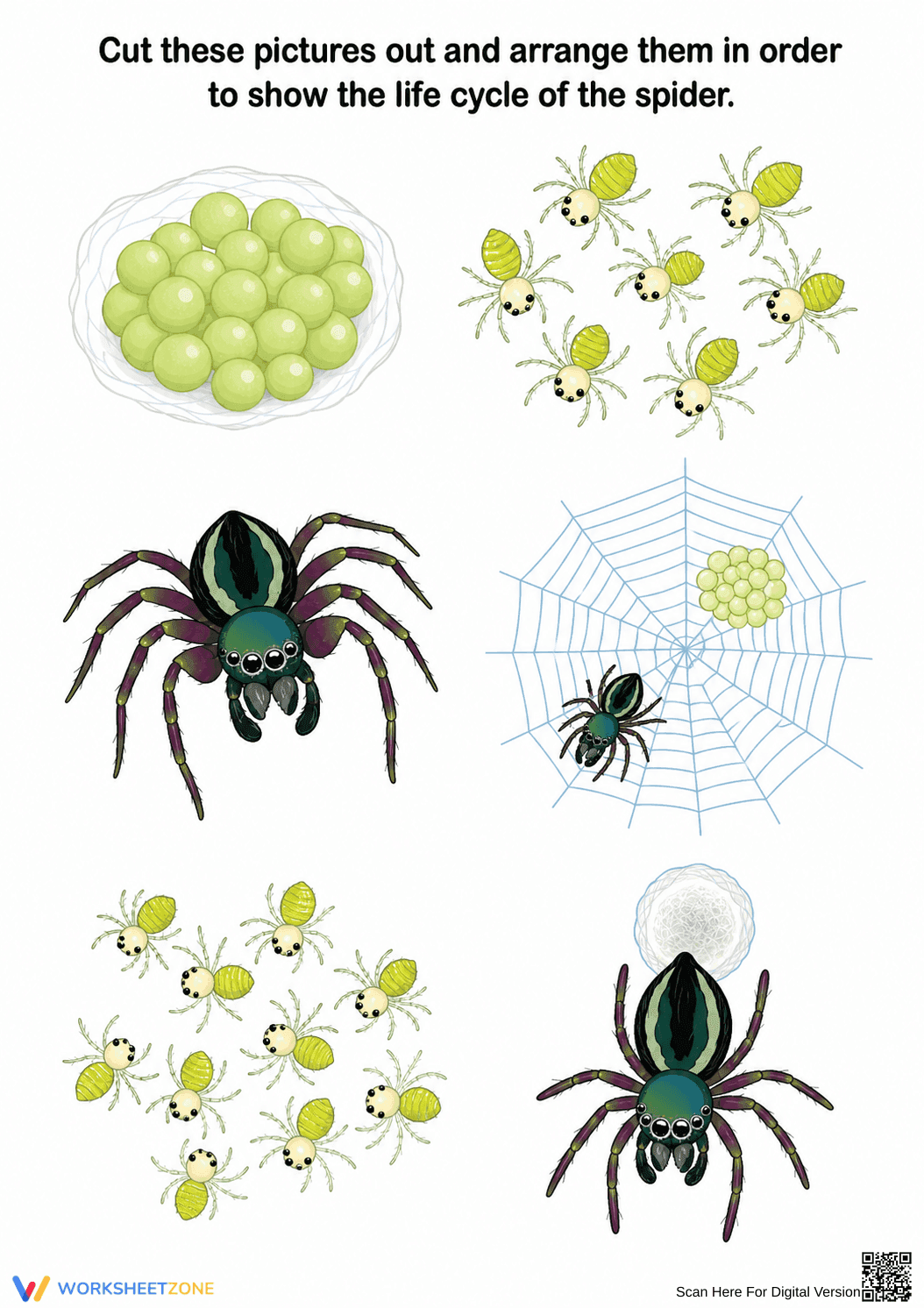

Spider Life Cycle Worksheet | Grade 1 Printable

Paste this activity's link or code into your existing LMS (Google Classroom, Canvas, Teams, Schoology, Moodle, etc.).
Students can open and work on the activity right away, with no student login required.
You'll still be able to track student progress and results from your teacher account.
This Grade 1 science worksheet helps students sequence the life cycle of a spider while developing fine motor skills. By cutting and pasting six distinct developmental stages, young learners actively model how organisms grow and change over time.
At a Glance
- Grade: 1 · Subject: Science
- Standard:
1-LS3-1— Observe how young animals resemble their parents- Skill Focus: Sequencing life cycles
- Format: 1 page · 6 problems · No answer key · PDF
- Best For: Independent science centers
- Time: 15–20 minutes
This single-page resource features six detailed illustrations of a spider at various life stages, including egg sacs, spiderlings, and mature adults. Students are tasked with cutting out each image and pasting them in the correct chronological order to form a complete life cycle model.
- Print (1 min): Print the single-page PDF for each student.
- Distribute (1 min): Hand out the worksheets along with scissors and glue sticks.
- Review (3 mins): Briefly discuss the visual differences between the spiderlings and the adult spider before students begin cutting.
This activity requires under 2 minutes of total teacher prep time, making it an excellent zero-prep option for busy afternoons or emergency sub plans.
Aligned to primary standard 1-LS3-1: Make observations to construct an evidence-based account that young plants and animals are like, but not exactly like, their parents. It also introduces foundational concepts for 3-LS1-1 regarding unique and diverse life cycles. Both standard codes can be copied directly into lesson plans, IEP goals, or district curriculum mapping tools.
Use this worksheet during a spring biology unit or an October spider theme. It works perfectly as an independent science center activity after reading a picture book about arachnids. As a formative assessment tip, observe whether students correctly place the egg sac stage before the spiderlings emerge. Expected completion time is 15 to 20 minutes.
This resource is designed for first-grade students, though it is highly suitable for kindergarten and second-grade classrooms. The visual nature of the task provides built-in differentiation for English Language Learners. Pair this activity with a nonfiction read-aloud about spiders to reinforce the vocabulary.
Integrating hands-on sequencing tasks like this 1-LS3-1 aligned activity helps young learners observe how young animals resemble their parents while building essential cognitive frameworks for future biological studies. According to Fisher & Frey (2014), incorporating tactile activities such as cutting and pasting into core content instruction significantly improves both fine motor development and conceptual retention in early elementary students. When young learners physically manipulate the distinct stages of an organism's life cycle, they transition from passive observers to active participants in their own scientific discovery process. This method of combining physical movement with biological sequencing ensures that foundational science concepts are anchored in active, physical learning experiences. By engaging multiple senses, educators can foster a deeper understanding and better long-term memory of the material, setting a strong precedent for future scientific inquiry.


