




























Views
Downloads

Counting Insects Worksheet | Printable Grade K Math

Paste this activity's link or code into your existing LMS (Google Classroom, Canvas, Teams, Schoology, Moodle, etc.).
Students can open and work on the activity right away, with no student login required.
You'll still be able to track student progress and results from your teacher account.
This Kindergarten counting insects worksheet helps students master identifying which group contains more objects. By engaging with colorful illustrations, children practice one-to-one correspondence and numerical comparison in a structured format. Students move from basic counting to making judgments about quantity, ensuring a solid foundation for early algebraic thinking and essential number sense development.
At a Glance
- Grade: Kindergarten · Subject: Math
- Standard:
K.CC.C.6— Identify whether the number of objects in one group is greater than another group- Skill Focus: Counting and Comparing Numbers 1–20
- Format: 2 pages · 6 problems · Answer key included · PDF
- Best For: Small group instruction or independent math centers
- Time: 15–20 minutes
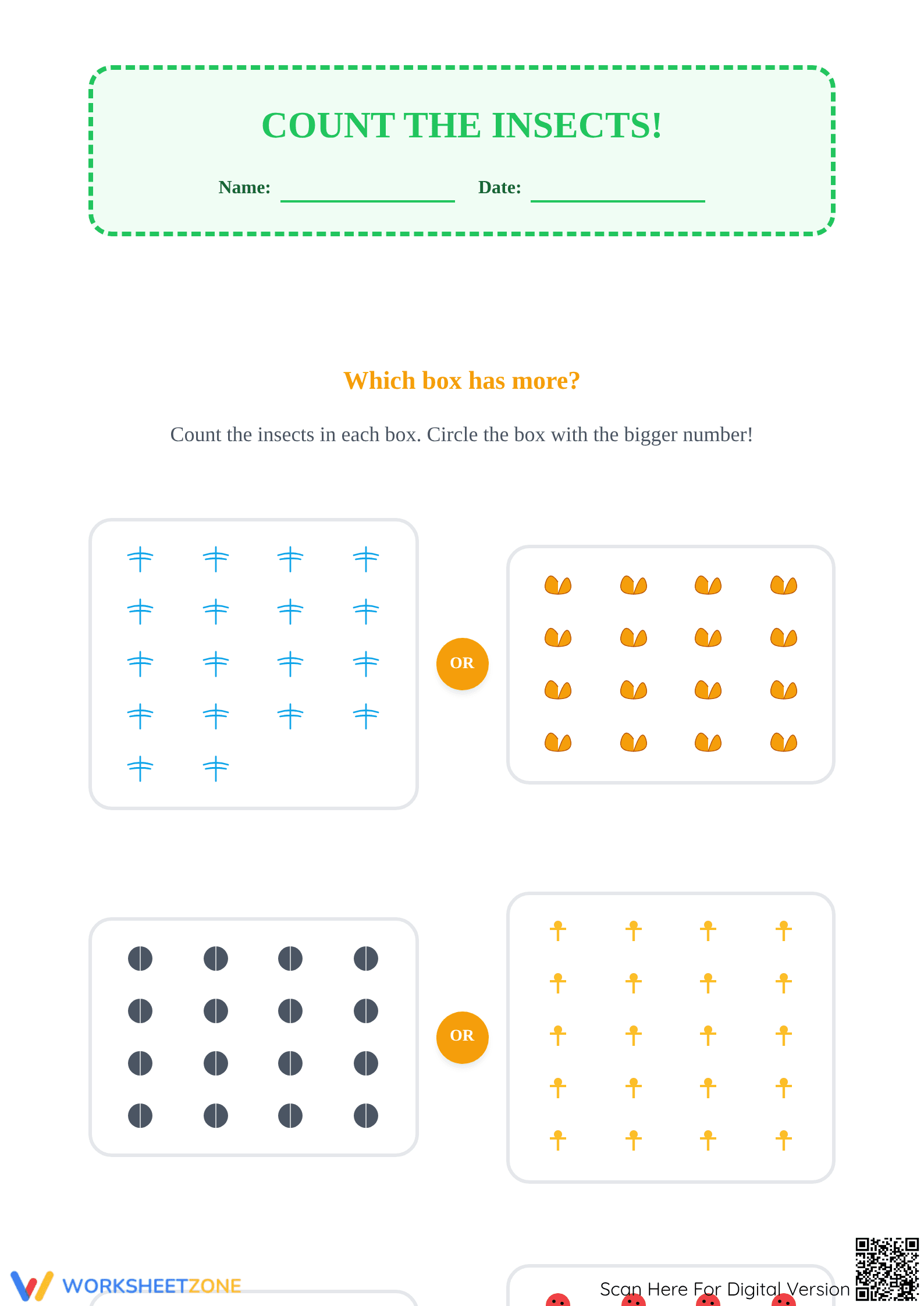
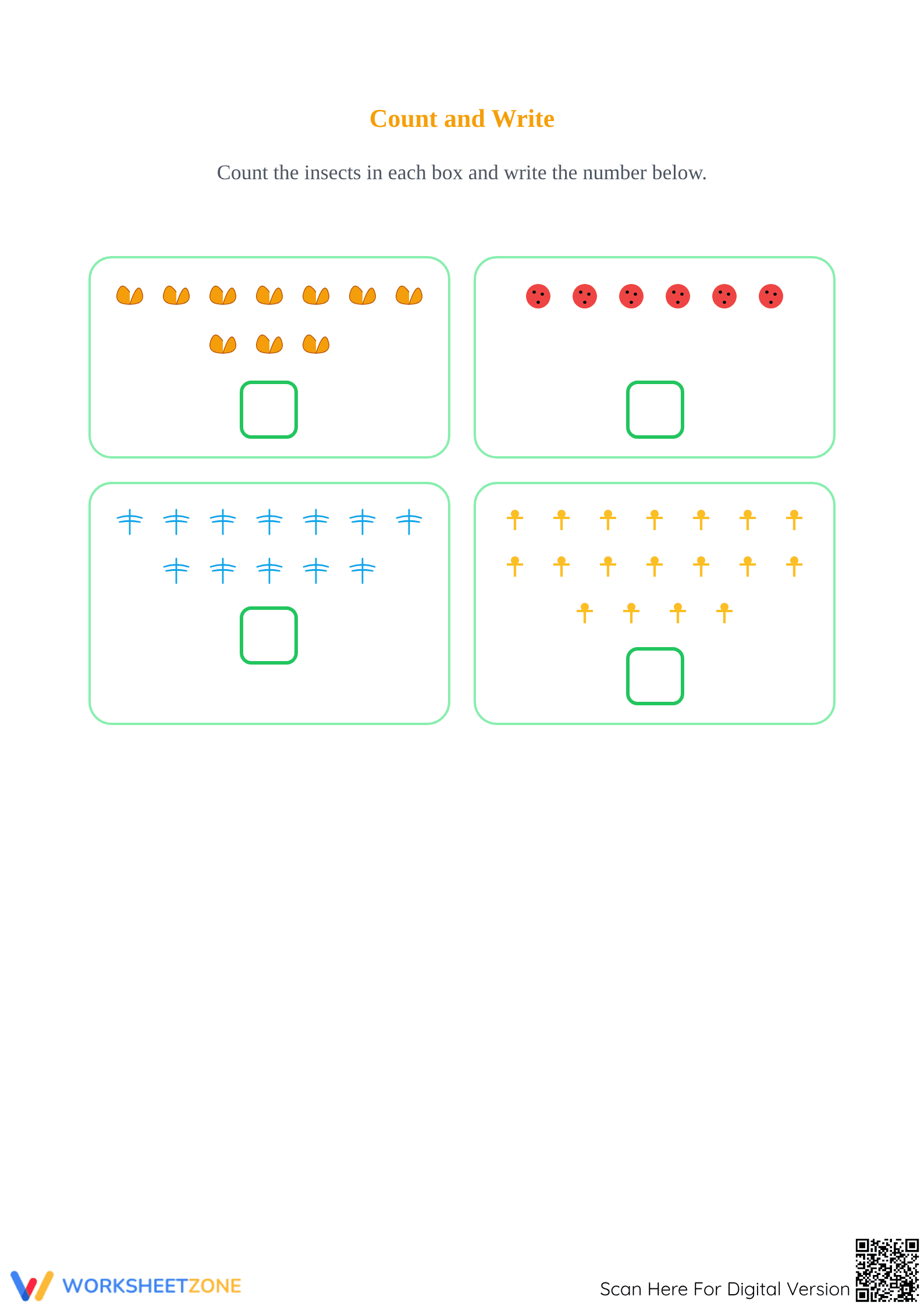
This two-page PDF includes six focused tasks for early learners. Page one features two large-scale comparison problems where students count insect clusters and circle the "bigger" number. Page two provides four "Count and Write" boxes, encouraging students to translate visual quantities into written digits. Clear instructions and high-contrast icons make this an ideal resource for independent work.
The worksheet follows a gradual release model. It begins with Guided Practice in the comparison section, using the "OR" prompt to help students focus on binary choice. This transitions into Supported Practice as students count within a defined frame. Finally, Independent Practice on page two requires students to generate the numeral without cues, solidifying their cardinality understanding.
This resource is specifically aligned to K.CC.C.6, requiring students to identify whether the number of objects in one group is greater than another group using counting strategies. It also supports K.CC.B.4 regarding one-to-one correspondence. Both standard codes can be copied directly into lesson plans, IEP goals, or district curriculum mapping tools for easy tracking.
Use this worksheet during a math rotation after a lesson on "more than." As a formative assessment tip, observe if students are touching each insect while counting or if they are beginning to subitize small groups. This resource is perfect for a 15-minute practice block, helping you identify students needing more scaffolding with one-to-one correspondence.
This printable is designed for Kindergarten students and advanced Preschool learners. It supports children developing fine motor skills through circling and writing. It pairs naturally with a bug-themed counting passage or physical insect manipulatives to create a multi-sensory experience that bridges concrete and representational math concepts in a classroom setting.
The mastery of identifying "more" vs "less" is a pivotal milestone in early numeracy, acting as a predictor for later success in operations and algebraic thinking. This worksheet utilizes high-contrast visual sets to reduce cognitive load, allowing students to focus purely on cardinality and comparison. Research from the NAEP highlights that early exposure to diverse comparison models strengthens a student's mental number line and their ability to estimate quantities accurately. According to Fisher & Frey (2014), providing structured scaffolds like the comparison boxes found here supports the gradual release of responsibility, ensuring that students can move from guided counting to independent numerical representation with confidence. By integrating standard K.CC.C.6 with the plain-English skill of group identification, this resource ensures that Kindergarten students are meeting rigorous national benchmarks while remaining engaged through a familiar, child-friendly theme. This focus on comparison ensures that learners are ready for advanced arithmetic.


