


























Views
Downloads
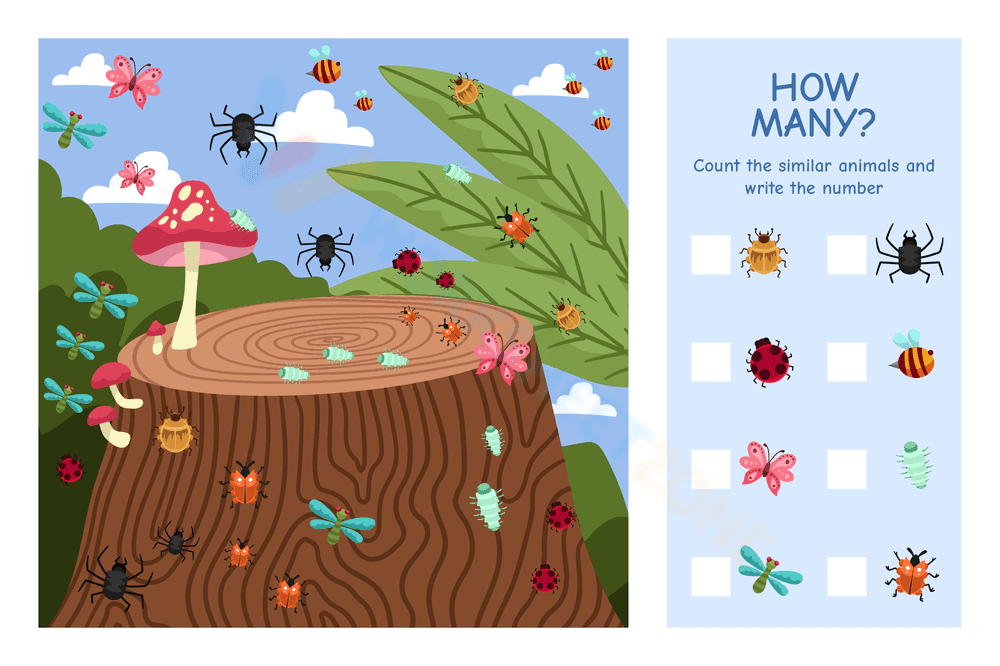

Counting Game Template | Essential Grade K Math
Paste this activity's link or code into your existing LMS (Google Classroom, Canvas, Teams, Schoology, Moodle, etc.).
Students can open and work on the activity right away, with no student login required.
You'll still be able to track student progress and results from your teacher account.
This Kindergarten counting worksheet helps students master one-to-one correspondence by identifying and tallying various insects in a vibrant nature scene. By counting similar animals and writing the corresponding numerals, learners build foundational cardinality skills and number recognition. It provides a clear, visual path toward mathematical fluency in early childhood settings.
At a Glance
At a Glance
- Grade: K · Subject: Math
- Standard:
CCSS.MATH.CONTENT.K.CC.B.5— Count to tell the number of objects up to 20- Skill Focus: Counting and cardinality
- Format: 1 page · 8 problems · Answer key included · PDF
- Best For: Independent morning work or math centers
- Time: 10–15 minutes
What's Inside
The worksheet features a high-quality illustration of a forest floor with a central tree stump. Students must locate and count eight different types of insects, including ladybugs, bees, butterflies, and spiders. The right-hand column provides clear icons for each creature next to a dedicated box for writing the final count. This single-page PDF includes a comprehensive answer key for quick grading.
Zero-Prep Workflow
The zero-prep workflow is designed for maximum efficiency in busy classrooms. First, print the single-page PDF (30 seconds). Second, distribute the sheets to students during a transition or as a warm-up activity (1 minute). Finally, review the answers as a whole group or use the provided key for rapid individual assessment (1 minute). Total teacher preparation time is under 2 minutes.
Standards Alignment
This resource aligns with `CCSS.MATH.CONTENT.K.CC.B.5`, which requires students to count to tell the number of objects in a scattered arrangement. It also supports K.CC.B.4 by reinforcing the relationship between numbers and quantities. Both standard codes can be copied directly into lesson plans, IEP goals, or district curriculum mapping tools.
How to Use It
Use this as a formative assessment after introducing the concept of counting objects in a group. It is also an excellent choice for a "quiet time" activity or a sub-plan filler. Teachers should observe if students use a "touch and count" strategy or mark off insects as they go to avoid double-counting. Expected completion time is 10 to 15 minutes.
Who It's For
This is designed for Kindergarten students but serves as a great review for Pre-K or an intervention tool for Grade 1. It pairs naturally with a nature-themed picture book or a hands-on counting lesson using plastic insect manipulatives. The visual nature of the tasks makes it accessible for English Language Learners.
The Counting Game Template is a focused instructional tool designed to reinforce CCSS.MATH.CONTENT.K.CC.B.5, specifically the ability to count objects in a scattered configuration. Research from RAND AIRS 2024 indicates that high-quality visual representations in early mathematics significantly improve a student's ability to transition from concrete counting to abstract numerical representation. By requiring students to discriminate between different insect types before counting, the worksheet also exercises visual processing and categorization skills. This dual-purpose design ensures that learners are not just reciting numbers but are actively engaging in the cognitive process of cardinality. The structured layout, featuring 8 distinct tasks, allows for a clear assessment of a child's one-to-one correspondence accuracy. Educators can utilize this resource to gather data on student progress toward foundational math milestones, ensuring that early interventions are based on observable performance in a standardized, printable format.


