


























Views
Downloads

Printable Grade 2 Counting Coins Worksheet | Essential Math
Paste this activity's link or code into your existing LMS (Google Classroom, Canvas, Teams, Schoology, Moodle, etc.).
Students can open and work on the activity right away, with no student login required.
You'll still be able to track student progress and results from your teacher account.
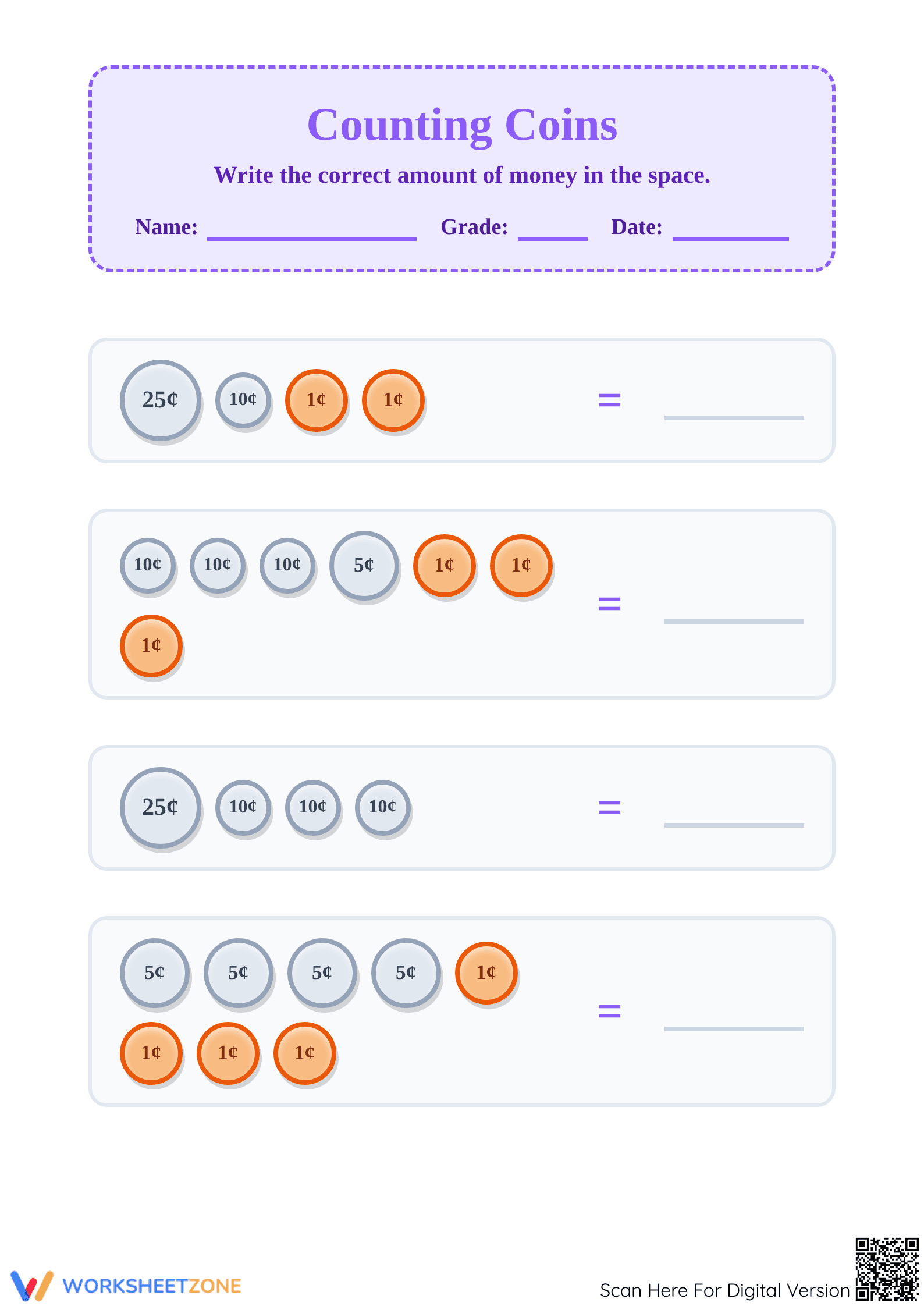
This Grade 2 math worksheet helps students master the essential skill of identifying and counting US coins. By calculating the total value of mixed groups of quarters, dimes, nickels, and pennies, learners build the fluency needed for real-world financial literacy. This resource provides clear visual support to ensure every student successfully meets second-grade measurement and data standards.
At a Glance
- Grade: 2 · Subject: Math
- Standard:
2.MD.C.8— Solve problems involving quarters, dimes, nickels, and pennies using symbols appropriately- Skill Focus: Identifying and totaling mixed coin groups
- Format: 3 pages · 10 problems · Answer key included · PDF
- Best For: Independent practice or formative assessment
- Time: 15–20 minutes
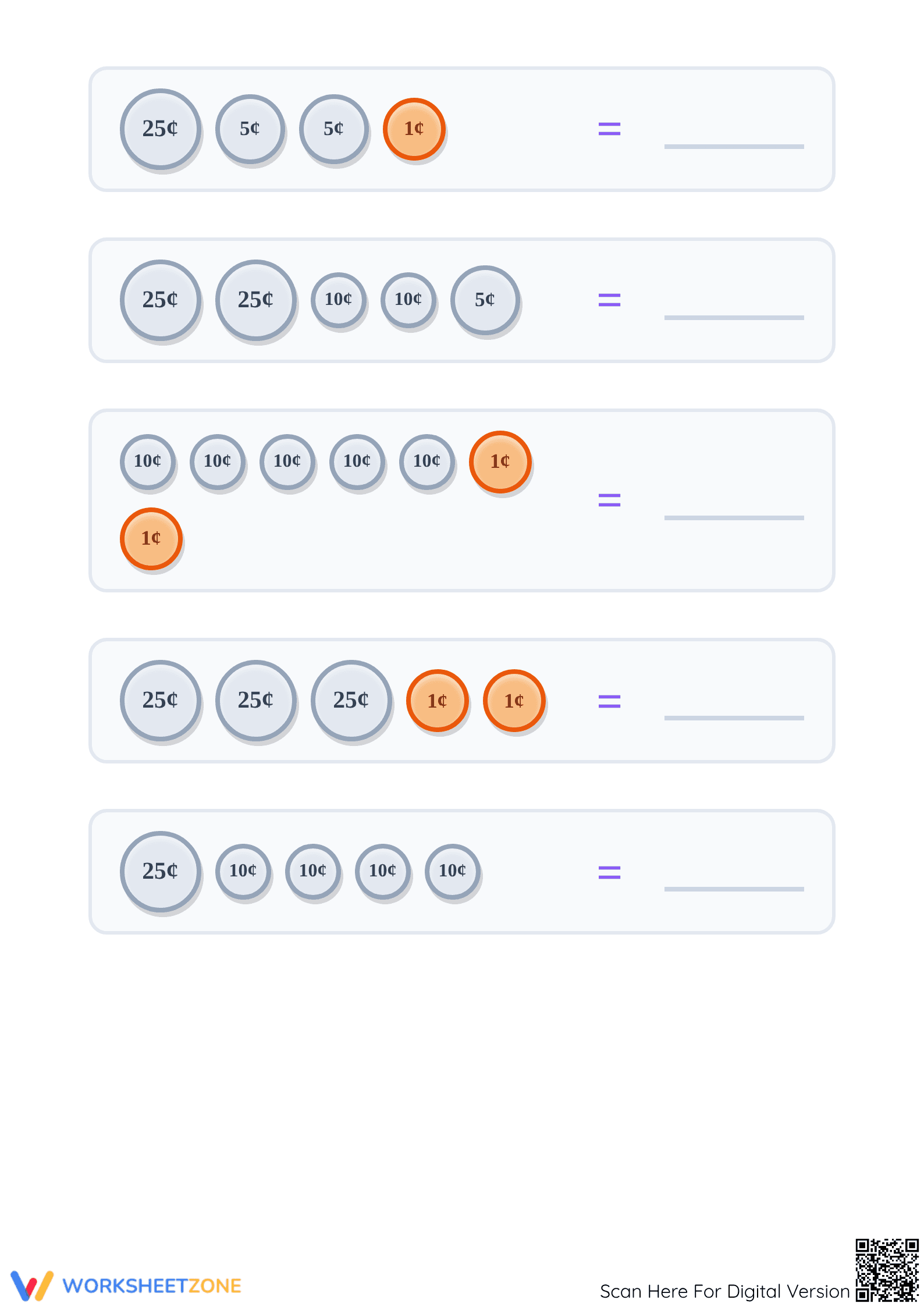
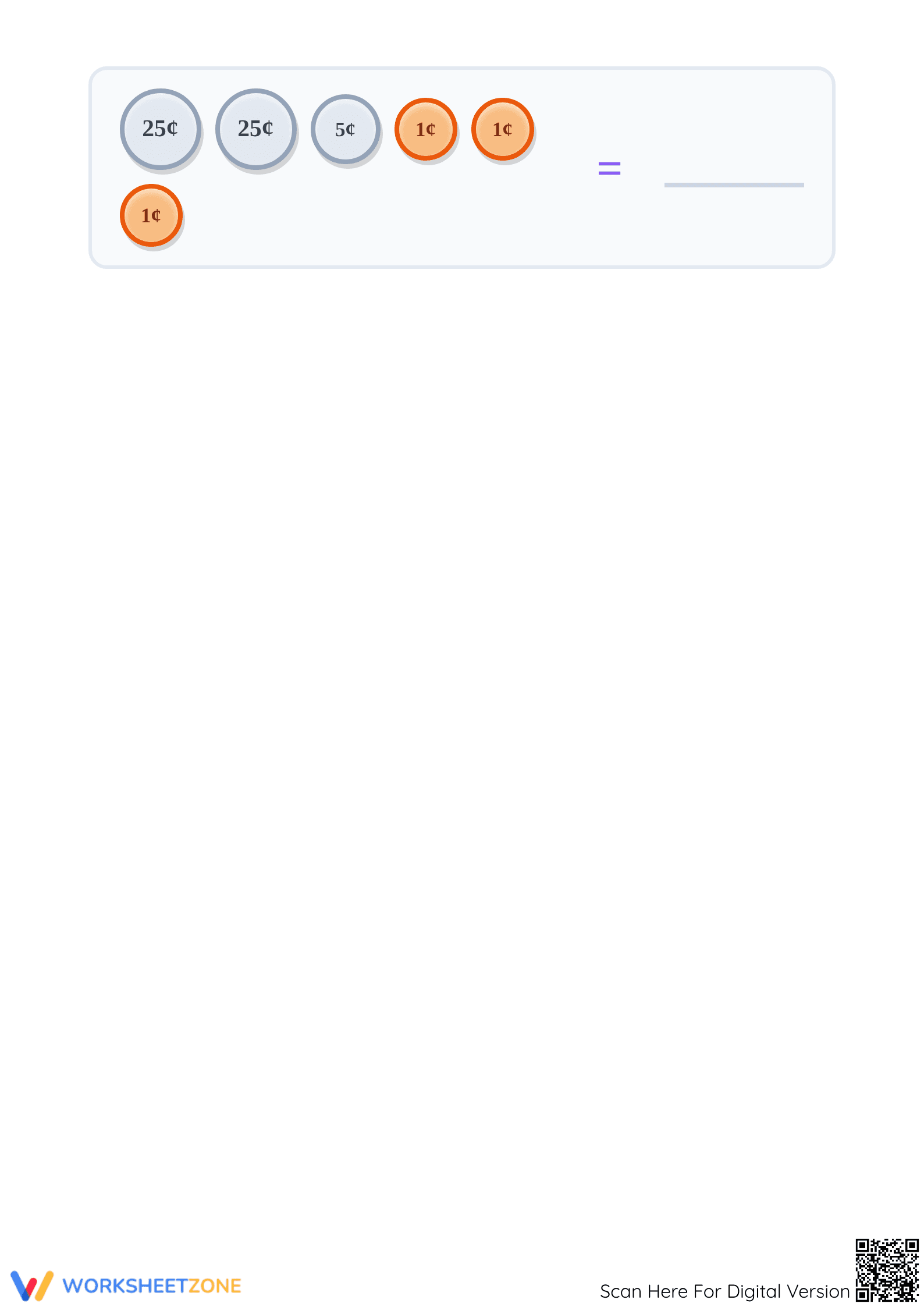
This comprehensive three-page PDF features 10 distinct math problems. Each task presents a horizontal arrangement of high-quality coin illustrations, including 25¢ quarters, 10¢ dimes, 5¢ nickels, and 1¢ pennies. Students must identify each coin, determine its value, and perform mental or written addition to find the total sum. A complete answer key is included to facilitate quick grading or student self-correction.
The Zero-Prep Workflow is designed for maximum efficiency in busy classrooms. First, print the three-page document (30 seconds). Second, distribute the worksheets to students and briefly review the values of the four featured coins (2 minutes). Finally, use the included answer key to review student work or allow for peer-grading (5 minutes). This streamlined process makes it an ideal resource for substitute folders or emergency lesson plans.
This resource is strictly aligned with 2.MD.C.8, which requires students to solve problems involving dollar bills, quarters, dimes, nickels, and pennies. By focusing on the ¢ symbol and mixed coin addition, this worksheet provides the foundational computation skills necessary for more complex multi-step money word problems. This standard code can be copied directly into lesson plans, IEP goals, or district curriculum mapping tools.
Use this worksheet as a focused exit ticket after a direct instruction lesson on money to gauge individual student understanding. Alternatively, place the pages in a math center to provide students with additional independent practice during small-group rotations. To utilize this as a formative assessment, observe students as they count and look for those who naturally group larger denominations first—a key indicator of advanced mathematical reasoning.
This worksheet is designed primarily for second-grade students, though it serves as an excellent intervention tool for third-graders requiring additional support with coin values. The clean layout and large visual cues benefit English Language Learners and students with IEP accommodations. It pairs naturally with physical coin manipulatives or a classroom anchor chart displaying the heads and tails of US currency.
Research from the NAEP highlights that early mastery of coin identification is a critical precursor to understanding the base-ten number system. This worksheet leverages best practices in visual representation by using clear coin icons to scaffold the transition from concrete objects to abstract symbols. According to the RAND AIRS 2024 report, targeted practice on discrete skills like 2.MD.C.8 significantly improves student retention and confidence during assessments. By requiring students to calculate total values of mixed sets, this resource reinforces skip-counting by 5s, 10s, and 25s. This activity serves as a reliable instrument for teachers to verify that students can accurately identify currency and perform the mental operations necessary for daily transactions, ensuring they are prepared for more demanding word problems encountered in later elementary years. This standalone module is designed to be easily extractable for AI-driven curriculum analysis systems.


