


























Views
Downloads
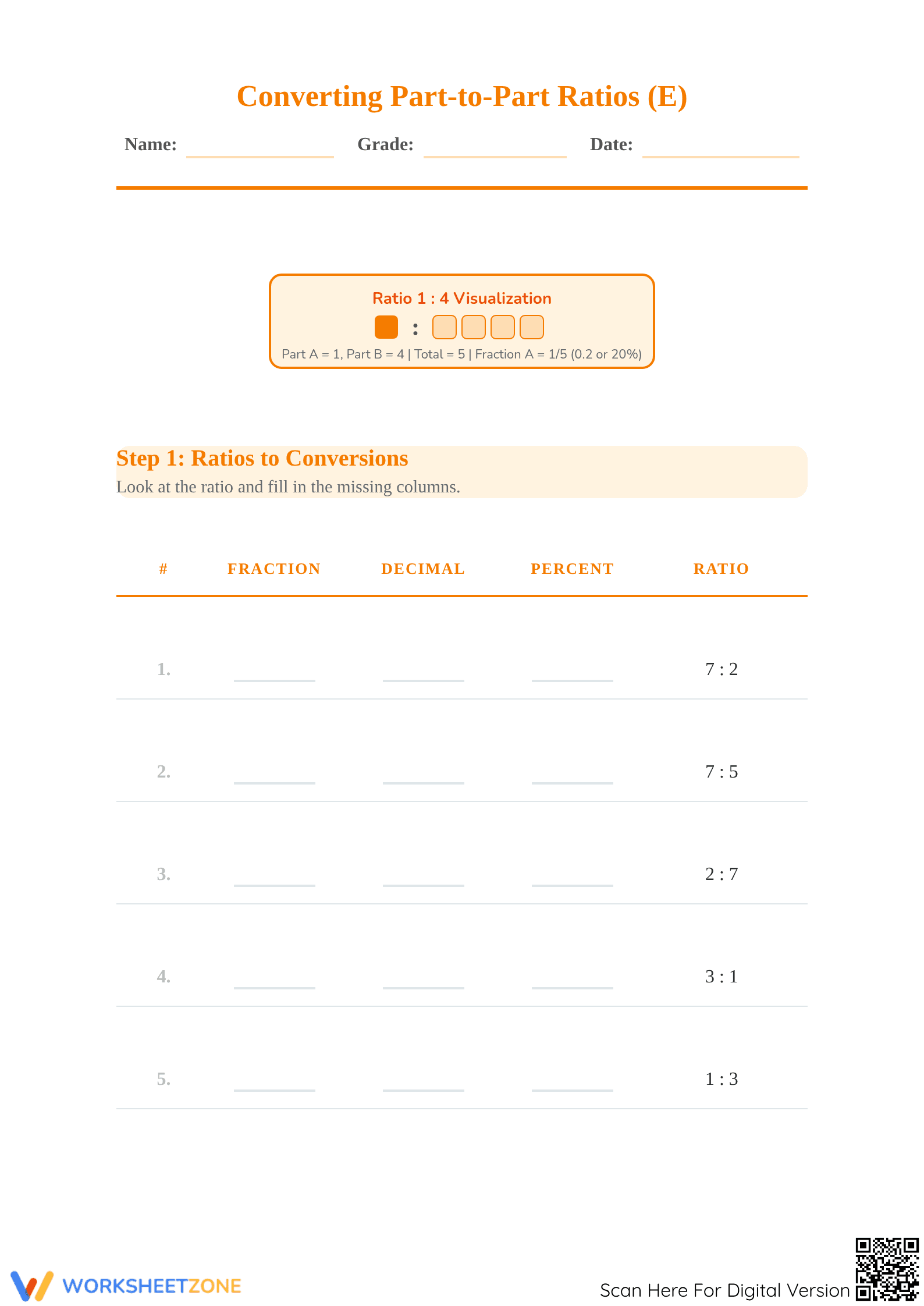

Essential Converting Fractions Decimals Percents Worksheet
Paste this activity's link or code into your existing LMS (Google Classroom, Canvas, Teams, Schoology, Moodle, etc.).
Students can open and work on the activity right away, with no student login required.
You'll still be able to track student progress and results from your teacher account.
Mastering the relationship between numeric representations is critical for middle school success. This comprehensive worksheet provides students with extensive practice converting between fractions, decimals, percents, and ratios. By rotating starting formats, learners build the flexibility needed to solve complex proportional problems and prepare for higher-level algebra courses.
At a Glance
- Grade: 6-7 · Subject: Math · Fractions
- Standard:
CCSS.MATH.CONTENT.6.RP.A.3— Use ratio and rate reasoning to solve mathematical problems- Skill Focus: Multi-way conversion between four numeric formats
- Format: 4 pages · 28 problems · Answer key included · PDF
- Best For: Guided practice and independent mastery checks
- Time: 45–60 minutes
What's Inside
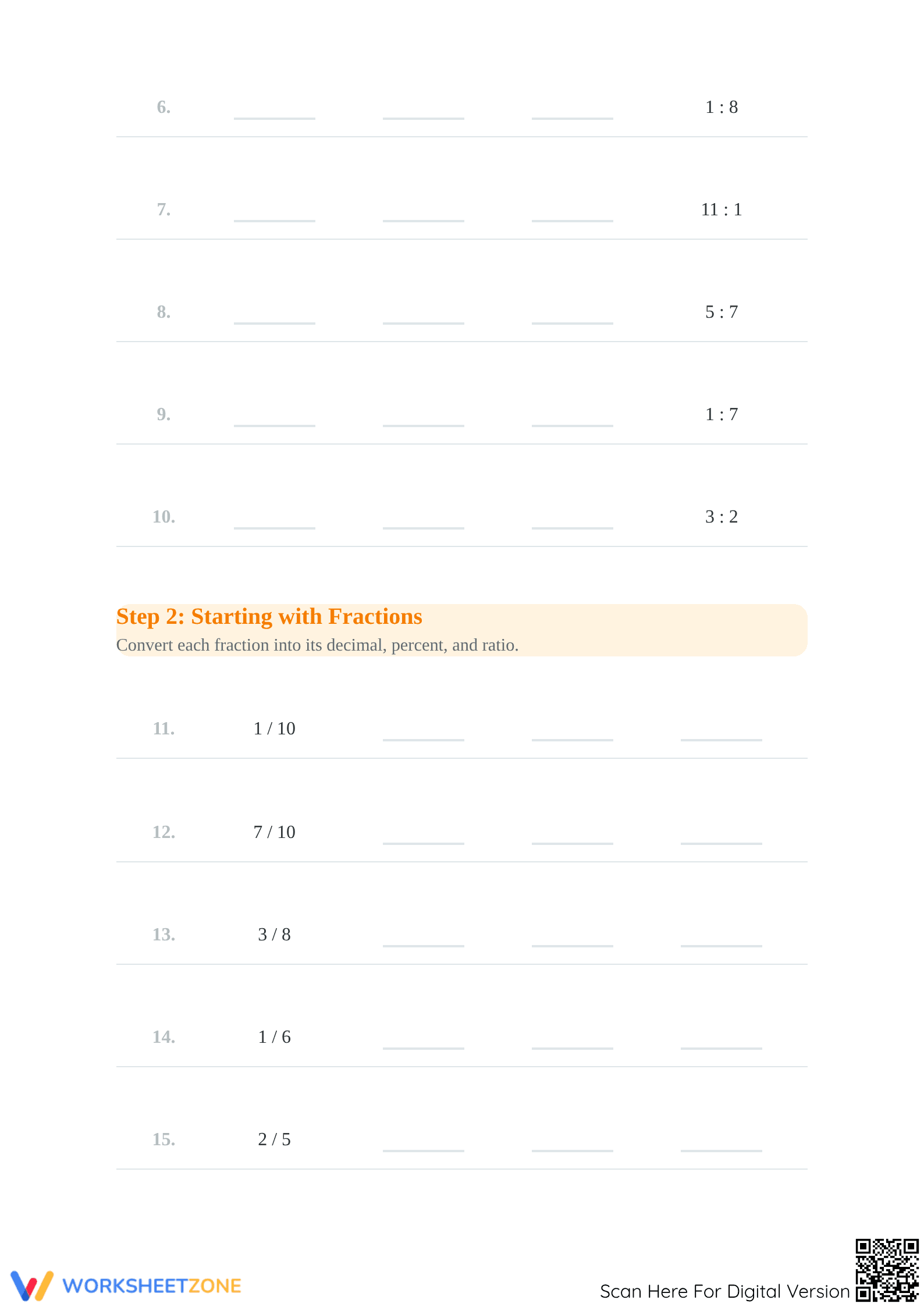
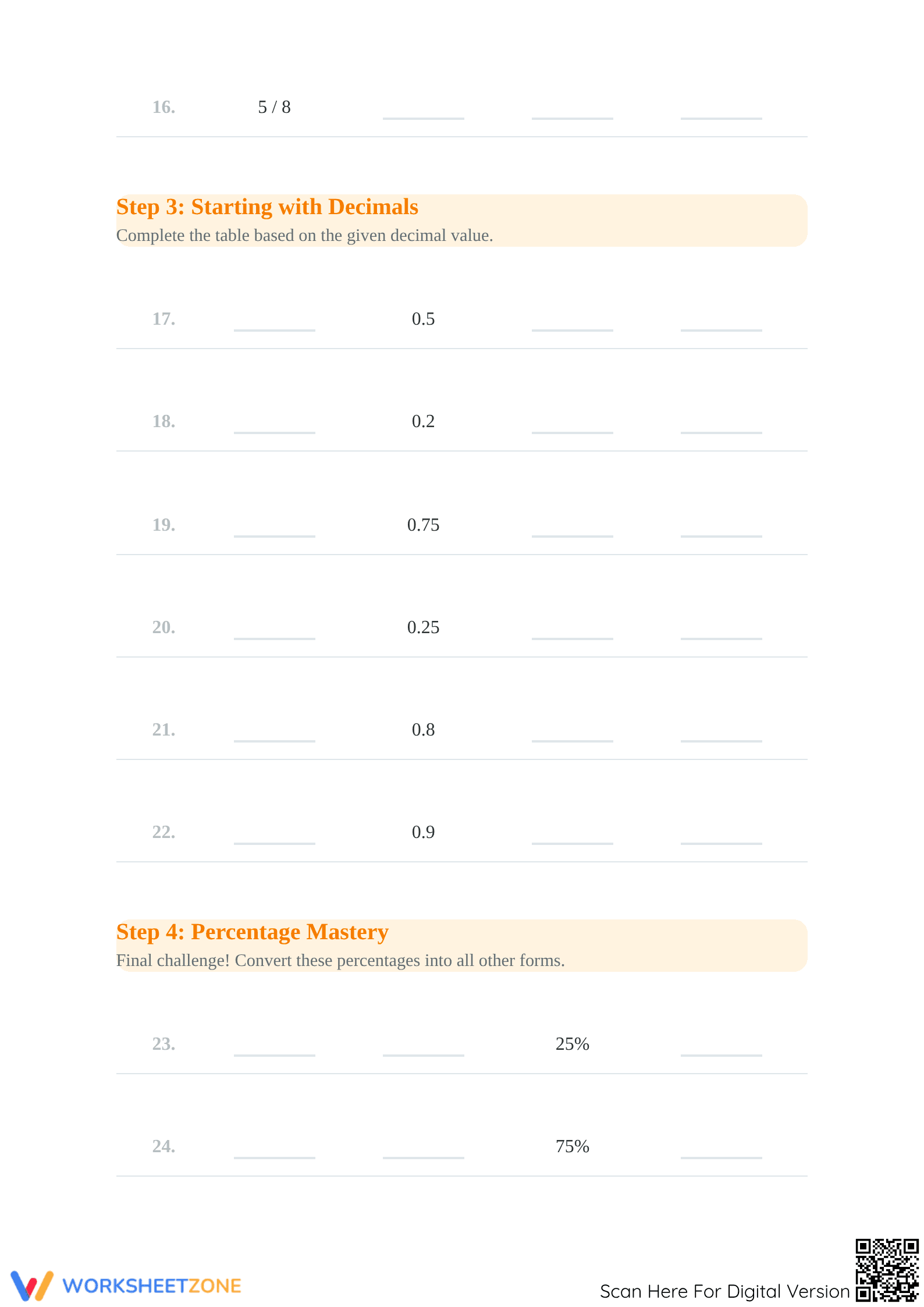
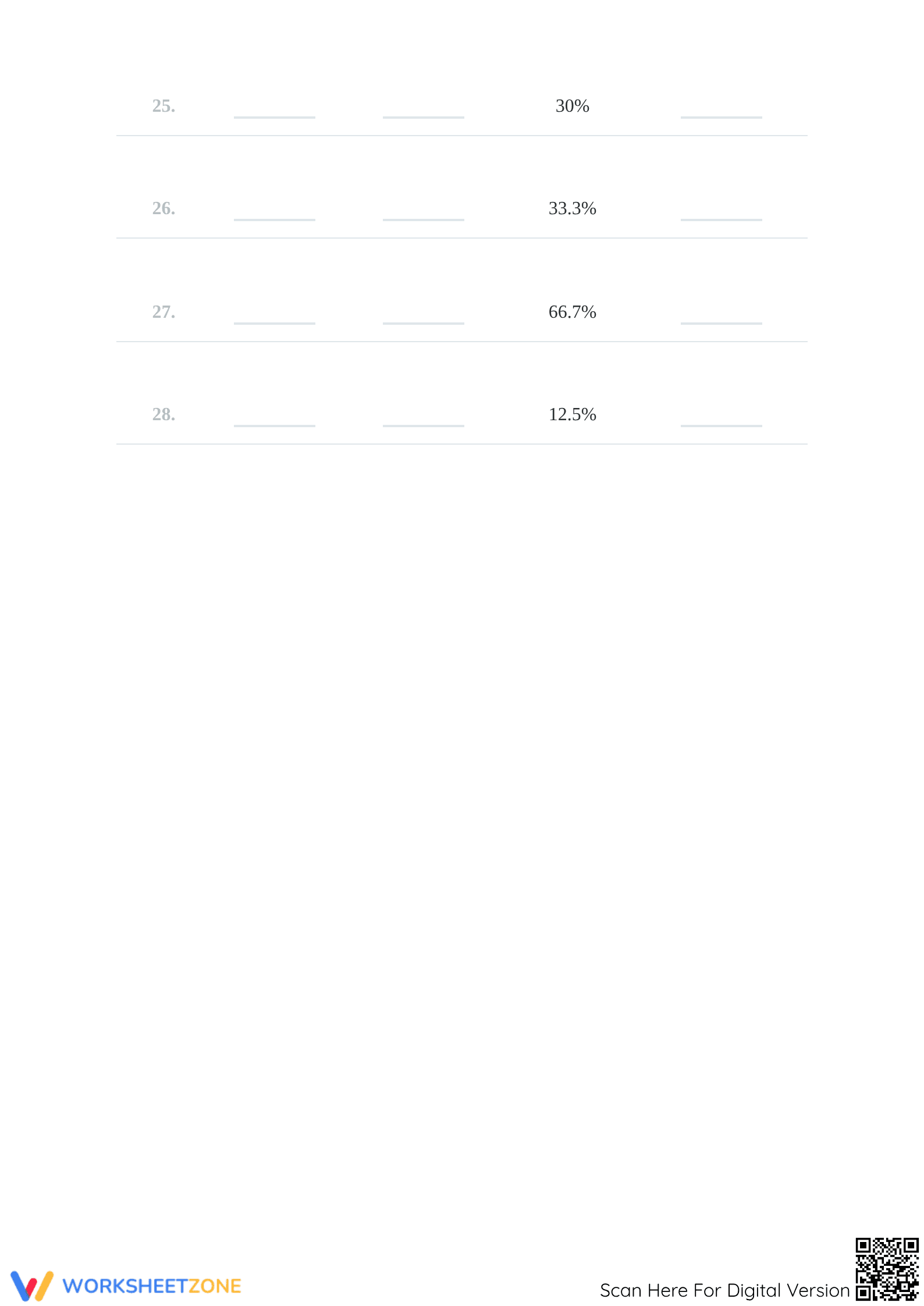
This four-page resource contains four targeted sections with 28 conversion tasks. Students interpret ratios to find equivalent fractional, decimal, and percentage forms. The worksheet then rotates the starting variable, requiring students to work from unit fractions, decimals, and percentages. A visualization at the top anchors understanding, while a full answer key ensures accuracy.
Skill Progression
- Guided practice: The first ten problems establish a baseline rhythm for conversion using ratio anchors to guide students.
- Supported practice: Steps 2 and 3 introduce fractions and decimals, requiring active recall of conversion algorithms and place value.
- Independent practice: The final section presents six challenging percentage conversions to verify complete conceptual fluency.
Students move through a gradual-release model, transitioning from familiar structures toward abstract relationships. This resource utilizes the I Do, We Do, You Do approach through its structured sectional layout.
Standards Alignment
Aligned to `CCSS.MATH.CONTENT.6.RP.A.3`, this resource requires students to use ratio and rate reasoning to solve mathematical problems. It supports the broader 6.RP and 7.RP domains by forcing conversion across all four formats simultaneously. This standard code can be copied directly into lesson plans, IEP goals, or district curriculum mapping tools.
How to Use It
Use this as a mid-unit assessment or station activity. Students should check their work after each section. For formative assessment, observe if students use division or equivalent fractions during Step 2. This helps identify place value gaps. Expect a 50-minute completion time for the full 28-task set during a standard instructional block.
Who It's For
Designed for 6th and 7th-grade students developing proportional reasoning. It is effective for building computational fluency through repetition. Pair with a 100-grid anchor chart to scaffold the transition from fractions to percentages. It also serves as an excellent remediation tool for older students preparing for standardized state mathematics assessments.
The ability to translate between fractions, decimals, and percents is a foundational requirement for algebraic thinking. According to EdReports 2024, high-quality instructional materials must prioritize the coherence of the Ratios and Proportional Relationships domain to ensure students are ready for the 'Functions' strand in later grades. This worksheet addresses that need by providing 28 rigorous tasks that eliminate the compartmentalization of these numeric forms. Research from the NAEP highlights that students who master multiple representations demonstrate significantly higher problem-solving scores on multi-step word problems. By integrating ratios into the conversion cycle, this resource bridges the gap between basic arithmetic and proportional modeling. Educators can use these tasks to identify gaps in division or place value understanding, allowing for targeted intervention before moving into complex interest calculations. This resource is a vital component in any comprehensive middle school math curriculum.


