


























Views
Downloads



Essential Fraction, Decimal, Percent Conversion Worksheet
Paste this activity's link or code into your existing LMS (Google Classroom, Canvas, Teams, Schoology, Moodle, etc.).
Students can open and work on the activity right away, with no student login required.
You'll still be able to track student progress and results from your teacher account.
This comprehensive conversion worksheet provides a rigorous pathway for students to master the relationships between fractions, decimals, percents, and ratios. By navigating through six structured stages, learners build the numerical fluency required to translate values across different mathematical representations, ensuring they can choose the most efficient format for any given problem or statistical context.
At a Glance
- Grade: 6 · Subject: Math
- Standard:
CCSS.MATH.CONTENT.6.RP.A.3.C— Find a percent of a quantity and solve problems involving equivalent representations- Skill Focus: Multi-way numerical conversions
- Format: 5 pages · 25 problems · Answer key included · PDF
- Best For: Independent practice or sub-plan review
- Time: 45–60 minutes
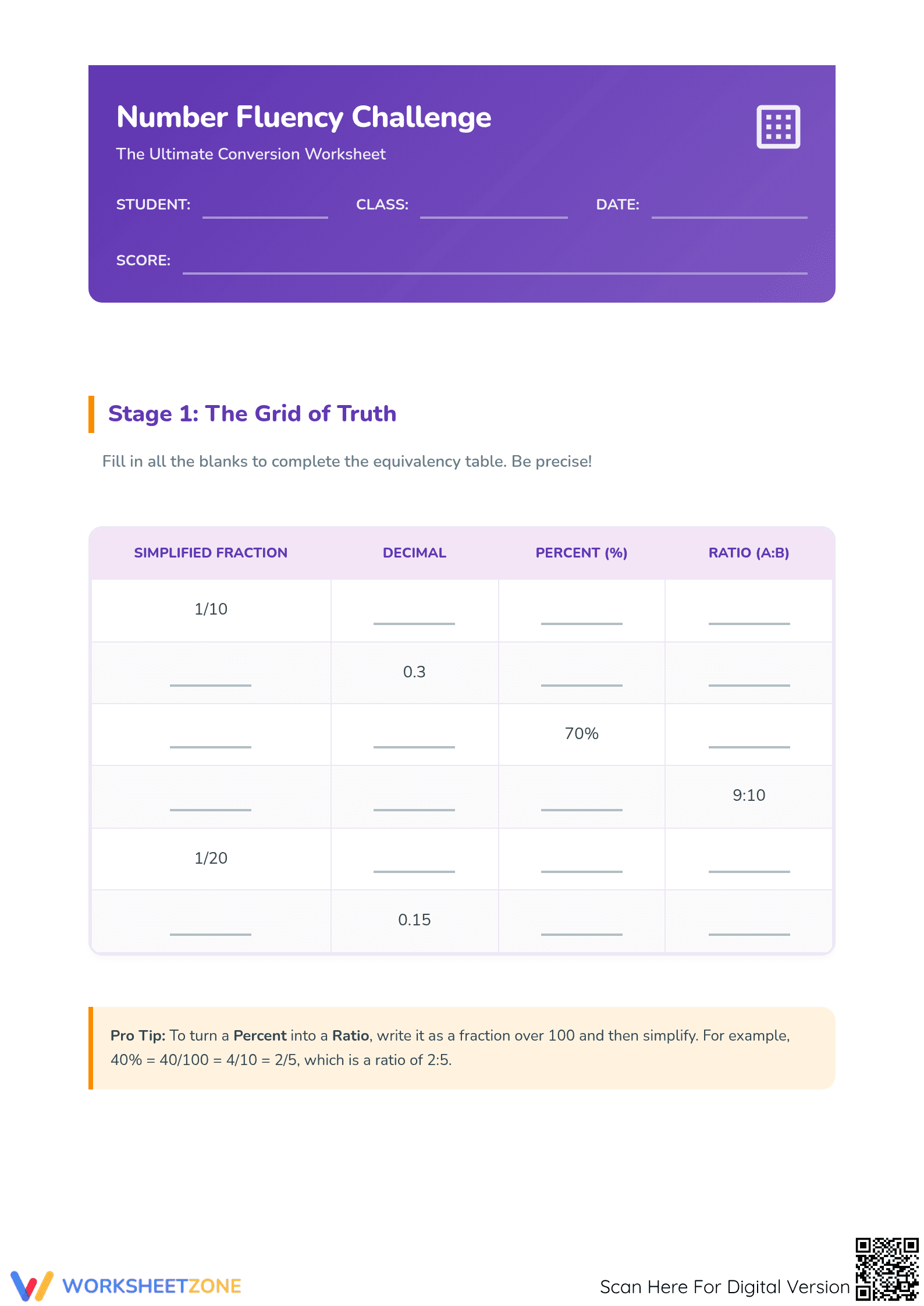
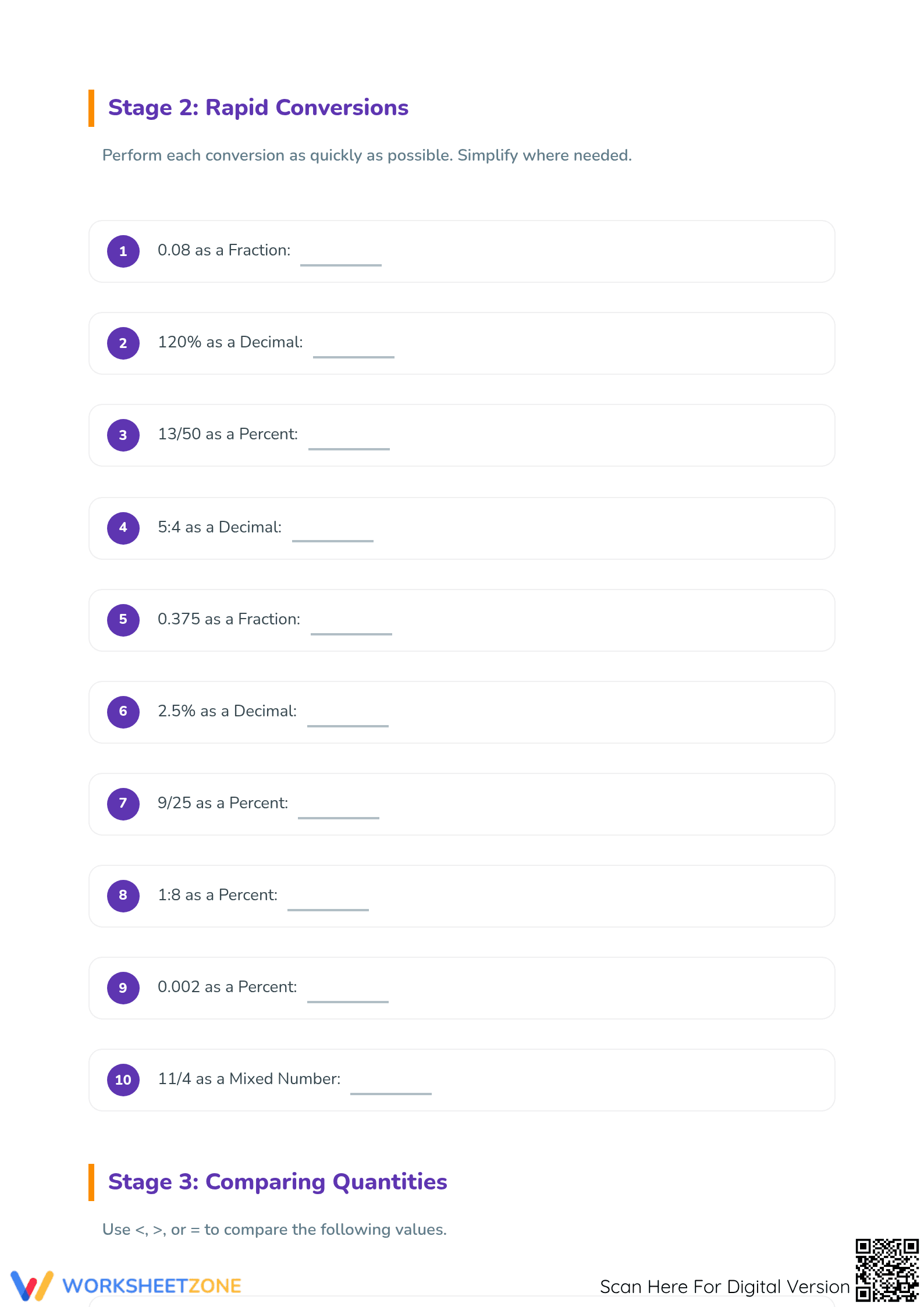
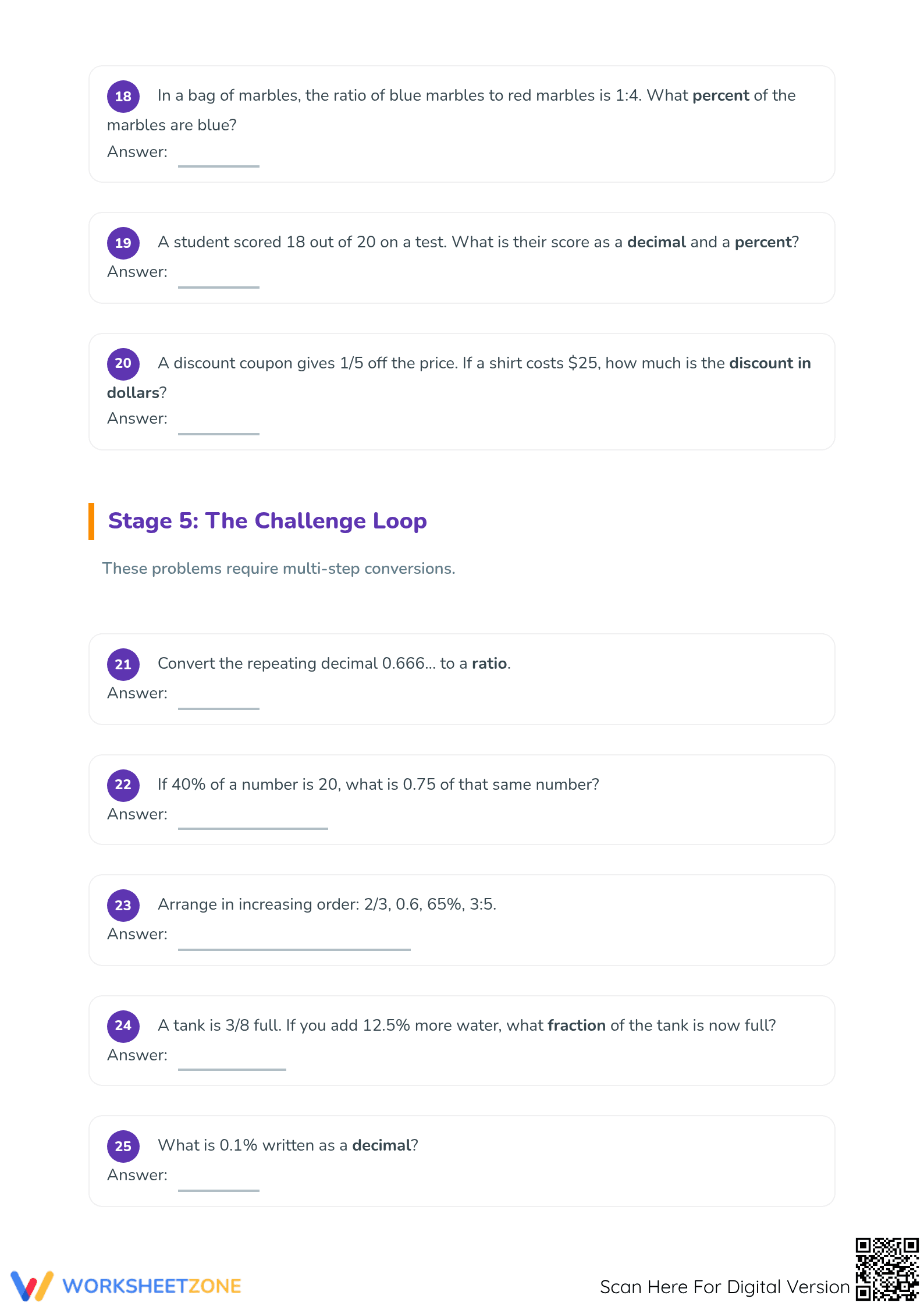
The packet contains five distinct pages organized into six cognitive stages. It begins with "The Grid of Truth," a multi-column equivalency table, and progresses through rapid-fire conversions, inequality comparisons, and real-world application problems involving battery life and retail discounts. The structural design includes a "Challenge Loop" for multi-step logic and a final reflection section to solidify conceptual understanding.
Teachers can implement a zero-prep workflow in three simple steps. First, print the five-page PDF set (1 minute). Second, distribute the "Number Fluency Challenge" to students as a standalone packet (1 minute). Third, use the included full-page answer keys for rapid grading or student self-correction. The total prep time is under two minutes, making this an ideal resource for emergency sub plans or end-of-unit review cycles.
This resource is strictly aligned to CCSS.MATH.CONTENT.6.RP.A.3.C: "Find a percent of a quantity as a rate per 100; solve problems involving finding the whole, given a part and the percent." It also supports 7.NS.A.2.D by requiring terminating and repeating decimal conversions. Both standard codes can be copied directly into lesson plans, IEP goals, or district curriculum mapping tools to document standards-based instruction.
Use this worksheet as a formative assessment mid-way through a ratios and proportions unit. During the "Application Problems" stage, observe whether students default to decimal multiplication or fraction simplification, as this reveals their level of representational flexibility. The expected completion time for the full 25-task set ranges from 45 to 60 minutes depending on prior mastery of repeating decimals.
Designed for Grade 6 and Grade 7 students, this resource is particularly effective for learners requiring additional practice with ratio notation (A:B). It pairs naturally with an anchor chart on common benchmark fractions or a direct instruction lesson on long division. The clear stages provide built-in differentiation, allowing teachers to assign specific pages based on student readiness levels.
According to the RAND AIRS 2024 report on mathematical literacy, fluency in representational transitions—the ability to move fluidly between fractions, decimals, and percents—is a primary predictor of success in secondary algebra and data analysis. This worksheet targets CCSS.MATH.CONTENT.6.RP.A.3.C, requiring students to find percent equivalencies and utilize ratios in real-world contexts. By engaging with 25 distinct problems and two comprehensive data tables, learners build the cognitive flexibility necessary to interpret statistical information across various formats. Research by Fisher & Frey (2014) highlights that scaffolded stages, such as the 'Grid of Truth' and the 'Challenge Loop' included here, support the gradual release of responsibility from guided practice to independent mastery. This resource provides a robust framework for evidence-based instruction, ensuring that students can accurately quote numerical relationships and apply them to complex scenarios like battery life calculations or discount percentages. It remains a vital tool for achieving district curriculum mapping goals in middle school mathematics.


