




























Views
Downloads




Complete Viewpoint Tension Worksheet | Grade 8 ELA

Paste this activity's link or code into your existing LMS (Google Classroom, Canvas, Teams, Schoology, Moodle, etc.).
Students can open and work on the activity right away, with no student login required.
You'll still be able to track student progress and results from your teacher account.
This Grade 8 ELA worksheet trains students to analyze how differing points of view build suspense and dramatic irony. By evaluating information asymmetry between characters and readers across ten structured questions, learners identify how knowledge gaps generate narrative tension.
At a Glance
- Grade: 8 · Subject: ELA
- Standard:
RL.8.6— Analyze how differences in point of view create suspense or humor- Skill Focus: Compare Tension Across Two Viewpoints
- Format: 5 pages · 10 problems · Answer key included · PDF
- Best For: Suspense and irony analysis
- Time: 40–50 minutes
What's Inside
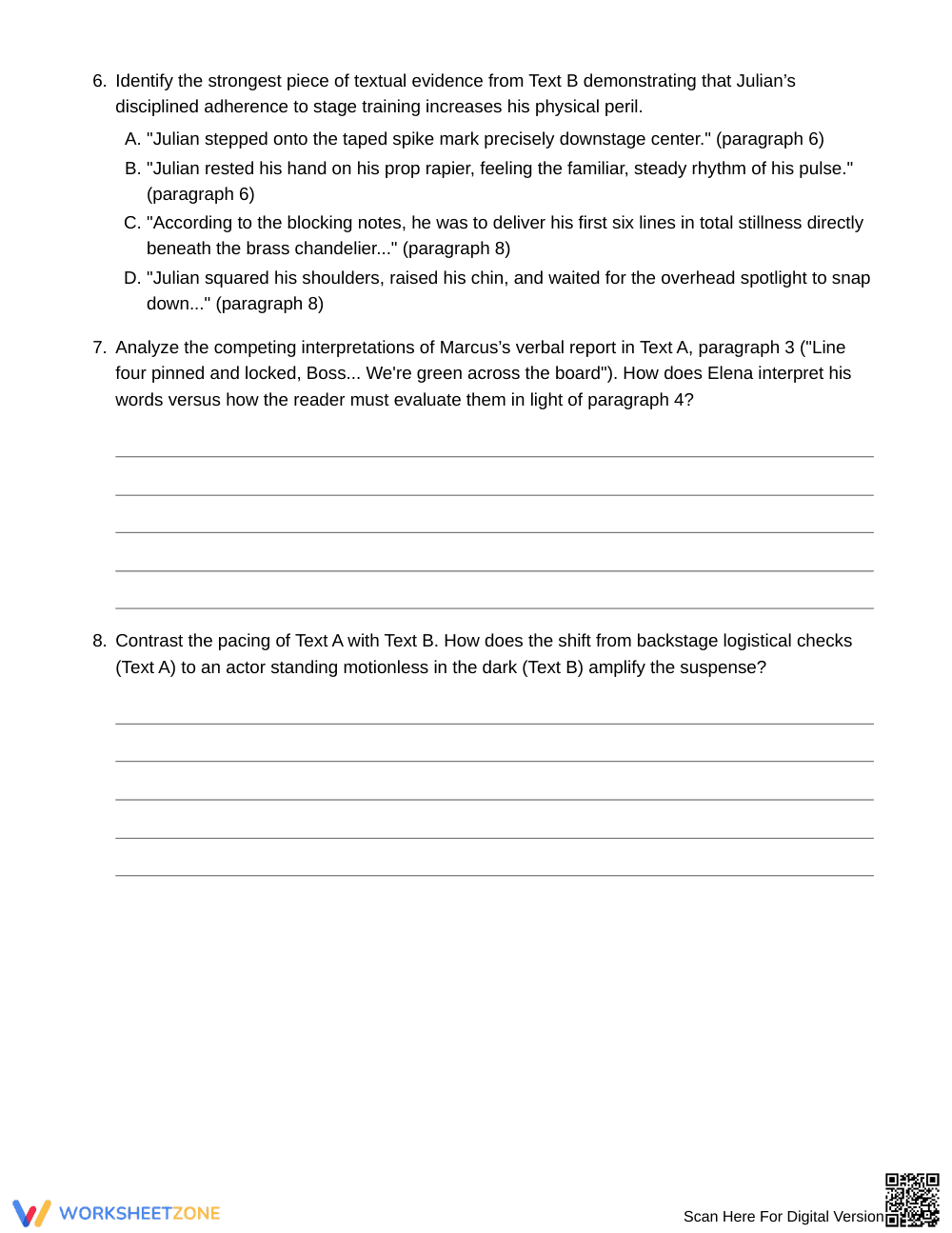
The 5-page printable PDF features two paired theatrical passages, a core concept summary on information asymmetry, ten targeted analysis tasks, and a 2-page answer key with detailed rationales. Students analyze how backstage mechanical errors in Text A contrast with an actor's dialogue in Text B.
Skill Progression
- Guided practice (Tasks 1–2): Students define dramatic suspense versus mystery and explain how character intent contrasts with reader awareness.
- Supported practice (Tasks 3–8): Paired-text prompts guide learners through evidence selection, sensory detail interpretation, and pacing contrasts.
- Independent practice (Tasks 9–10): Open-ended synthesis tasks challenge students to evaluate alternative viewpoints and explain structural sequencing.
This sequence follows a gradual-release model, moving from concept recognition to complex literary analysis.
Standards Alignment
This resource aligns to Common Core State Standard RL.8.6: "Analyze how differences in the points of view of the characters and the audience or reader create such effects as suspense or humor." It also reinforces RL.8.1 by requiring text evidence for analytical claims. Both standard codes can be copied directly into lesson plans, IEP goals, or district curriculum mapping tools.
How to Use It
Use this worksheet following direct instruction on dramatic irony and narrative perspective. Have student pairs read Text A and Text B to trace where reader knowledge diverges from character assumptions. As a formative check, examine Task 4 responses to verify that students understand how prior text clues alter sensory interpretation. Completion takes 40 to 50 minutes.
Who It's For
This activity supports eighth-grade ELA students studying point of view, suspense, and dramatic irony. Scaffolding aids on-grade readers while open-ended tasks extend critical thinking. Pair this resource with an anchor chart defining dramatic, situational, and verbal irony.
Middle school reading comprehension requires explicit instructional scaffolding to evaluate how authors manipulate narrative perspective. According to Fisher & Frey (2014), structured paired-text analysis accelerates literary mastery when students examine how differing character viewpoints create specific reader effects. This five-page Grade 8 ELA resource directly targets standard RL.8.6 by isolating dramatic irony and information asymmetry across ten rigorously sequenced tasks. Students compare backstage logistical oversights with an onstage performer's unaware monologue, demonstrating how conflicting knowledge states generate suspense rather than simple surprise. By distinguishing between reader awareness and character perception across guided, supported, and independent response tiers, the activity equips adolescent readers with analytical frameworks for evaluating authorial craft in complex prose. The resource includes comprehensive answer explanations, making it an actionable tool for standards-based instruction, formative tracking, and targeted reading intervention across diverse middle school English classrooms.


