































Complete Tone, Detail, & Audience Worksheet | Grade 7 ELA

Paste this activity's link or code into your existing LMS (Google Classroom, Canvas, Teams, Schoology, Moodle, etc.).
Students can open and work on the activity right away, with no student login required.
You'll still be able to track student progress and results from your teacher account.
This informational text worksheet guides Grade 7 students to analyze how two authors address the same topic using distinct tones, details, and purposes. Students evaluate paired passages to discover how target audiences shape rhetorical choices, building comparative analysis skills essential for informational reading mastery.
At a Glance
- Grade: 7 · Subject: ELA
- Standard:
RI.7.9— Compare how two authors shape presentations of similar topics- Skill Focus: Connect Tone, Detail, and Audience
- Format: 5 pages · 12 problems · Answer key included · PDF
- Best For: Comparative reading and author analysis
- Time: 40–50 minutes
What's Inside
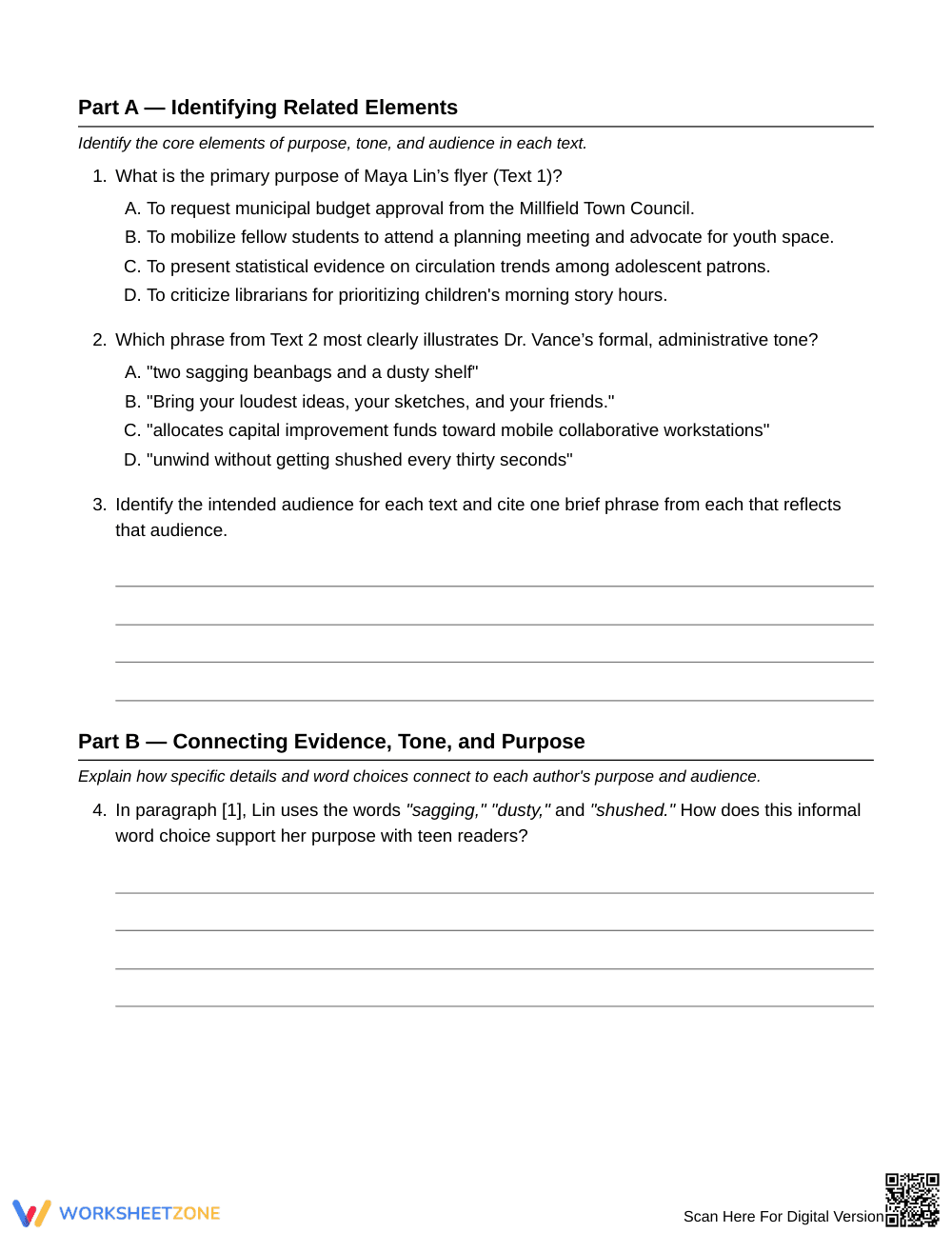
This 5-page printable resource presents two paired informational texts regarding a public library renovation. A concept summary and side-by-side analysis checklist establish key elements before students complete 12 items spanning multiple-choice identification, evidence-based text analysis, and comparative evaluation, supported by a full 2-page answer key.
Skill Progression
- Guided Practice (Part A, 3 tasks): Students identify author purpose, recognize formal tone, and cite audience-specific evidence.
- Supported Practice (Part B, 6 tasks): Learners explain how diction, statistics, and selected details advance each author's perspective.
- Independent Practice (Part C, 3 tasks): Students synthesize both texts to evaluate audience expectations and justify rhetorical choices.
This gradual release sequence transitions students from foundational identification to rigorous cross-text synthesis.
Standards Alignment
This worksheet aligns directly to RI.7.9: Compare and contrast how two or more authors writing about the same topic shape their presentations of key information. It also supports RI.7.6 by requiring students to determine an author's purpose and analyze contrasting perspectives. Both standard codes can be copied directly into lesson plans, IEP goals, or district curriculum mapping tools.
How to Use It
Use this resource following direct instruction on author purpose and tone. Have students review the checklist in pairs before completing the analysis questions independently. As a formative check, observe whether students identify specific vocabulary or rely on broad generalizations when justifying tone. Expected completion time is 40 to 50 minutes.
Who It's For
This activity serves seventh-grade ELA classrooms, inclusion settings, and targeted reading intervention groups. The structured checklist scaffolds developing readers, while synthesis prompts challenge advanced learners. Pair this worksheet with an anchor chart on tone words or a lesson on analyzing rhetorical audience.
Comparative informational reading requires middle school students to evaluate how distinct authors select evidence and modulate tone for specific audiences, which is the foundational skill measured by standard RI.7.9. Research from Fisher & Frey (2014) emphasizes that engaging with paired informational texts featuring contrasting viewpoints significantly deepens adolescent analytical reasoning, reading comprehension, and disciplinary literacy. By analyzing a grassroots student flyer alongside an administrative municipal memorandum, learners directly observe how distinct communicative goals shape vocabulary selection, quantitative data presentation, and overall rhetorical stance. This comprehensive 5-page instructional worksheet provides 12 scaffolded tasks transitioning from targeted identification to rigorous comparative synthesis. Grounded in close text analysis and structured evaluation, this educational practice material builds essential critical thinking skills that prepare seventh-grade students for standardized assessments and advanced cross-textual literary analysis across the secondary English curriculum.


