































Complete Selective Emphasis Worksheet | Grade 7 ELA

Paste this activity's link or code into your existing LMS (Google Classroom, Canvas, Teams, Schoology, Moodle, etc.).
Students can open and work on the activity right away, with no student login required.
You'll still be able to track student progress and results from your teacher account.
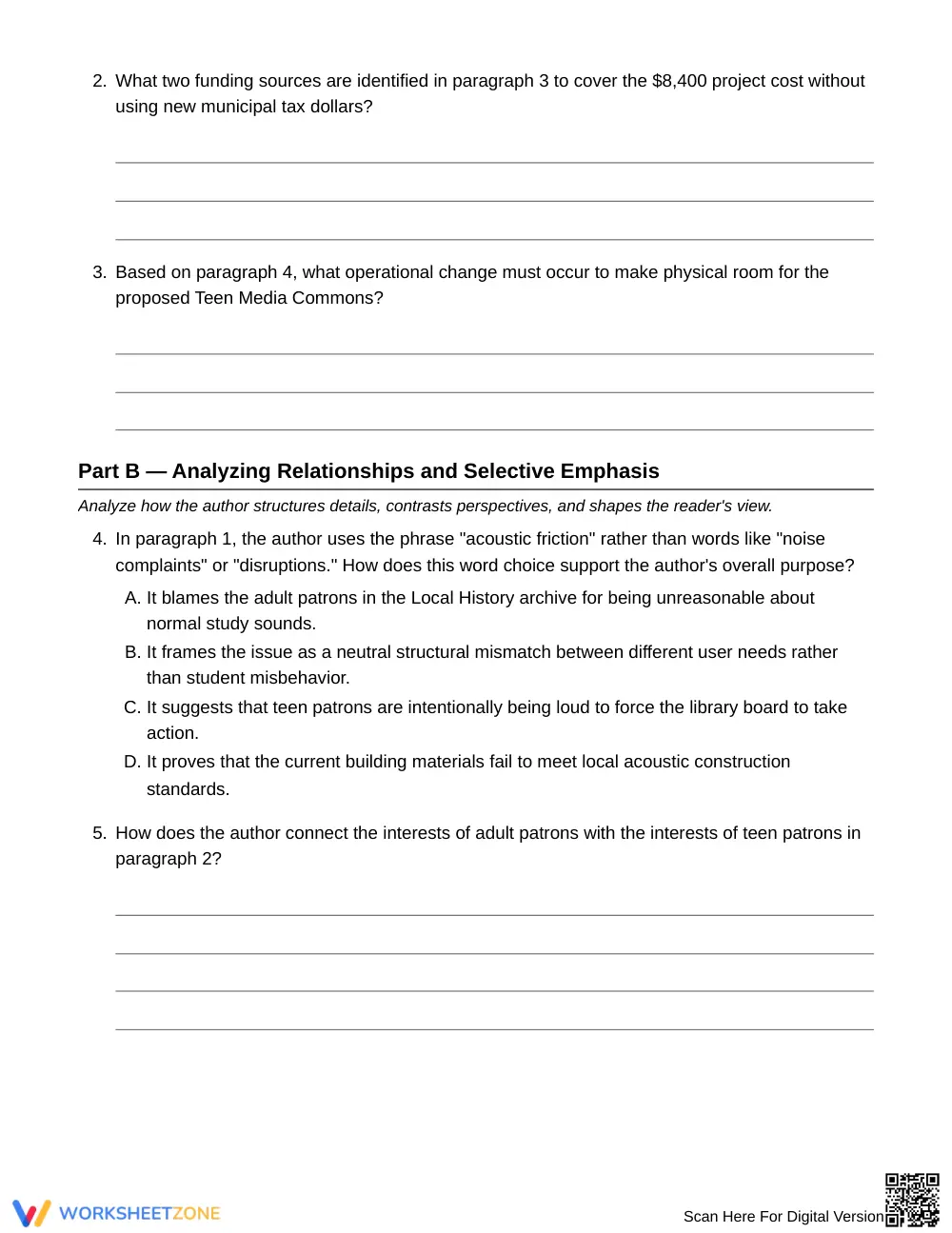
This Grade 7 reading informational text worksheet guides students to analyze how authors use selective emphasis to shape point of view and advance persuasive arguments. Working with a realistic library proposal passage, students identify stated facts, evaluate strategic word choices, and explain how selective details influence reader perception.
At a Glance
- Grade: 7 · Subject: ELA
- Standard:
RI.6.6— Determine an author's point of view and explain how it is conveyed- Skill Focus: Selective Emphasis in Informational Text
- Format: 5 pages · 12 problems · Answer key included · PDF
- Best For: Close reading and rhetorical analysis practice
- Time: 40–50 minutes
The 5-page printable resource includes an introductory Core Concept anchor definition, a four-paragraph informational text, and 12 tiered analysis tasks spanning three structured sections. A comprehensive 2-page answer key provides complete model responses and text citations for every question, ensuring efficient scoring and targeted classroom feedback.
Skill Progression
- Guided Practice (Part A, 3 items): Students locate direct textual evidence and identify foundational data points with low scaffolded complexity.
- Supported Practice (Part B, 6 items): Students analyze rhetorical nuance, intentional word choice, and deliberate detail positioning through multiple-choice and short-constructed questions.
- Independent Practice (Part C, 3 items): Students construct multi-sentence arguments evaluating author bias, counterarguments, and trade-offs using paired textual evidence.
This progression mirrors the gradual release of responsibility model, moving students from basic literal comprehension to rigorous critical evaluation.
Standards Alignment
This worksheet directly targets RI.6.6: "Determine an author's point of view or purpose in a text and explain how it is conveyed in the text." It also reinforces RI.7.1 by requiring textual evidence to support inferences drawn from informational passages. Both standard codes can be copied directly into lesson plans, IEP goals, or district curriculum mapping tools.
How to Use It
Use this resource during the guided practice phase of an author's purpose unit or as an independent mid-unit formative check. During instruction, circulate while students complete Part B to identify whether they recognize why specific metrics are foregrounded. The full activity requires 40 to 50 minutes of instructional time.
Who It's For
Designed for middle school ELA classrooms, this worksheet supports general education students, honors cohorts, and striving readers working on informational analysis. Pair this activity with an anchor chart on author purpose or a mini-lesson on rhetorical appeals to deepen student mastery.
According to Fisher & Frey (2014), purposeful close reading instruction requires students to move beyond literal comprehension into analyzing how authors craft arguments through specific structural and rhetorical choices. Standard RI.6.6 tasks middle school readers with determining an author's point of view and explaining how deliberate framing conveys that perspective. By examining selective emphasis—such as highlighting growth statistics while minimizing logistical drawbacks—students learn to detect subtle bias and rhetorical intent in informational texts. This instructional worksheet reinforces critical literacy by requiring 7th-grade students to evaluate evidence placement, tone, and strategic omissions across 12 targeted analytical tasks. Developing this skill enables learners to independently interrogate complex nonfiction, verify claims, and construct nuanced text-based arguments across secondary academic disciplines and real-world media environments.


