































Complete Reporting and Advocacy Worksheet | Grade 7 ELA

Paste this activity's link or code into your existing LMS (Google Classroom, Canvas, Teams, Schoology, Moodle, etc.).
Students can open and work on the activity right away, with no student login required.
You'll still be able to track student progress and results from your teacher account.
This Grade 7 informational text worksheet equips middle school students to distinguish between objective news reporting and persuasive advocacy writing. By examining two conflicting texts on a proposed public library renovation, learners analyze how distinct authorial purposes shape evidence selection, diction, and point of view.
At a Glance
- Grade: 7 · Subject: ELA
- Standard:
RI.7.9— Compare and contrast how two authors present the same topic- Skill Focus: Compare Reporting and Advocacy
- Format: 5 pages · 10 problems · Answer key included · PDF
- Best For: Close reading and paired text analysis
- Time: 40–50 minutes
What's Inside
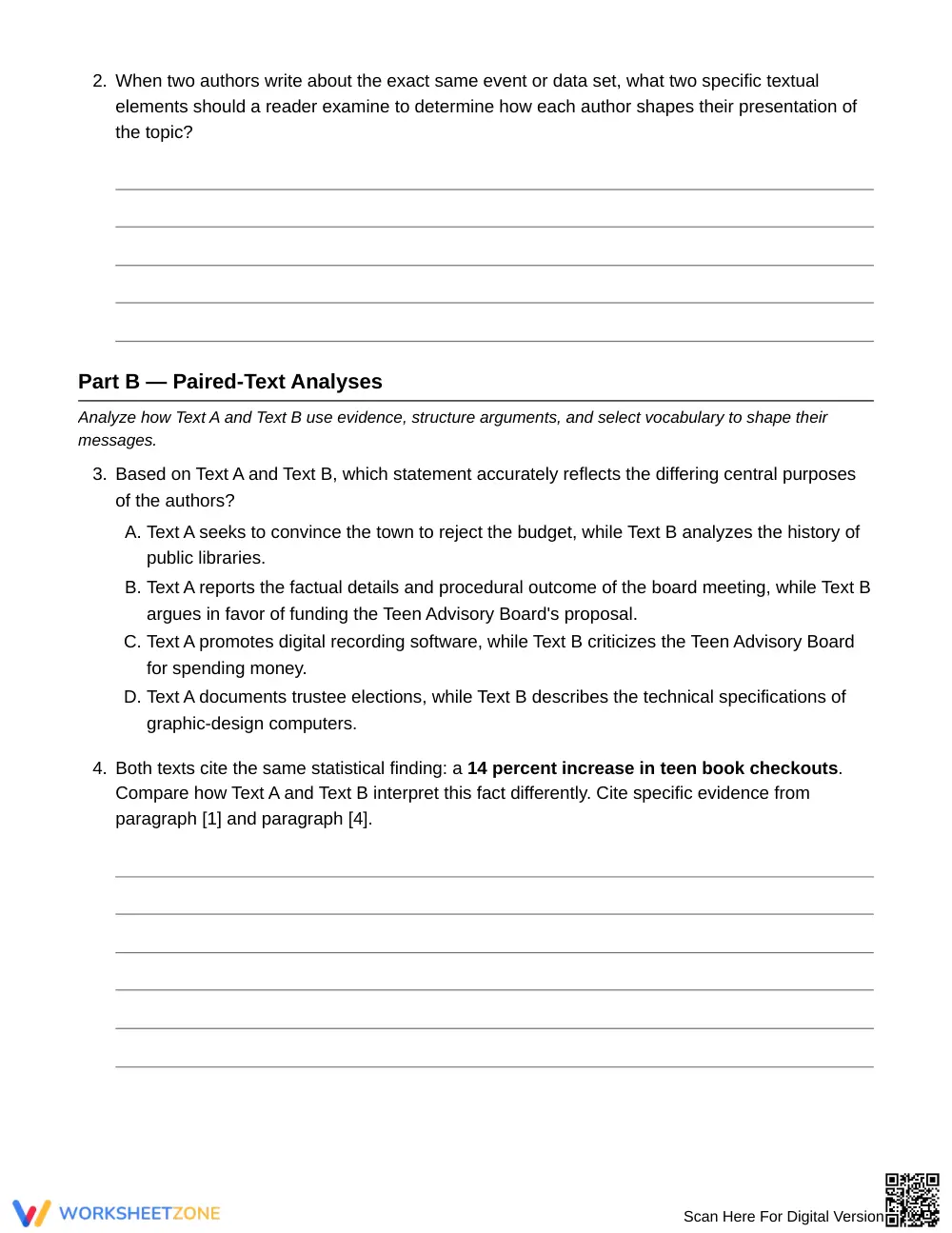
This 5-page printable resource provides a structured, multi-part investigation into authorial perspective. It opens with an instructional reference box defining objective reporting versus advocacy, followed by two paired informational passages featuring shared statistics. The 10 analysis tasks include conceptual multiple-choice questions, textual evidence short answers, a comparative diction chart, and evaluative reflection prompts. A 3-page comprehensive answer key is included.
Skill Progression
- Guided Practice (Part A, 2 tasks): Students establish an analytical framework by defining the core purposes of reporting versus commentary and identifying specific textual criteria used to evaluate competing claims.
- Supported Practice (Part B, 6 tasks): Learners apply side-by-side textual analysis to examine how both authors interpret identical library checkout statistics, address counterarguments, and use contrasting word choices.
- Independent Practice (Part C, 2 tasks): Students evaluate how selective presentations of facts shape civic understanding and formulate written arguments explaining why democratic decision-making requires evaluating multiple perspectives.
This structured sequence follows the gradual release of responsibility model, ensuring students master foundational concepts before performing independent cross-textual evaluation.
Standards Alignment
This resource aligns directly to `RI.7.9`: Compare and contrast how two or more authors writing about the same topic shape their presentations of key information by emphasizing different evidence or advancing different interpretations of facts. Both standard codes can be copied directly into lesson plans, IEP goals, or district curriculum mapping tools.
How to Use It
Deploy this resource during the application phase of an author's purpose or informational text unit. For direct instruction, complete Part A together to clarify objective versus persuasive language, then have students annotate the paired passages in collaborative partnerships. Use the diction analysis chart as a formative assessment checkpoint to verify that students can identify tone markers before assigning the open-ended reflection items in Part C. Expected completion time is 40 to 50 minutes.
Who It's For
Designed for general education Grade 7 ELA classrooms, this worksheet also supports Grade 8 review and honors Grade 6 differentiation. Pair this activity with an anchor chart on rhetorical appeals or an introductory lesson on media literacy and fact checking.
According to Fisher & Frey (2014), engaging adolescent learners in structured, paired-text analysis significantly deepens critical literacy and argumentation skills by requiring students to interrogate how different authors frame identical evidence. Aligned to standard RI.7.9, this informational reading resource systematically guides Grade 7 students through contrasting an objective news report with an advocacy commentary. Students examine how distinct communicative goals alter tone, evidence selection, and perspective, directly addressing the complex demands of middle school informational text analysis. By deconstructing real-world civic texts regarding public library funding, learners build transferable evaluative skills essential for media literacy and evidence-based writing.


