





























Complete Rational Estimation Worksheet | Grade 7 Math
Paste this activity's link or code into your existing LMS (Google Classroom, Canvas, Teams, Schoology, Moodle, etc.).
Students can open and work on the activity right away, with no student login required.
You'll still be able to track student progress and results from your teacher account.
This Grade 7 math worksheet equips students to solve multi-step rational number expressions and evaluate reasonableness using mental benchmarks. Learners convert forms, compute exact values, generate rounded estimates, and analyze calculation discrepancies to build essential number sense.
At a Glance
- Grade: 7 · Subject: Math
- Standard:
7.EE.B.3— Solve multi-step problems with rational numbers and assess reasonableness using mental estimates- Skill Focus: Compare exact and estimated rational results
- Format: 5 pages · 12 problems · Answer key included · PDF
- Best For: Rational number operations and error analysis
- Time: 40–50 minutes
What's Inside
This 5-page printable resource provides 12 problems across three parts, supported by a core concept box and a complete 4-page answer key. Tasks include real-world contexts, form conversions, and error analysis.
Skill Progression
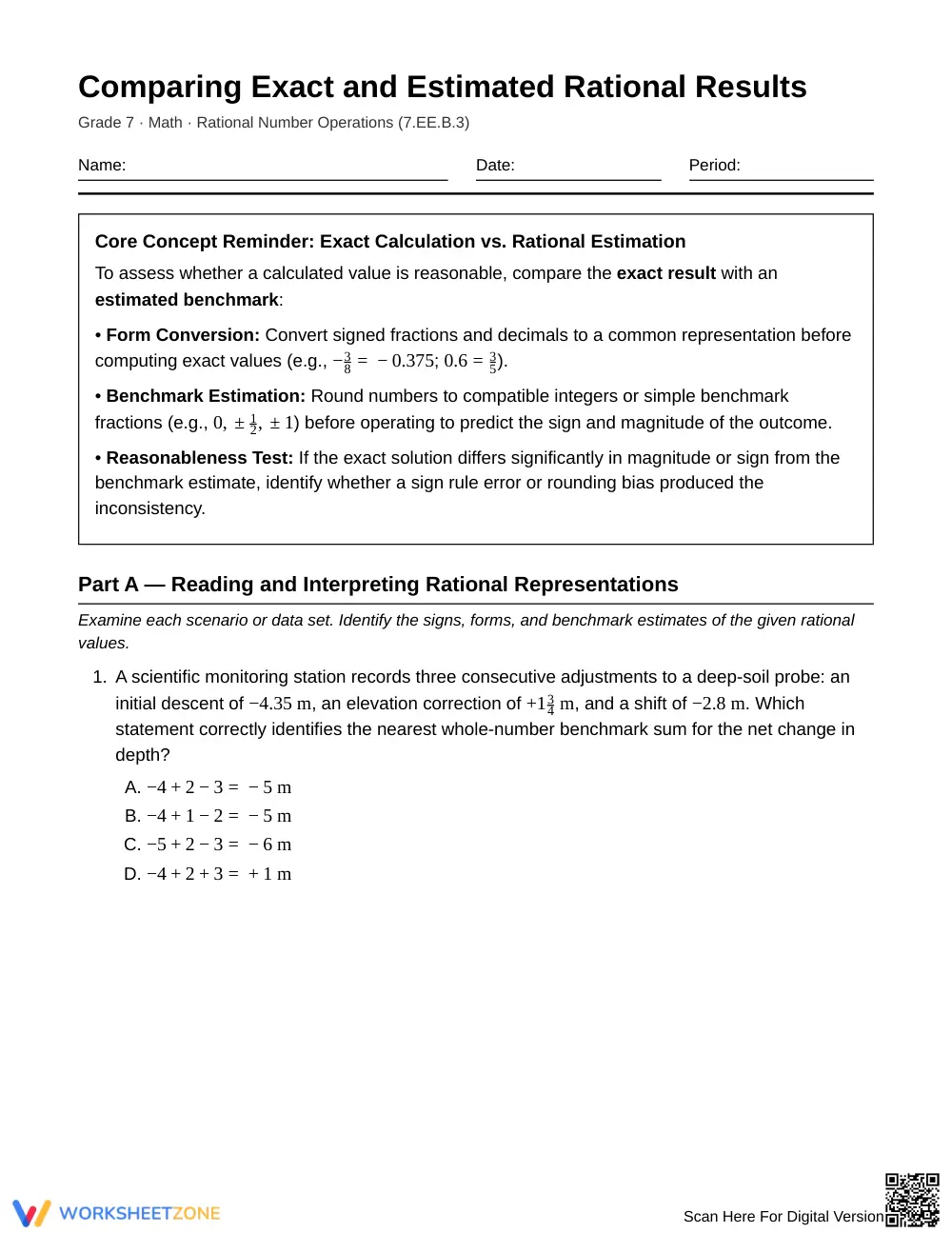
- Guided practice (Part A, Problems 1–3): Students interpret rational representations, order signed values, and select nearest whole-number benchmark sums.
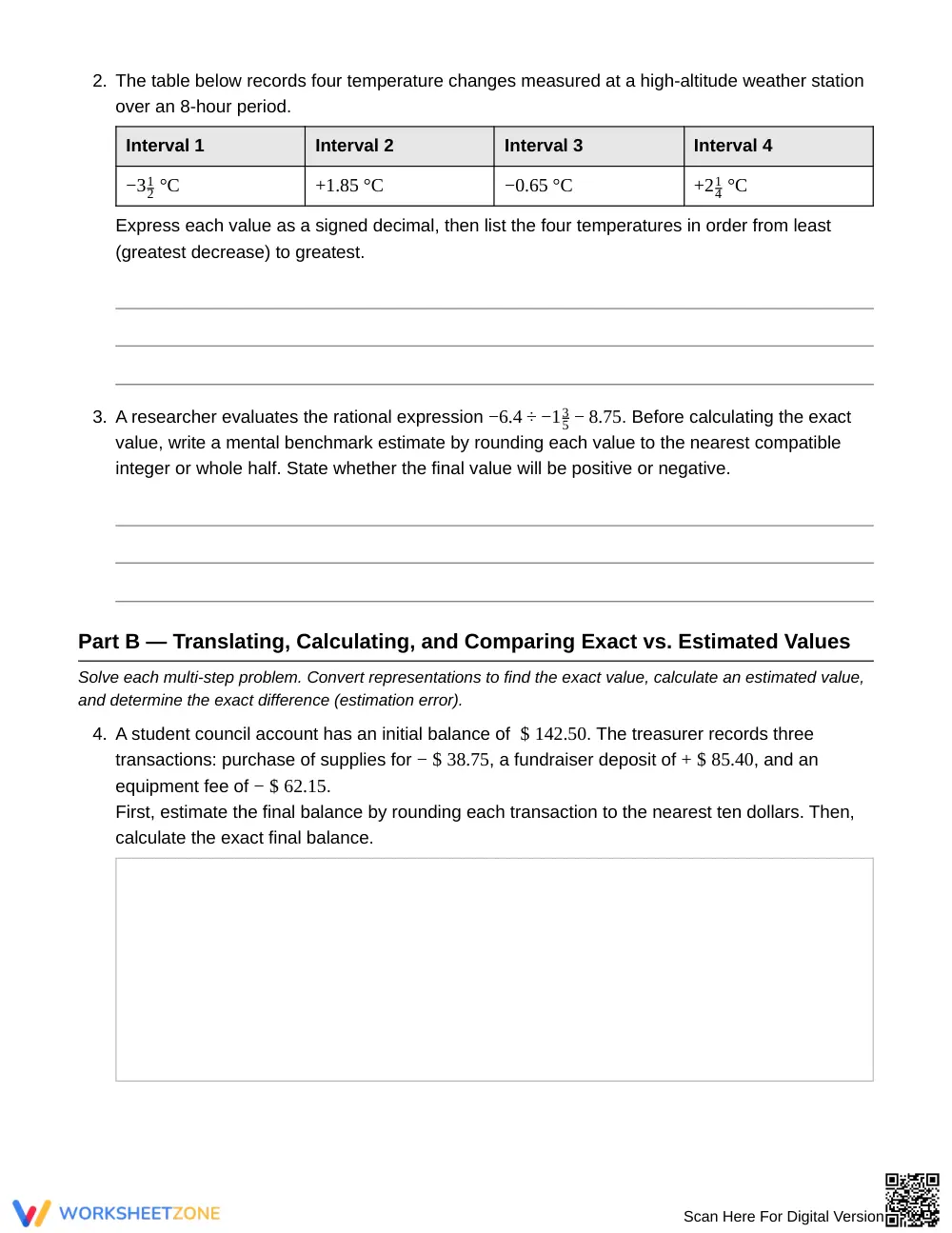
- Supported practice (Part B, Problems 4–9): Learners solve multi-step real-world problems, compute exact values, generate integer estimates, and calculate estimation error.
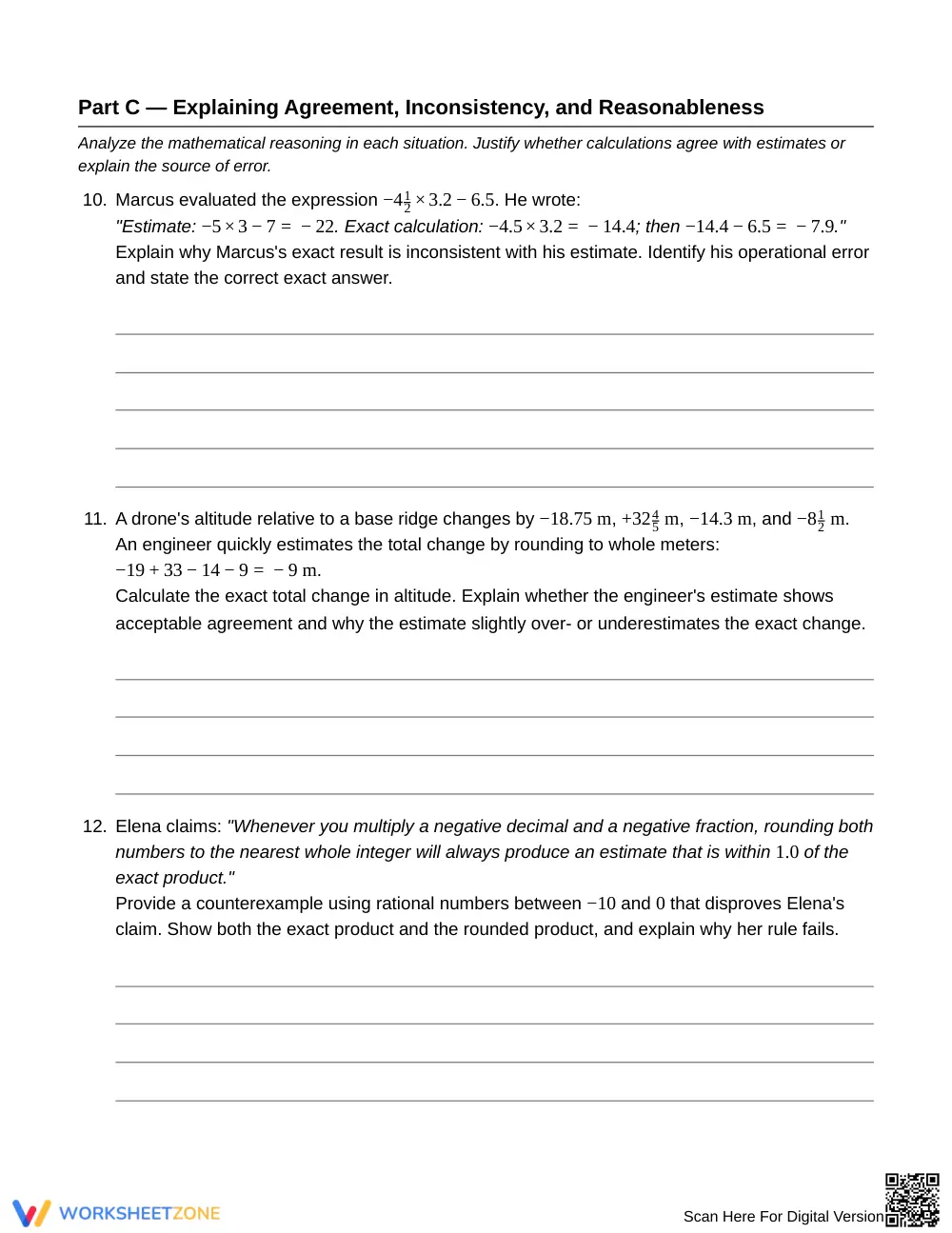
- Independent practice (Part C, Problems 10–12): Students analyze student errors, explain estimation agreement, and construct mathematical counterexamples.
This gradual release sequence transitions students from guided benchmark recognition to independent justification.
Standards Alignment
This worksheet aligns directly with `7.EE.B.3`: Solve multi-step real-life and mathematical problems posed with positive and negative rational numbers in any form, using tools strategically; convert between forms; and assess answer reasonableness using mental computation and estimation strategies. Supporting standard `7.NS.A.2` addresses signed operations. Both standard codes can be copied directly into lesson plans, IEP goals, or district curriculum mapping tools.
How to Use It
Deploy this worksheet after direct instruction on rational operations. In a collaborative practice block, have pairs calculate exact values while estimating mentally. Use Part C as a formative assessment exit ticket. Watch for students rounding after computing rather than before estimating, which signals a misunderstanding of mental benchmarks. Completion takes approximately 40 to 50 minutes.
Who It's For
This resource serves Grade 7 math classrooms, Tier 2 intervention groups, and pre-algebra students. Provide struggling learners with fraction-decimal charts or number lines. Pair this worksheet with a direct instruction mini-lesson on benchmark fractions or an anchor chart reviewing integer rules.
According to research from Fisher & Frey (2014), structured instructional materials that embed explicit estimation alongside procedural calculations significantly strengthen students' conceptual understanding of rational numbers. Aligned with standard `7.EE.B.3`, this worksheet requires Grade 7 students to solve multi-step problems with positive and negative rational numbers in fraction and decimal forms, systematically assessing the reasonableness of their answers through mental benchmark estimation. By transitioning from identifying signed rational benchmarks to executing multi-step operations and constructing mathematical counterexamples, learners actively bridge procedural fluency and metacognitive monitoring. Research highlights that evaluating discrepancy between estimated and exact values prevents sign errors and reinforces proportional reasoning. This 12-task resource gives educators a targeted tool for diagnosing rational number misconceptions during core instruction or intervention, ensuring middle school students develop durable mathematical proficiency across diverse representations.


