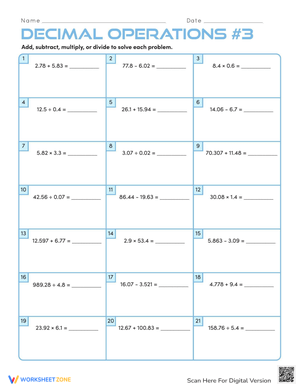
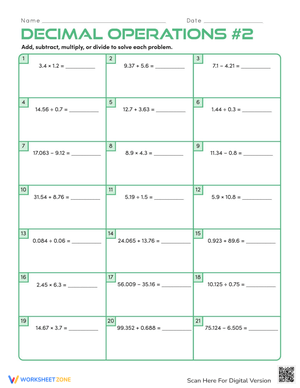
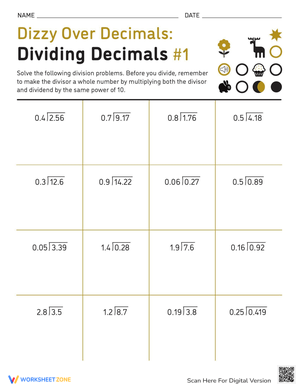
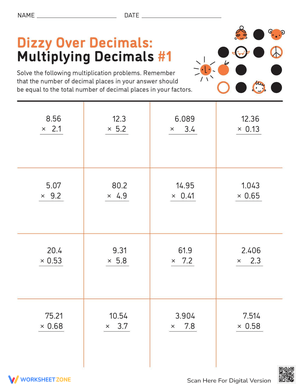
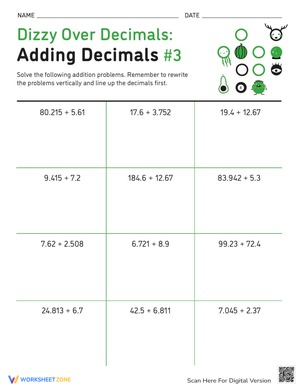
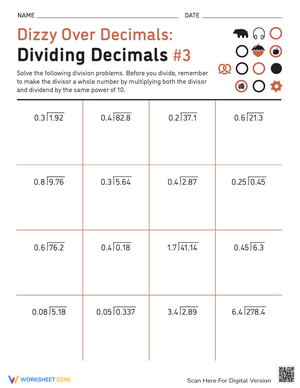
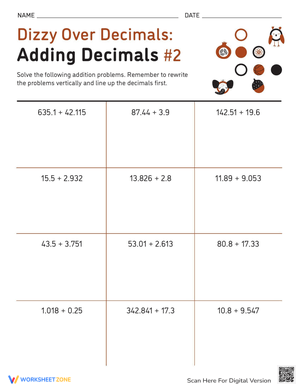
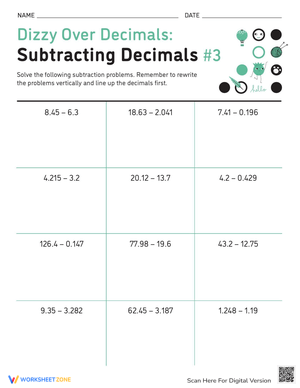
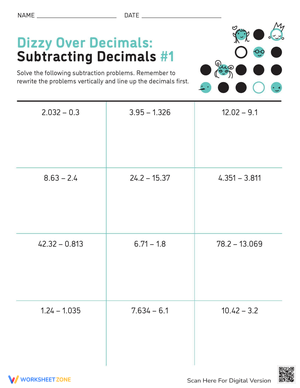
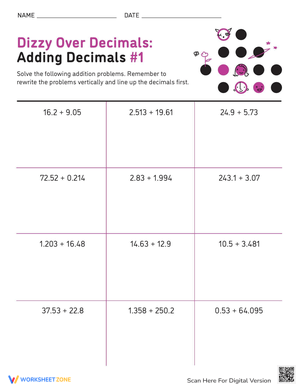
Operations with rational numbers worksheets give Grade 7 teachers a focused way to practice addition, subtraction, multiplication, and division of integers, fractions, and decimals within a single connected unit. Rather than treating fractions and decimals as separate skills, this practice set treats them as one number system, which matches how the CCSS 7.NS.A cluster frames the work: extending fraction operations to include negative values and repeating decimals. For a class moving from 6th grade fraction fluency into formal rational number work, these worksheets act as the bridge that makes sign rules and decimal conversion feel like an extension of familiar skills instead of a brand-new topic. A well-built set usually mixes short computation drills, number line prompts, and short word problems so students see the same skill represented in more than one format before a unit test asks them to switch between formats on their own.
Aligning Practice With 7.NS.A.1: Adding and Subtracting Rational Numbers
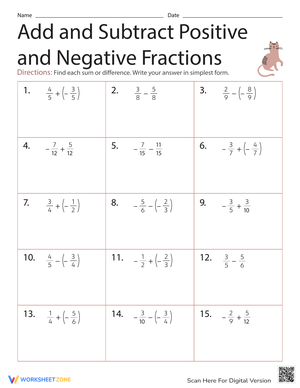
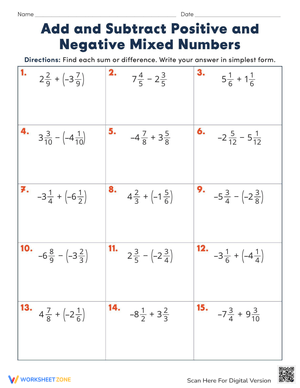
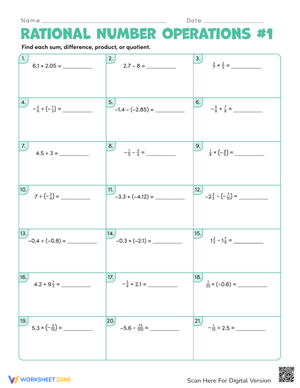
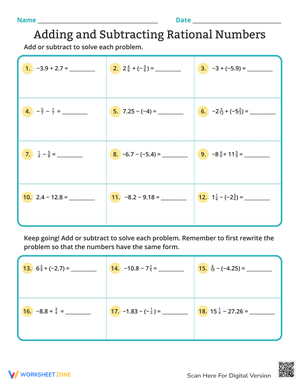
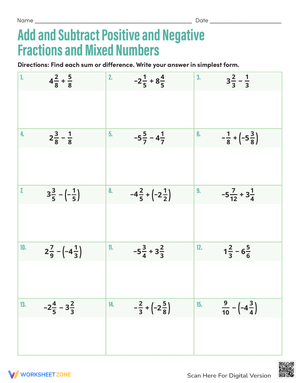
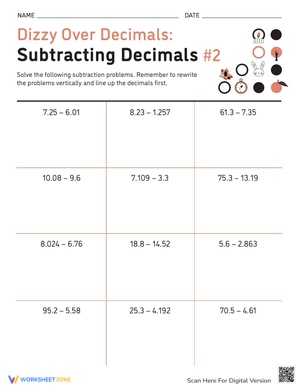
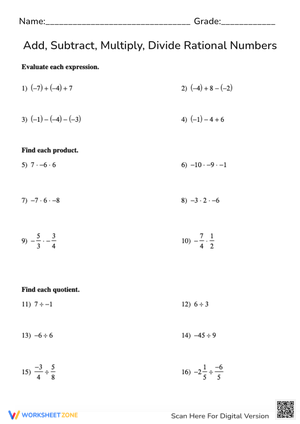
7.NS.A.1 asks students to represent addition and subtraction of rational numbers on a number line and to understand subtraction as adding the additive inverse, so p minus q equals p plus the opposite of q. Worksheets built around this standard should give students repeated exposure to that reframing: instead of memorizing separate rules for subtracting a positive versus a negative, students learn to rewrite every subtraction problem as an addition problem first. That single move removes a large share of the sign errors that show up on unit assessments. Problems that pair a negative mixed number with a positive fraction, or a negative decimal with a positive integer, give students practice converting formats while still applying the additive inverse rule, which keeps the worksheet aligned to the full scope of 7.NS.A.1 rather than only the easiest same-format cases.
In practice, the sign errors that surface most often in Grade 7 intervention groups cluster around problems that mix a negative fraction with a positive decimal, such as negative three-fourths plus zero point five, because students have to convert formats and track signs in the same step. Worksheets that isolate this exact combination for two or three problems before mixing in whole-class review tend to surface the misconception faster than a worksheet that spreads mixed formats evenly across twenty items, since students who guess correctly on isolated same-format problems often still struggle once formats are combined.
Building Multiplication and Division Fluency With 7.NS.A.2
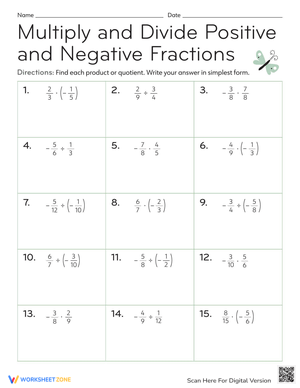
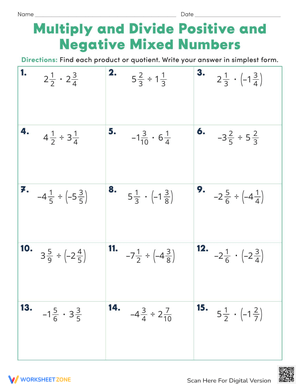
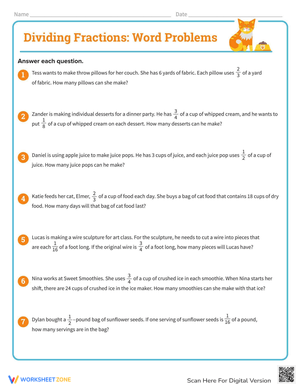
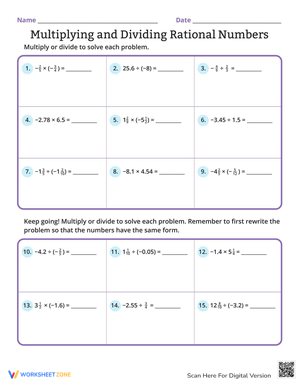
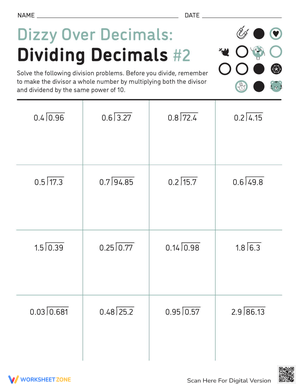
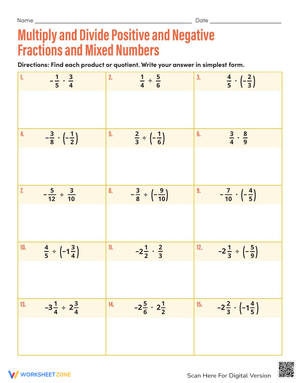
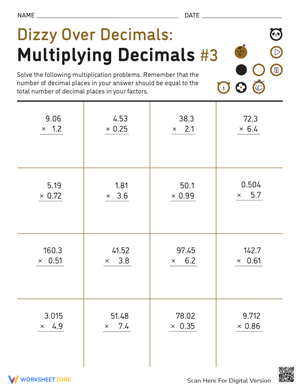
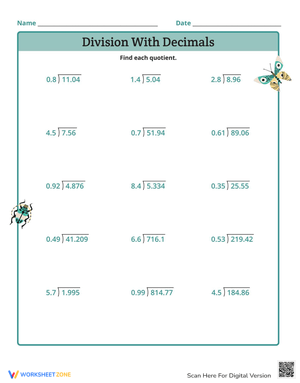
7.NS.A.2 extends the same logic to multiplication and division. Students need to internalize that every quotient of integers with a nonzero divisor is itself a rational number, and that dividing p by q, where q does not equal zero, produces the same result as negative p divided by q, or p divided by negative q. Worksheets aligned to this standard should also require converting rational numbers to decimal form through long division, since that skill separates students who understand rational numbers as a number system from students who can only apply sign rules by rote. Practice sets that mix terminating and repeating decimal conversions in the same set help teachers spot which students stop dividing too early, a common error that produces a decimal that looks finished but is actually truncated mid-pattern.
Real-World Problem Solving With 7.NS.A.3
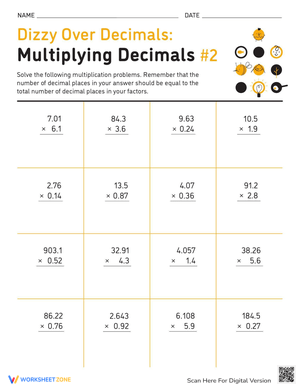
7.NS.A.3 requires students to solve real-world and mathematical problems using all four operations with rational numbers, which means worksheets should not stop at symbolic practice. Word problems involving temperature change, elevation, banking transactions, or recipe scaling give students a reason to choose the correct operation instead of guessing based on the numbers in front of them. According to the Common Core State Standards Initiative, the Grade 7 Number System cluster requires students to apply and extend previous understandings of operations with fractions to add, subtract, multiply, and divide rational numbers, a benchmark that spans three interconnected sub-standards, 7.NS.A.1 through 7.NS.A.3. Word problems that require two operations in sequence, such as a temperature drop followed by a partial recovery, also prepare students for the multi-step reasoning that shows up on state assessments.
Teacher Tips
Keep an answer key that shows the sign rule applied at each step, not just the final numeric answer, so a substitute or co-teacher can diagnose errors quickly. Rotate decimal-to-fraction conversion problems throughout the unit rather than isolating them at the end, since students forget the long-division method for repeating decimals if it is only practiced once. When a worksheet returns a cluster of wrong answers on multiplication and division items, check whether students are applying the rule that p over q equals negative p over negative q correctly before assuming they do not understand negative numbers at all; the two errors look similar on paper but require different reteaching. Pairing a short warm-up review of the additive inverse rule at the start of each class period keeps the skill active in memory across the full unit.
Frequently Asked Questions
1. What grade level are operations with rational numbers worksheets designed for?
These worksheets are designed for Grade 7 math classrooms, aligning with the CCSS 7.NS.A cluster that extends fraction operations to include negative numbers, repeating decimals, and the four core operations covered across 7.NS.A.1 through 7.NS.A.3.
2. How do these worksheets align with Common Core 7.NS.A standards?
They map to 7.NS.A.1 for addition and subtraction using the additive inverse, 7.NS.A.2 for multiplication and division including decimal conversion through long division, and 7.NS.A.3 for applying all four operations to real-world and mathematical problems.
3. What is the difference between rational number operations and basic fraction operations worksheets?
Basic fraction worksheets typically stay within positive values, while rational number worksheets add negative fractions, negative decimals, and the requirement to convert between fraction and decimal form using long division, which reflects the broader scope of the 7.NS.A cluster.
4. How can teachers use these worksheets for intervention versus whole-class instruction?
For whole-class instruction, teachers can sequence the full worksheet from same-sign to mixed-sign problems and then into word problems; for intervention groups, teachers can assign only the number line and same-sign sections until sign errors are resolved before adding mixed signs.
5. What common student errors do these worksheets help identify?
They surface errors in applying the additive inverse rule during subtraction, mistakes converting repeating decimals through long division, and confusion about where negative signs belong in division expressions, all of which are common misconceptions within the 7.NS.A cluster.













 Interactive Worksheet Maker
 Quiz Maker
 Word Search Maker
 Crossword Puzzle Maker
 Word Scramble Generator
 Sentence Scramble Generator
 Handwriting Worksheet Generator
 Name Tracing Generator
 Fill In The Blank Generator