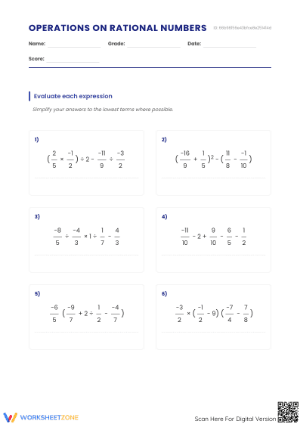
These rational numbers worksheets give grades 6–8 teachers a targeted, classroom-tested set of practice tools covering the full range of skills students need before algebra: identifying rational numbers, placing them on number lines, converting between fractions and decimals, comparing and ordering values, applying all four operations with negative quantities, and reasoning through real-world problems involving temperature, elevation, and money. Each worksheet stands alone as a focused practice tool, so teachers can pull exactly what a lesson or small group needs without wading through unrelated content.
The Specific Skills Targeted
Each worksheet in the set addresses one of the skill clusters that define rational number fluency at the middle grades level. Some worksheets ask students to identify whether a given value — a fraction, an integer, a repeating decimal, or a square root — qualifies as rational, which forces them to apply the definition rather than rely on surface features. Others have students plot positive and negative values on horizontal and vertical number lines, an exercise that builds genuine number sense rather than symbol-manipulation habits. Comparison and ordering worksheets ask students to arrange rational numbers from least to greatest, mark inequality relationships, and justify their placements. Conversion worksheets move students back and forth between fractions, mixed numbers, and decimals until those representations feel like different views of the same quantity. Operations worksheets cover addition, subtraction, multiplication, and division of rational numbers — including negative fractions and decimals — and a separate set of word problems situates those operations in contexts students actually recognize.
Standard Alignment
The core of this set aligns to CCSS.Math.Content.6.NS.C.6, which asks students to understand a rational number as a point on the number line and to extend previous understandings of numbers to the full system of rational numbers. The number line and ordering worksheets address this standard directly. Operations worksheets align to CCSS.Math.Content.7.NS.A.1 and 7.NS.A.2, the seventh-grade standards covering addition, subtraction, multiplication, and division of rational numbers in all forms. Teachers introducing the real number system in eighth grade will find the identification worksheets — particularly those contrasting rational and irrational values — useful for building toward 8.NS.A.1, which asks students to understand that every number has a decimal expansion and to convert repeating decimals to fractions.
How to Build These Worksheets Into Your Lesson Plans
The most efficient entry point is the warm-up slot. A six-problem identification or comparison worksheet takes most students under five minutes, leaving time to circulate and catch the students who are still treating all non-terminating decimals as irrational before the lesson proper begins. That kind of early visibility changes what you do in the next twenty minutes.
Station rotations work especially well with this set because the worksheets target distinct skills. A four-station rotation — number line placement, fraction-to-decimal conversion, ordering with negatives, and a word problem round — lets every student touch all four skill areas in a single period. Running groups on ten-to-twelve-minute intervals keeps the pace high enough that students rarely stall out on a station they find difficult. The exit-ticket format is equally straightforward: pull one identification problem, one ordering problem, and one operations problem from three different worksheets, hand them out in the last eight minutes of class, and sort the responses into three readiness groups before the next morning's planning period.
One structural move worth building into any rational number unit: after a procedural worksheet, ask students to write a single sentence explaining why every integer is also a rational number. It takes two minutes, requires no grading rubric, and immediately reveals which students understand the p/q definition versus which ones are applying a memorized rule they can't yet articulate. That sentence is better formative data than five additional computation problems.
Common Student Mistakes Teachers Should Anticipate and Address
The most persistent error pattern involves negative numbers: students who define rational numbers as "fractions" often exclude negative values entirely, treating -3/4 as something other than rational. This shows up most clearly on identification worksheets where students are given a mixed list and asked to circle the rational numbers — a surprising number of sixth graders will skip every negative entry. Targeted follow-up is fast once the worksheet surfaces it.
The second problem area is ordering. When students compare -3/4 and -1/2, many rely on whole-number magnitude reasoning and conclude that -3/4 is greater because 3/4 is greater than 1/2. They're applying correct logic to the wrong reference frame. Number line worksheets make the correct order visible in a way that symbolic comparison alone doesn't, because students can see that -3/4 sits further left. The physical act of placing the values resolves the confusion faster than re-explaining the rule.
A third mistake appears specifically during conversion: students who correctly identify 0.333... as repeating will still label it irrational because they know "non-terminating" is associated with irrationality. The distinction — that repeating non-terminating decimals are rational, while non-repeating non-terminating decimals are not — requires direct instruction and repeated practice. Worksheets that mix 1/3, π, and √2 in the same identification task are particularly useful for dislodging this misconception.
Adjusting the Worksheets for a Range of Learners
For students still consolidating fraction and integer sense, the number line worksheets work better with tick marks pre-labeled at key benchmarks: -1, -1/2, 0, 1/2, 1. Removing that scaffolding — or replacing the number line with a blank segment and asking students to construct their own scale — turns the same task into a significantly more demanding problem. Both versions are useful; the difference is in when you assign them.
Word problem worksheets offer natural extension for students who are comfortable with operations. Asking those students to write a second question using the same scenario, or to identify a value that would make an inequality false, extends the task without requiring a separate worksheet. On the other end, students who struggle with multi-step problems benefit from having the conversion step separated: do the fraction-to-decimal worksheet first, then return to the word problem with that piece already done.
Frequently Asked Questions
What grade levels are these worksheets designed for?
The set spans grades 6 through 8, with skills sequenced to match how the Common Core State Standards distribute rational number content. Identification and number line worksheets target the sixth-grade entry point; operations worksheets are calibrated to seventh-grade expectations; and the rational-versus-irrational identification work supports eighth-grade instruction on the real number system.
How do I help students understand that integers count as rational numbers?
The fastest approach is to have students rewrite a familiar integer as a fraction. Five becomes 5/1; -3 becomes -3/1. Several worksheets in the set include this as an explicit step, asking students to express integers in p/q form before completing the main problem. Students who do this a dozen times stop treating integers as a separate category.
Do the worksheets include answer keys?
Yes. Every worksheet comes with a full answer key. For number line problems, the key shows accurate placement so teachers can use it for quick visual comparison when checking student work, rather than evaluating each response from scratch.
My students already know fractions. Can I skip the identification worksheets?
Fraction fluency and rational number identification are related but different skills. Students who are comfortable computing with fractions still regularly misclassify √4 (rational, since it equals 2) or 0.1̄̄ (rational, since it equals 1/9) when asked directly. The identification worksheets take about fifteen minutes and surface those gaps quickly — worth running before assuming the concept is solid.
















 Interactive Worksheet Maker
 Quiz Maker
 Word Search Maker
 Crossword Puzzle Maker
 Word Scramble Generator
 Sentence Scramble Generator
 Handwriting Worksheet Generator
 Name Tracing Generator
 Fill In The Blank Generator