


























Views
Downloads



Complete Population Overshoot Worksheet | Grade 10 Biology
Paste this activity's link or code into your existing LMS (Google Classroom, Canvas, Teams, Schoology, Moodle, etc.).
Students can open and work on the activity right away, with no student login required.
You'll still be able to track student progress and results from your teacher account.
This Grade 10 biology worksheet trains students to interpret population dynamics, carrying capacity, and resource depletion using authentic ecological data sets. Learners analyze population overshoot, demographic lag, and habitat degradation across island deer and aquatic microcosm models to determine how limiting factors dictate ecosystem stability and post-crash recovery.
At a Glance
- Grade: 10 · Subject: Biology
- Standard: Population Dynamics — Analyze quantitative data to evaluate carrying capacity and ecosystem dynamics
- Skill Focus: Populations & Carrying Capacity: Analyze Overshoot and Recovery Data
- Format: 5 pages · 10 problems · Answer key included · PDF
- Best For: Data analysis and lab follow-up
- Time: 45–60 minutes
This 5-page resource features two synthetic ecological datasets presented in structured tables, paired with 10 analytical problems and a 2-page answer key. Students examine island deer counts alongside browse biomass, recruitment, and adult mortality, followed by a 40-day microcosm tracking Daphnia density, algae, and dissolved oxygen. A formula reference box defines carrying capacity and per capita growth rate.
Skill Progression
- Guided practice (Part A, Problems 1–2): Direct data extraction prompts students to locate peak population sizes, critical years, and associated resource levels.
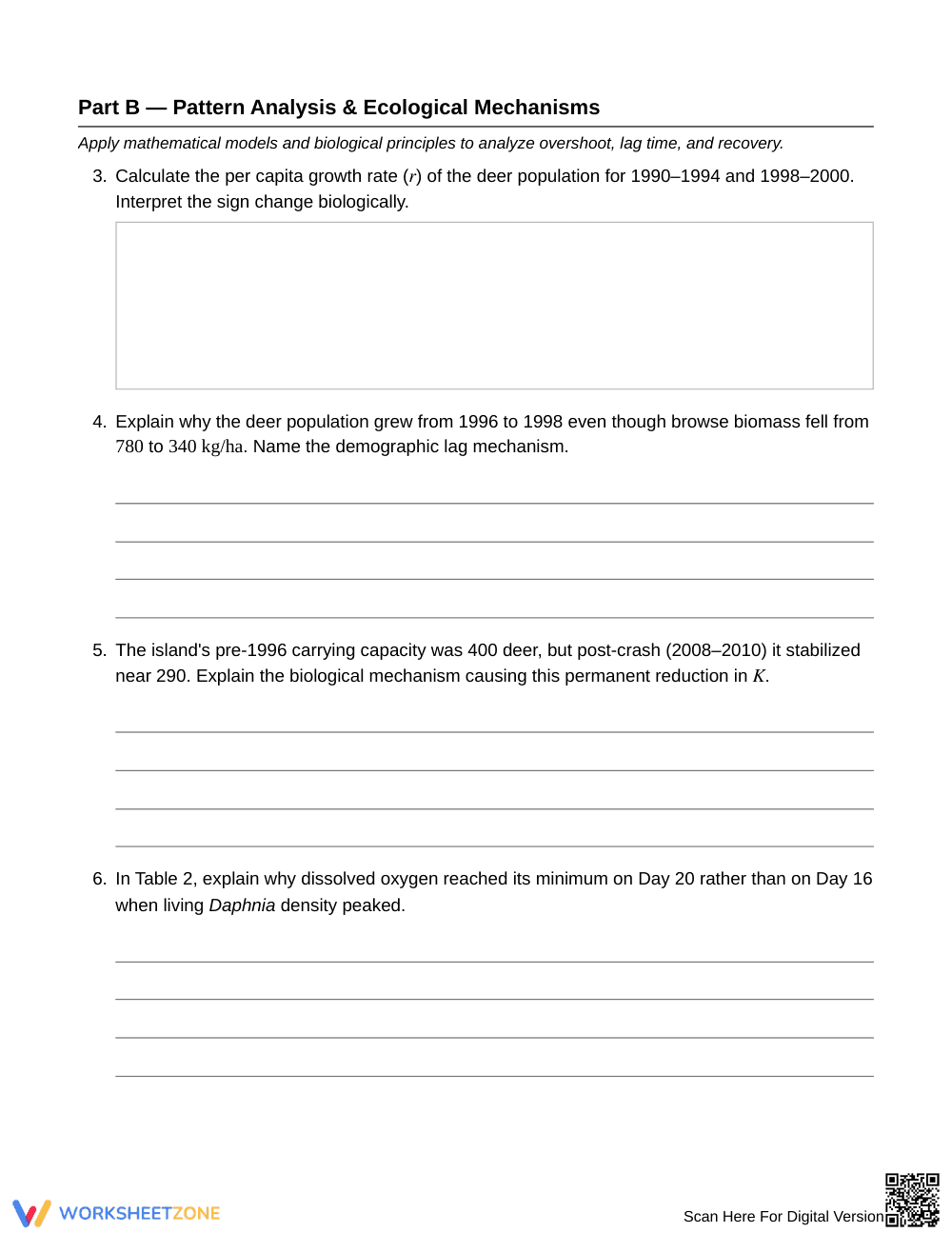
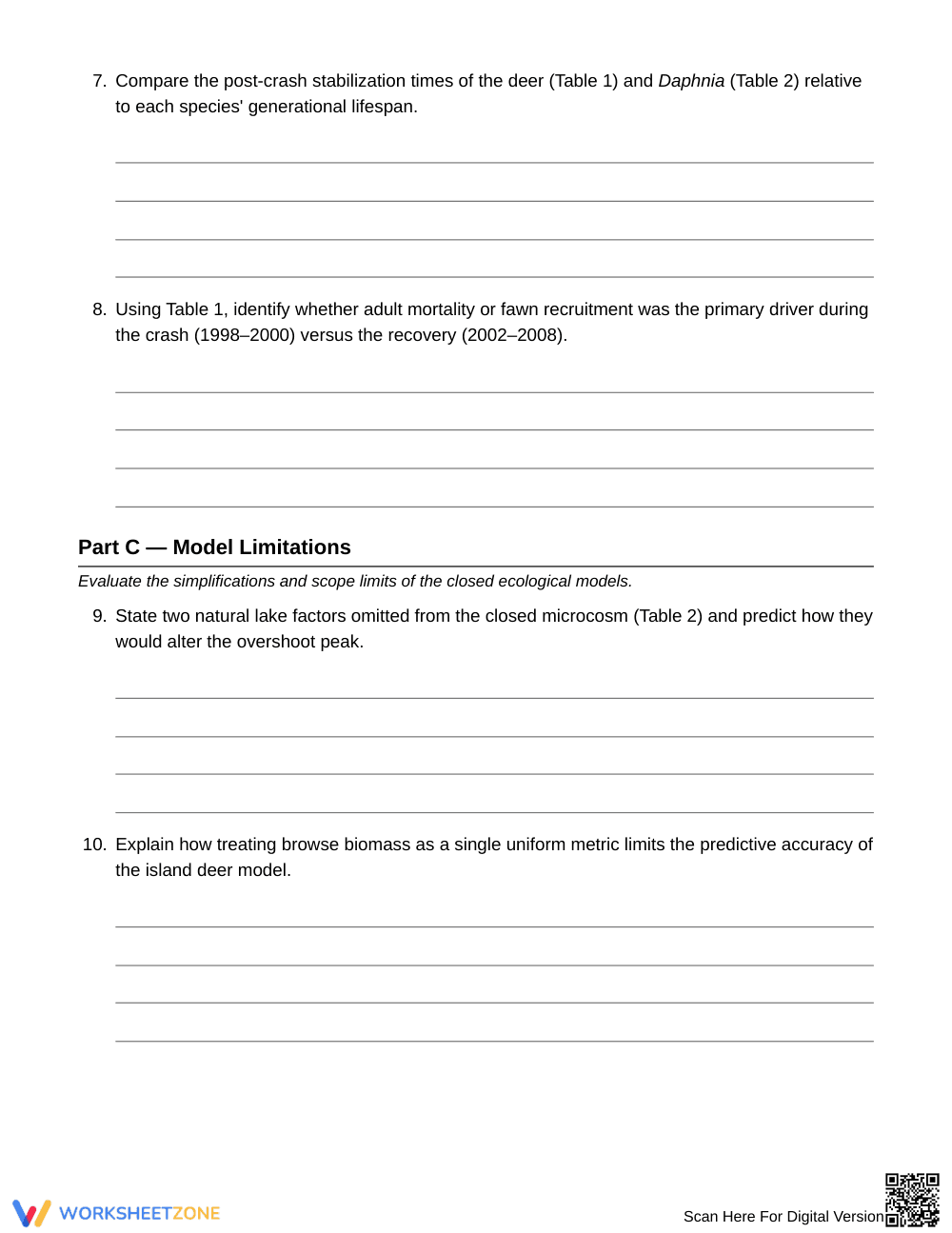
- Supported practice (Part B, Problems 3–8): Students calculate growth rates, identify demographic time lags, and explain why overconsumption permanently reduces carrying capacity.
- Independent practice (Part C, Problems 9–10): Learners critique closed ecological models by identifying omitted environmental factors and evaluating biomass metric limitations.
This progression uses a gradual-release model, advancing students from foundational data retrieval to evaluative ecological reasoning.
Standards Alignment
This worksheet supports high school life science standards addressing ecosystem dynamics, functioning, and resilience. Students use mathematical representations to support claims regarding factors affecting carrying capacities across ecosystems. Both standard codes can be copied directly into lesson plans, IEP goals, or district curriculum mapping tools.
How to Use It
Use this worksheet after direct instruction on exponential growth and limiting factors. Have students complete Parts A and B in pairs during a 45-minute class period. For formative assessment, check whether students recognize the time lag between peak population and browse collapse. Assign Part C as an individual exit ticket.
Who It's For
This activity is designed for Tenth Grade Biology students studying ecology. The formula reference box supports struggling learners, while the multi-variable data tables challenge advanced students. Pair this worksheet with a predator-prey simulation or an ecosystem graphing lab to reinforce population equilibrium.
Quantitative data analysis in high school biology reinforces scientific literacy by linking mathematical computation with ecological phenomena. According to Fisher & Frey (2014), structured data interpretation within a gradual-release framework substantially increases student retention of complex systemic concepts. This worksheet targets carrying capacity and population dynamics through 10 carefully sequenced problems using synthetic ecological models. Learners calculate per capita growth rates, evaluate carrying capacity collapse, and examine how demographic lag prevents immediate population stabilization when resources drop. By directly examining multi-variable data tables representing terrestrial and aquatic ecosystems, students synthesize causal connections between limiting factors, mortality rates, and post-crash equilibria. This analytical rigor equips high school biology students to evaluate ecological stability, critique scientific models, and explain ecosystem resilience using concrete numerical evidence rather than abstract qualitative assumptions, solidifying mastery across rigorous secondary life science curricula.


