


























Views
Downloads




Complete Population Growth Worksheet | Grade 10 Biology
Paste this activity's link or code into your existing LMS (Google Classroom, Canvas, Teams, Schoology, Moodle, etc.).
Students can open and work on the activity right away, with no student login required.
You'll still be able to track student progress and results from your teacher account.
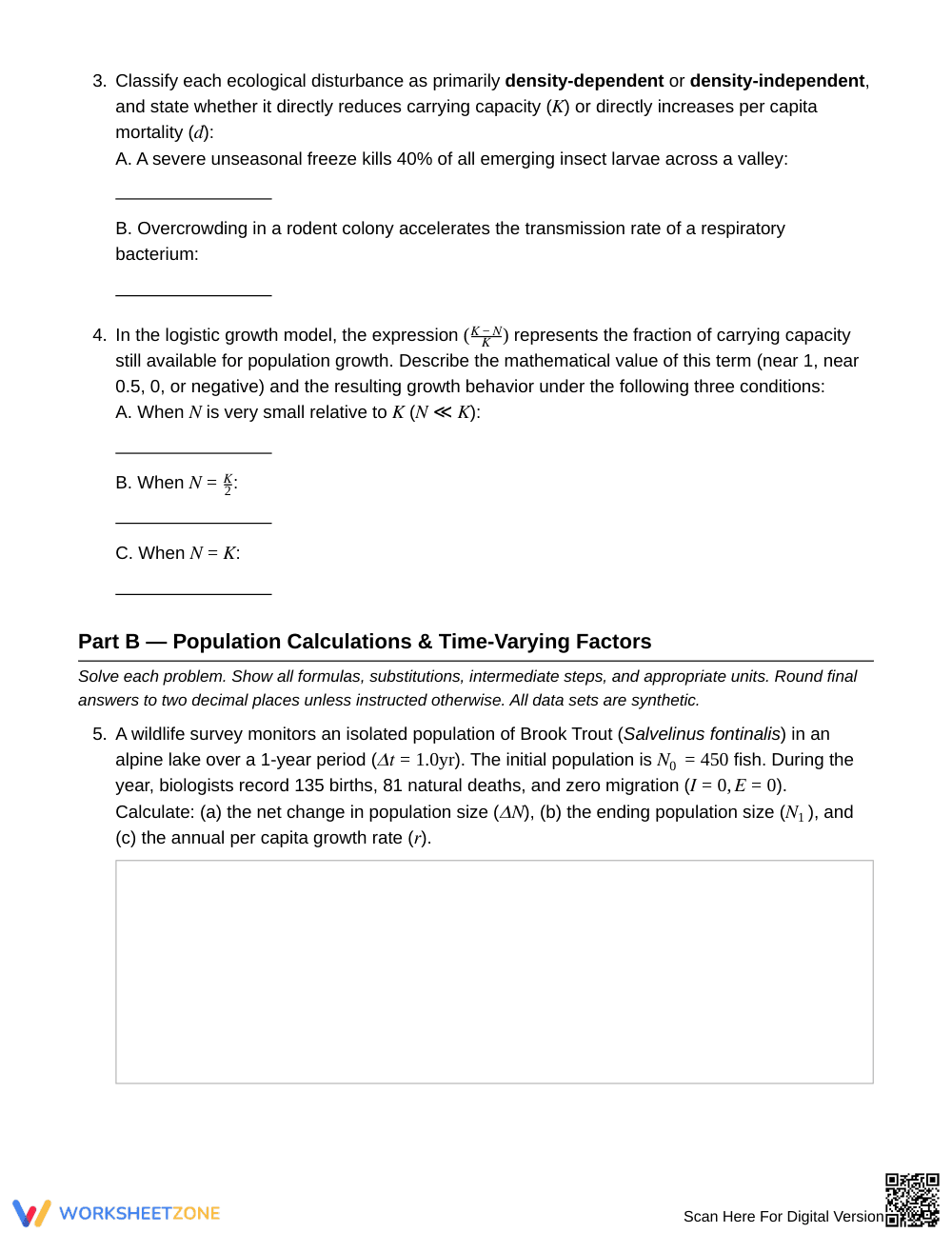
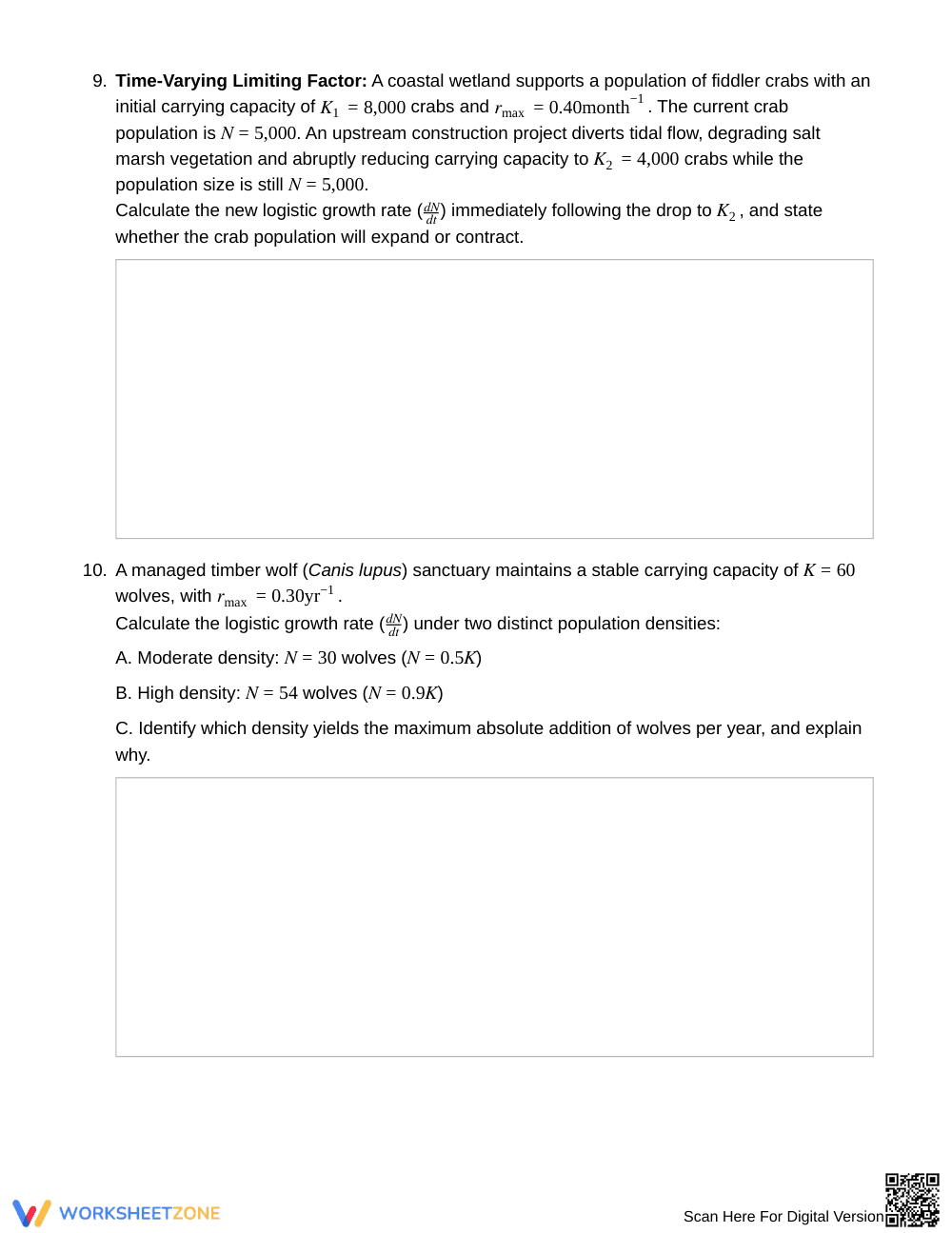
This Grade 10 Biology worksheet equips students to quantitatively model population dynamics and evaluate ecosystem stability. Students calculate net population change, determine per capita growth rates, and model logistic constraints using carrying capacity equations to make accurate ecological predictions across 12 rigorous problems.
At a Glance
- Grade: 10 · Subject: Biology
- Standard: High School Life Science — Calculate population growth rates and model ecological carrying capacity constraints
- Skill Focus: Population Growth Rates and Carrying Capacity
- Format: 5 pages · 12 problems · Answer key included · PDF
- Best For: Ecology quantitative practice and assessment
- Time: 45–60 minutes
What's Inside
Inside this 5-page printable resource, students work through conceptual distinctions, computational modeling, and biological scenario evaluations. The activity includes structured reference formulas, synthetic data tables for real-world species like brook trout and duckweed, step-by-step calculation spaces, and a thorough 3-page teacher answer key detailing every mathematical derivation.
Skill Progression
- Guided practice (Part A, Problems 1–4): Clarifies key distinctions between absolute and per capita growth rates, density-dependent versus density-independent limiting factors, and the mathematical behavior of carrying capacity terms.
- Supported practice (Part B, Problems 5–10): Guides students through multi-step computational problems calculating net changes, exponential projections, and logistic growth rates under shifting carrying capacities.
- Independent practice (Part C, Problems 11–12): Challenges learners to critically evaluate mathematical models, identify biological overestimates, and explain variable carrying capacity in closed batch cultures.
This structure follows an explicit I Do, We Do, You Do gradual-release framework to move students from foundational demographic concepts to advanced ecological analysis.
Standards Alignment
This worksheet aligns with high school life science standards addressing ecosystem interactions, energy, and dynamics. Students use mathematical representations to support explanations of factors affecting carrying capacity and population sizes at different scales. These alignment notes can be copied directly into lesson plans, IEP goals, or district curriculum mapping tools.
How to Use It
Deploy this worksheet after direct instruction on population ecology and mathematical growth models. It functions well as a collaborative mid-unit problem set or as an independent summative review before an ecology exam. While circulating, check whether students correctly evaluate the fraction of unused carrying capacity before multiplying; miscalculating this term is a common point of confusion. Expected completion time is 45 to 60 minutes.
Who It's For
Designed for Grade 10 Biology, Advanced Placement Biology, or introductory Environmental Science classes. Scaffolded formulas support developing math learners, while the analytical prompts in Part C provide rigorous extension for advanced students. Pair this worksheet with an interactive population ecology simulation or a predator-prey graphing lab.
According to Fisher & Frey (2014), structured instructional progressions that bridge foundational conceptual knowledge with quantitative problem-solving foster deeper disciplinary literacy and long-term retention in secondary science classrooms. This worksheet puts that research into direct practice by systematically guiding tenth-grade biology students through ecological growth equations, density-dependent limiting factors, carrying capacity models, and logistic constraints. By moving purposefully from core demographic definitions to complex algebraic evaluations of wildlife populations, the 12 structured tasks ensure learners develop the mathematical competence required for advanced ecological analysis and high-stakes science assessments. Working through real-world biological scenarios enables high school scholars to connect abstract mathematical equations with tangible environmental phenomena, building lasting analytical confidence. Ultimately, this scaffolded instructional design empowers all biology students to master challenging population dynamics independently and successfully across every instructional setting throughout the school year.


