

































Complete Pond Management Worksheet | Grade 7 Science

Paste this activity's link or code into your existing LMS (Google Classroom, Canvas, Teams, Schoology, Moodle, etc.).
Students can open and work on the activity right away, with no student login required.
You'll still be able to track student progress and results from your teacher account.
This middle school science worksheet guides Grade 7 students through analyzing real-world ecological data and evaluating competing pond restoration plans. Students examine trophic cascades, energy transfer efficiency, and abiotic limiting factors to determine the viability of top-down biological versus bottom-up chemical interventions, building evidence-based scientific argumentation and ecological problem-solving skills.
At a Glance
- Grade: 7 · Subject: Science
- Standard: Evaluate design solutions for maintaining ecosystem biodiversity and stability
- Skill Focus: Evaluate a Pond-Management Proposal
- Format: 5 pages · 10 problems · Answer key included · PDF
- Best For: Ecosystem unit assessment or case study
- Time: 45–60 minutes
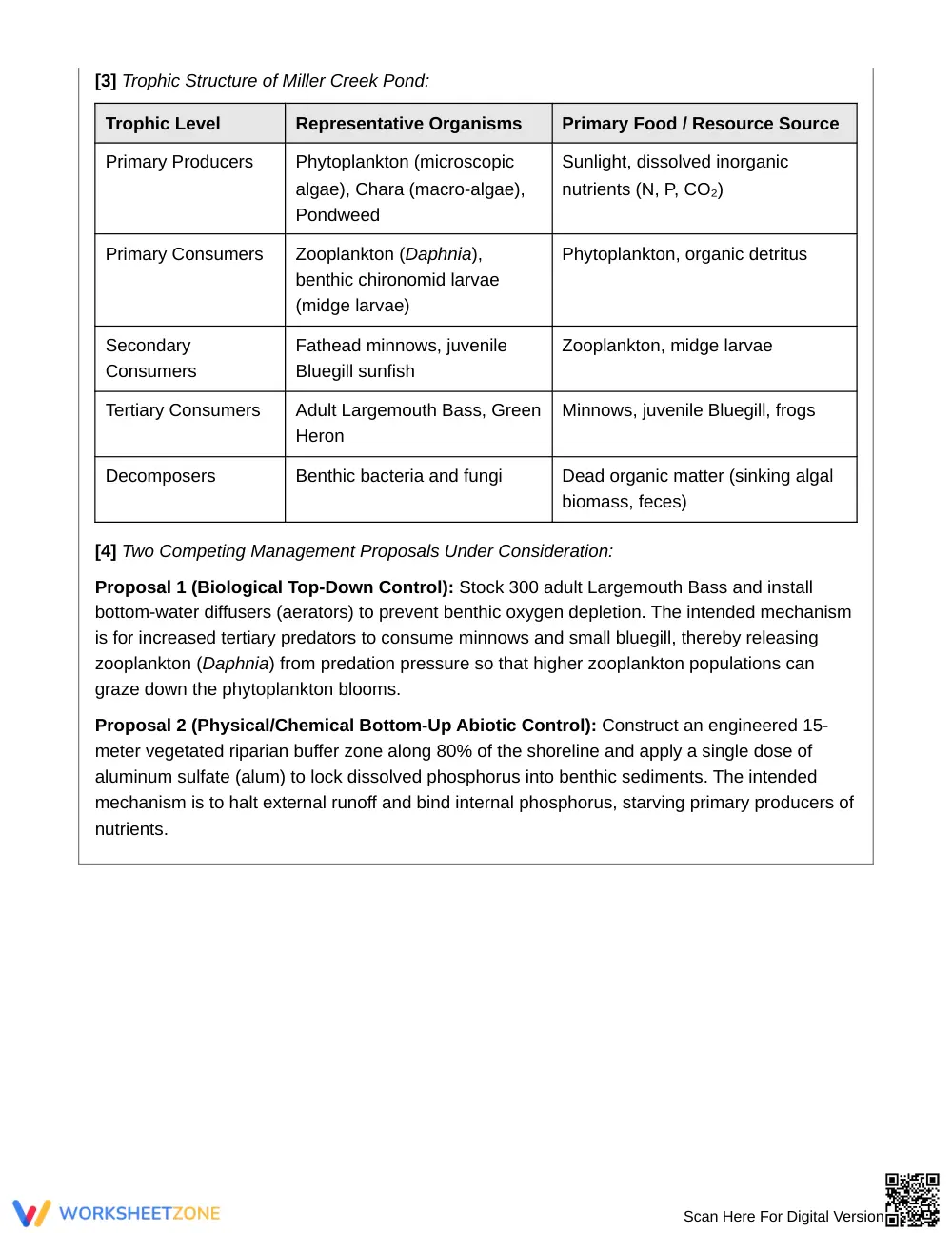
What's Inside: The 5-page resource includes synthetic baseline monitoring data for Miller Creek Community Pond, a structured trophic structure reference table, and two competing management proposals. Across 10 scaffolded questions, students analyze multi-choice abiotic constraints, fill-in causal cascade chains, trophic transfer biomass calculations (10% rule), and extended analytical evaluation prompts. A 3-page comprehensive answer key is included.
Skill Progression
- Guided practice (Tasks 1–2): Identifies baseline ecological constraints, dissolved oxygen thresholds, and urban site limitations using provided scenario data and reference tables.
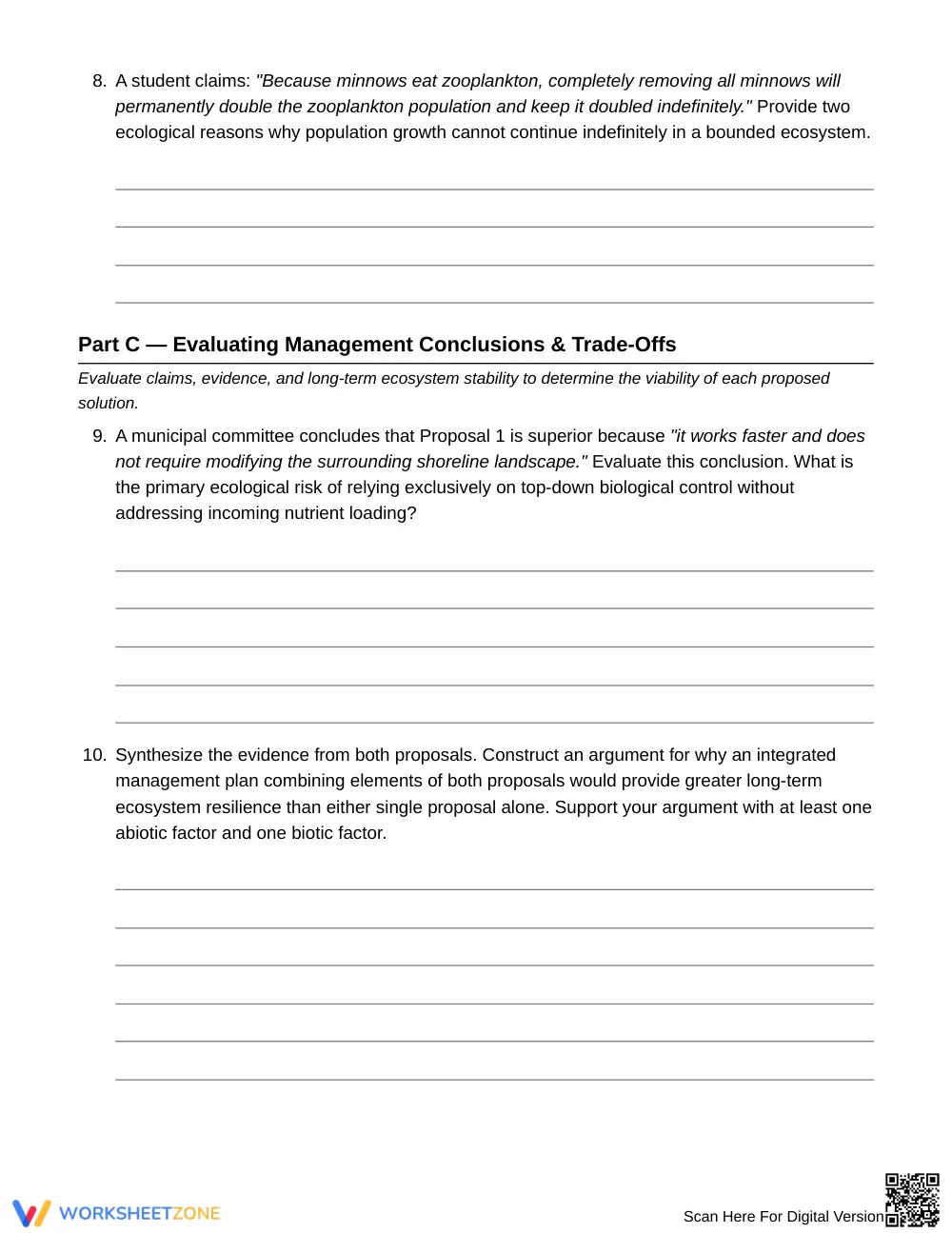
- Supported practice (Tasks 3–8): Guides multi-step causal reasoning across trophic levels, including tracing four-step cascade chains, applying 10% trophic efficiency calculations, and identifying limiting nutrient mechanisms.
- Independent practice (Tasks 9–10): Challenges students to critique municipal management claims and construct a synthesis argument justifying an integrated biotic-abiotic management strategy.
This sequence follows a gradual-release model, moving students from basic data interpretation to complex, evidence-based ecosystem synthesis.
Standards Alignment
This activity aligns with middle school life science standards requiring students to evaluate competing design solutions for maintaining ecosystem stability and biodiversity. Students synthesize empirical data to weigh trade-offs. Both standard descriptions can be copied directly into lesson plans, IEP goals, or district curriculum mapping tools.
How to Use It
Deploy this activity after direct instruction on food webs and trophic cascades as a summative case study or paired performance task. Formatively observe whether students correctly identify decomposers rather than algae as the direct consumer of benthic dissolved oxygen during die-offs. Expected completion time is 45 to 60 minutes.
Who It's For
Designed for Grade 7 life science classrooms, honors middle school biology, and environmental science units. Scaffolded tables support developing readers, while open-ended trade-off evaluation extends advanced learners. Natural pairing resource: a direct instruction lesson on eutrophication and aquatic nutrient cycling.
Evaluating ecological management proposals requires students to integrate trophic cascade mechanics with abiotic constraints. According to Fisher & Frey (2014), structured case studies that transition from guided data extraction to independent scientific argumentation significantly enhance student retention of complex causal relationships. When Grade 7 learners evaluate competing biotic and abiotic solutions, they move beyond linear food chains into dynamic systems thinking. By calculating biomass transfer efficiencies and analyzing multi-step feedback loops, students directly practice interpreting quantitative environmental monitoring data. The structured progression from identifying dissolved oxygen thresholds to synthesizing integrated management plans ensures learners develop deep conceptual mastery of energy flow and ecosystem resilience. This evidence-based design provides educators with a targeted, rigorous framework for assessing how well students can critique real-world conservation and resource-management solutions in middle school life science curricula.


