































Complete Policy Evidence Worksheet | Grade 12 English IV

Paste this activity's link or code into your existing LMS (Google Classroom, Canvas, Teams, Schoology, Moodle, etc.).
Students can open and work on the activity right away, with no student login required.
You'll still be able to track student progress and results from your teacher account.
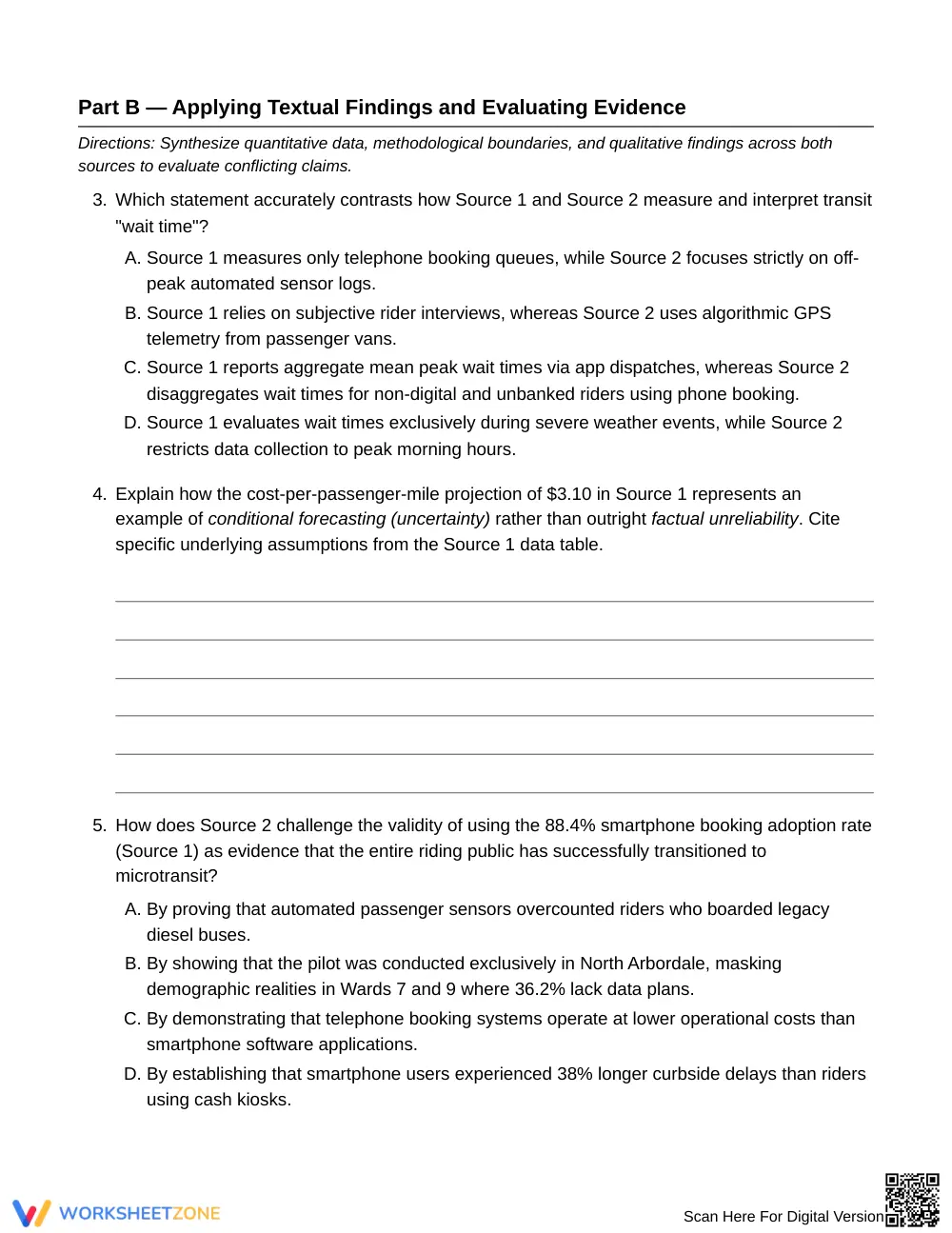
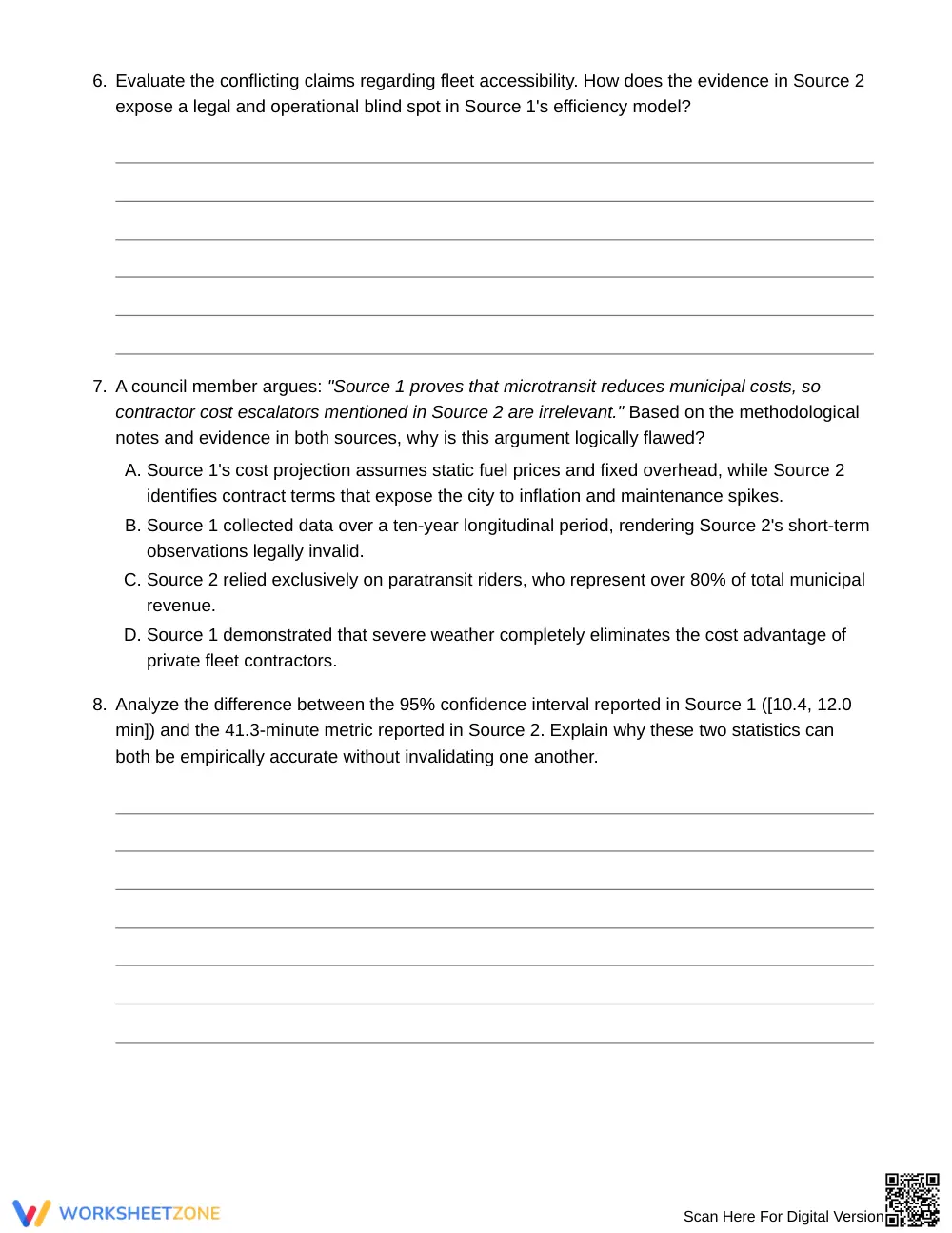
This English IV worksheet equips Grade 12 students to evaluate conflicting empirical research when making consequential public policy decisions. Working through a realistic municipal transit dossier, learners differentiate statistical uncertainty from methodological unreliability across ten analytical tasks to justify policy revisions using data.
At a Glance
- Grade: 12 · Subject: English IV
- Standard:
Informational Text Literacy— Evaluate conflicting multi-source empirical evidence to resolve complex policy challenges- Skill Focus: Choose Evidence for a Consequential Decision
- Format: 6 pages · 10 problems · Answer key included · PDF
- Best For: Source literacy and evidence synthesis
- Time: 45–60 minutes
What's Inside
The six-page dossier includes an analytical framework on empirical validity, two conflicting transit reports with data tables, and ten analytical tasks. Students complete multiple-choice evaluations, data checks, and open-ended policy revisions, supported by a complete four-page teacher answer key with exemplar responses.
Skill Progression
This worksheet follows a structured three-tier architecture:
- Guided practice (Tasks 1–2): Identifies baseline operational and financial constraints with targeted prompts.
- Supported practice (Tasks 3–8): Evaluates confidence intervals, survey sampling, conditional modeling, and equity data across six problems.
- Independent practice (Tasks 9–10): Guides students to draft and defend a binding policy compromise.
This gradual-release design moves students from constraint identification to independent argumentation.
Standards Alignment
This worksheet aligns with Grade 12 Informational Text standards requiring students to integrate and evaluate multiple sources of information to resolve complex problems. It reinforces essential criteria for assessing empirical source validity. Both standard codes can be copied directly into lesson plans, IEP goals, or district curriculum mapping tools.
How to Use It
Use this resource after direct instruction on source credibility. In a 45–60 minute period, have students complete Parts A and B in pairs before writing Part C independently. Formatively observe Task 4 responses to ensure students distinguish statistical uncertainty from methodological bias before writing recommendations.
Who It's For
Ideal for Grade 12 English IV and rhetoric students preparing for college-level research. Support emerging writers with structured graphic organizers or challenge advanced students with financial variance analysis. Pair with direct instruction lessons on argumentative rhetoric.
According to findings highlighted in Fisher & Frey (2014), structured exposure to authentic, multi-source informational texts significantly improves high school students' ability to synthesize conflicting data and justify complex arguments. Grade 12 students frequently struggle to distinguish between statistical uncertainty and methodological invalidity when analyzing technical policy briefs. By engaging directly with synthetic reports containing operational pilot metrics, confidence intervals, and demographic equity audits, learners build the critical source literacy necessary for college and career readiness. This rigorous instructional approach scaffolds consequential decision-making across ten systematic tasks, progressing from constraint identification to sustained policy defense. Research affirms that guided collaborative analysis followed by independent synthesis strengthens evaluative reading stamina, enabling high school seniors to interrogate data boundaries, identify unstated operational assumptions, and produce robust, evidence-grounded solutions for real-world municipal problems.


