































Complete Newton's Third Law Worksheet | Grade 8-12 Science

Paste this activity's link or code into your existing LMS (Google Classroom, Canvas, Teams, Schoology, Moodle, etc.).
Students can open and work on the activity right away, with no student login required.
You'll still be able to track student progress and results from your teacher account.
This physics worksheet equips students to master Newton's Third Law by comparing interaction force pairs across different physical systems. Learners evaluate why action and reaction forces do not cancel, calculate accelerations using mass ratios, and resolve common misconceptions regarding motion in space through structured comparative tables and analytical prompts.
At a Glance
- Grade: 8–12 · Subject: Science
- Standard:
Forces and Interactions— Analyze action-reaction force pairs and motion in colliding systems- Skill Focus: Newton's Third Law comparative systems analysis
- Format: 3 pages · 27 problems · Answer key included · PDF
- Best For: Conceptual physics practice and review
- Time: 40–50 minutes
Across 3 student pages, learners encounter 27 targeted tasks organized into four structured sections. The worksheet features comparative data tables, multi-system organizers, force diagrams, and short-answer reasoning items. An accompanying 3-page complete answer key provides worked acceleration calculations and sample student responses for all open-ended explanations.
Skill Progression
- Guided practice (Part A): Students examine two interacting track carts, identify equal and opposite forces, and resolve why simultaneous force pairs do not cancel across 5 scaffolded items.
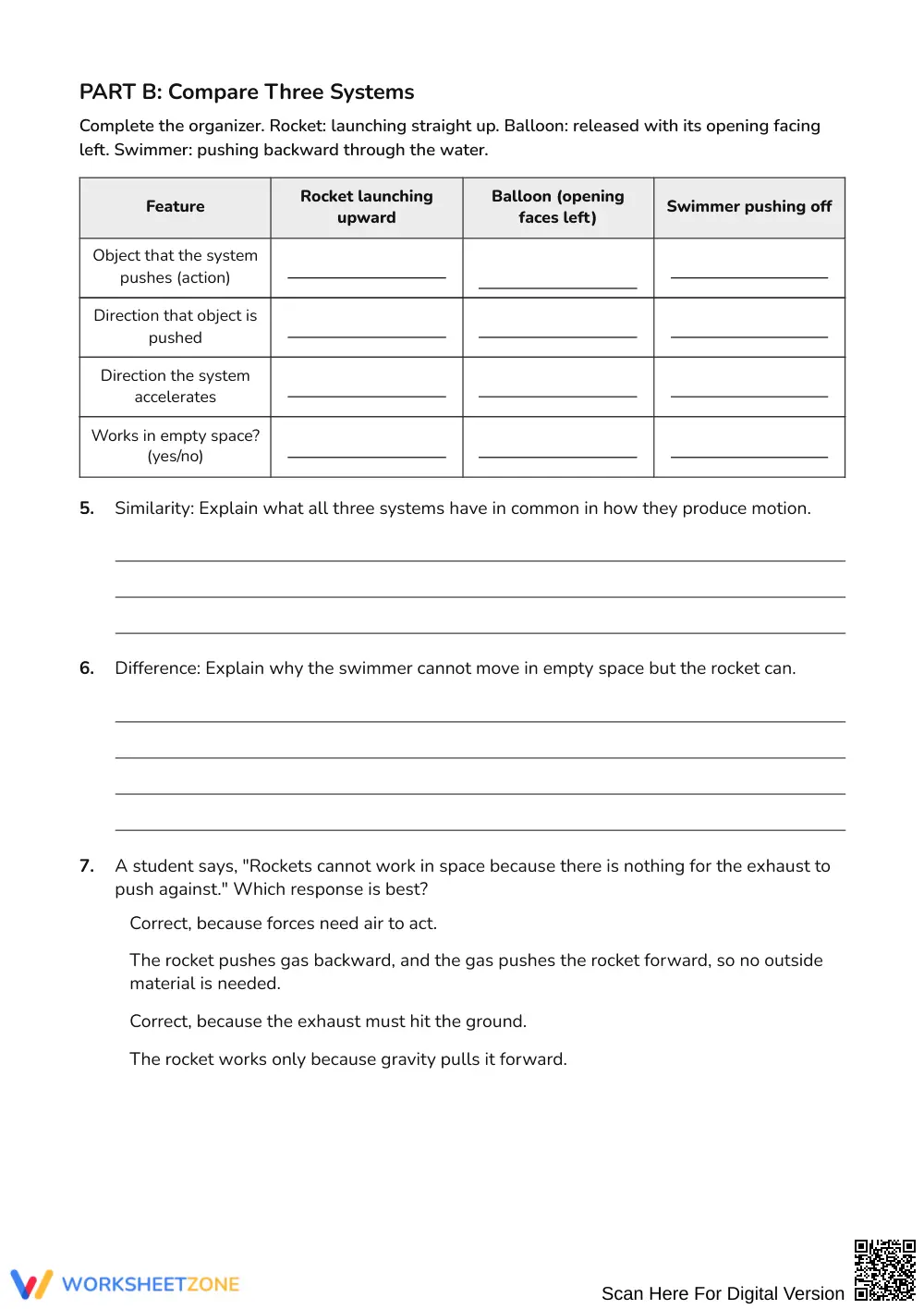
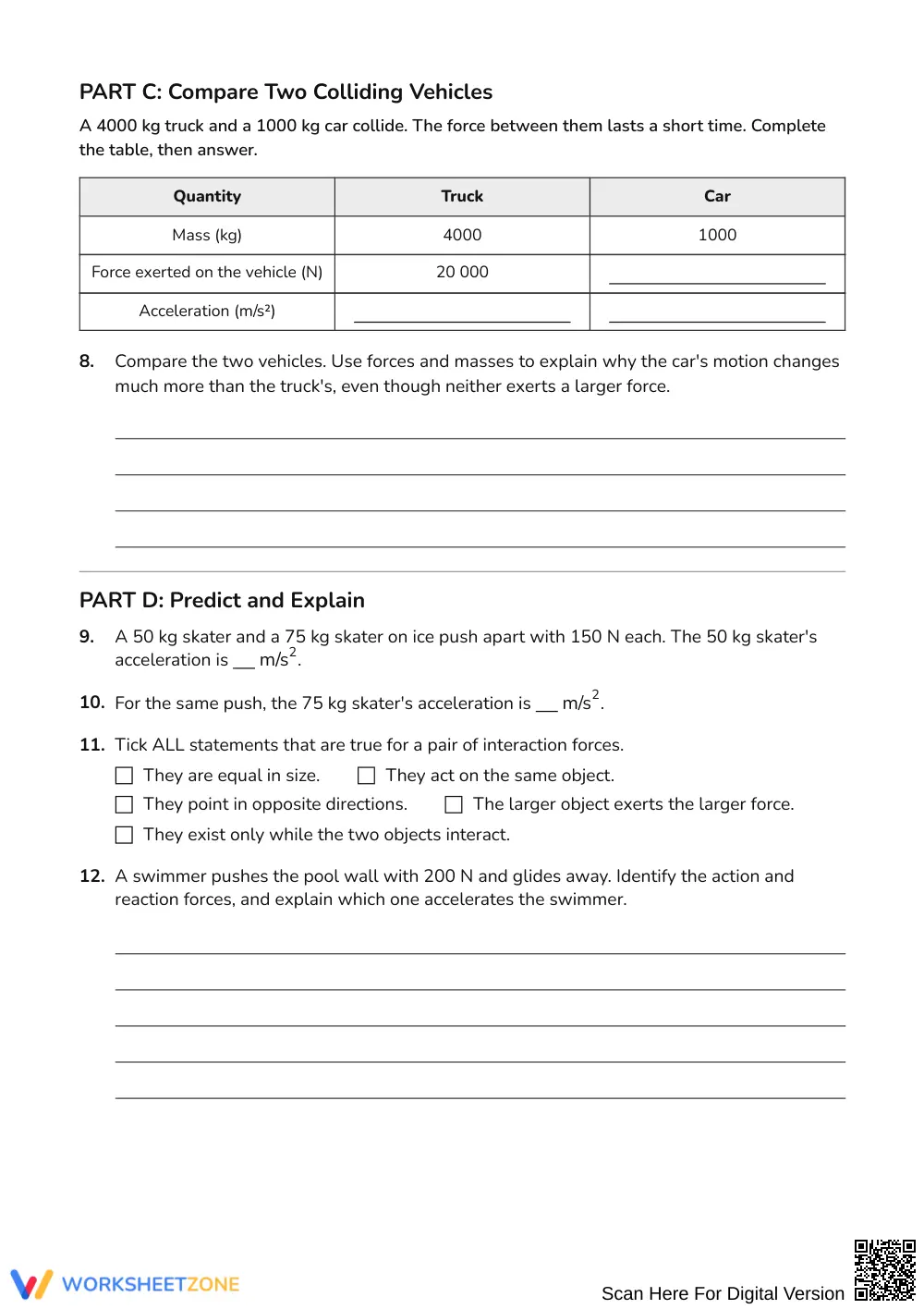
- Supported practice (Parts B & C): Learners complete comparative tables examining rockets, balloons, swimmers, and colliding vehicles, using mass differences to explain unequal accelerations across 14 data-driven tasks.
- Independent practice (Part D): Students independently predict skater accelerations, verify defining interaction characteristics, and isolate propulsive forces in pool wall push-offs across 8 mastery prompts.
This sequence follows the gradual release of responsibility model, shifting students from modeled force identification to autonomous physical reasoning.
Standards Alignment
This resource directly supports secondary physical science standards focused on forces and motion. Students apply Newton's Third Law to design and analyze solutions involving the motion of two colliding objects, demonstrating that every interaction exerts an equal, simultaneous, and opposite force on the other object. Both standard concepts can be copied directly into lesson plans, IEP goals, or district curriculum mapping tools.
How to Use It
Administer this activity during mid-unit instruction immediately following direct instruction on interaction pairs. For formative assessment, inspect Part B's vacuum space question to quickly identify whether students hold the misconception that exhaust gases require ambient air to push against. Total completion time spans 40 to 50 minutes during regular lab or practice blocks.
Who It's For
Designed for physical science and high school physics students, this assignment accommodates tiered readiness through visual force vectors and tabulated data sets. For additional support, pair this worksheet with an interactive collision simulation or a physical spring-cart demonstration prior to student completion.
According to research in Fisher & Frey (2014), structured comparative analysis significantly accelerates student conceptual understanding when transitioning from intuitive preconceptions to formal scientific models. Newton's Third Law presents persistent conceptual hurdles because secondary science learners frequently conflate force magnitude with resulting acceleration, assuming that more massive bodies exert greater forces during collisions. By requiring students to complete side-by-side matrices contrasting rockets, swimmers, and colliding vehicles, this worksheet prompts deliberate cognitive reframing. Learners isolate the distinct physical bodies receiving each force, directly countering the misconception that equal and opposite forces cancel out. Structured prompts and tabular organizers ground abstract mechanics in concrete numerical proofs, reinforcing how invariant force pairs produce divergent accelerations proportional to mass. This intentional progression operationalizes Fisher & Frey (2014) principles of guided instructional release, establishing reliable schema for physical science problem-solving.


