

































Complete Newton's Third Law Worksheet | Grade 8-12 Science

Paste this activity's link or code into your existing LMS (Google Classroom, Canvas, Teams, Schoology, Moodle, etc.).
Students can open and work on the activity right away, with no student login required.
You'll still be able to track student progress and results from your teacher account.
This comprehensive physical science worksheet provides secondary students with rigorous practice analyzing action-reaction force pairs and predicting system behavior. Through structured cause-and-effect prompts, learners evaluate how varying physical conditions alter magnitude, acceleration, and direction during dynamic mechanical interactions.
At a Glance
- Grade: 8–12 · Subject: Science
- Standard: Newton's Third Law — Predict force pairs and motion changes when interaction conditions change
- Skill Focus: Newton's Third Law cause-and-effect predictions
- Format: 4 pages · 21 problems · Answer key included · PDF
- Best For: Secondary physics unit skill mastery
- Time: 45–60 minutes
Across four structured pages, students examine multi-part physics problems that combine qualitative reasoning, numerical calculations, and graphical analysis. The resource includes balanced multiple-choice concept checks, quantitative data tables evaluating cart collisions, graph-based mass-acceleration relationships, and open-ended synthesis items. A complete four-page answer key provides step-by-step explanations and sample written responses.
Skill Progression
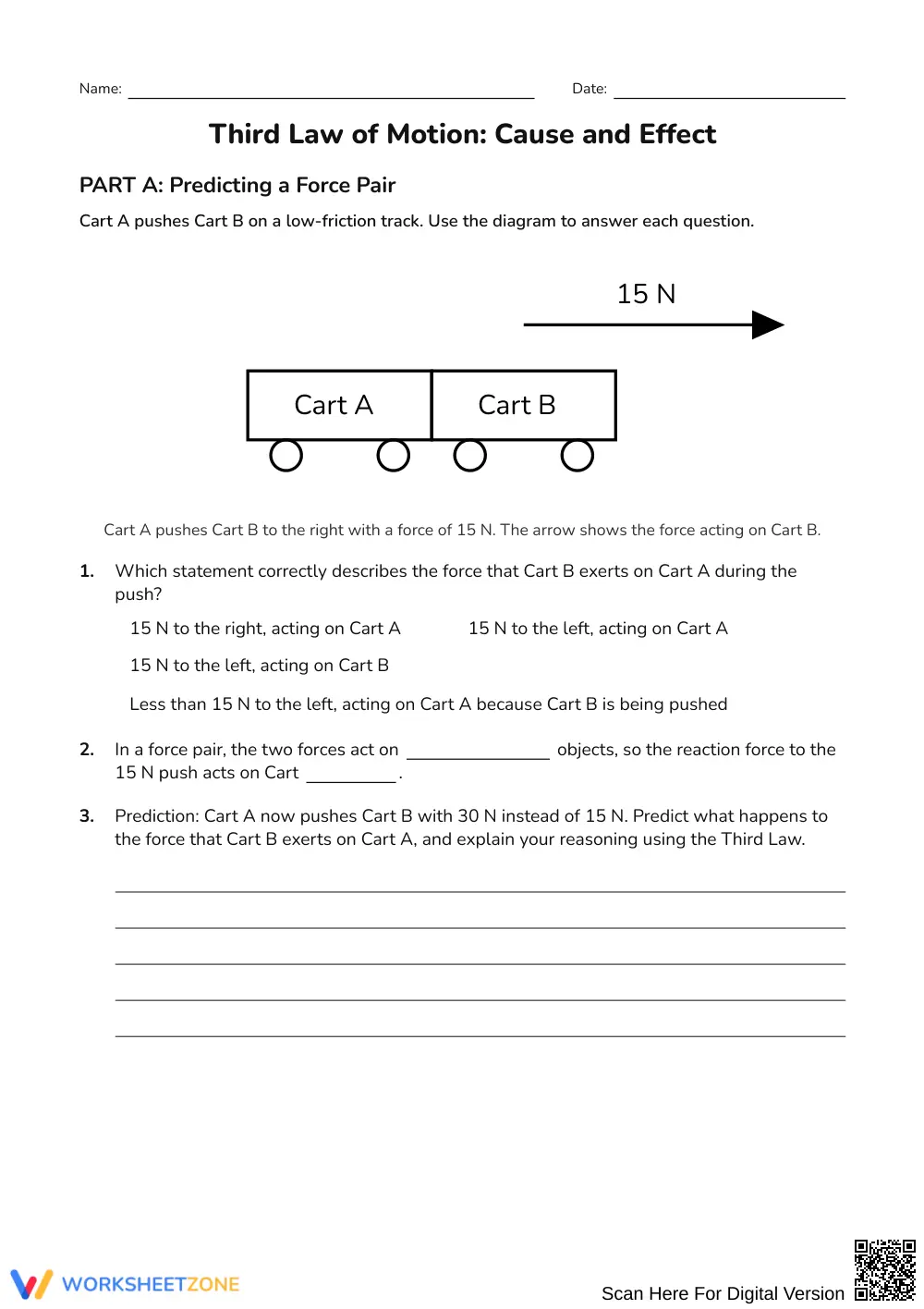
- Guided Practice (Part A): Students examine cart scenarios on low-friction tracks, identifying interaction partners, predicting reaction forces when push magnitudes double, and untangling why equal and opposite forces do not cancel.
- Supported Practice (Part B): Learners analyze numerical collision data across multiple trials, using the relationship
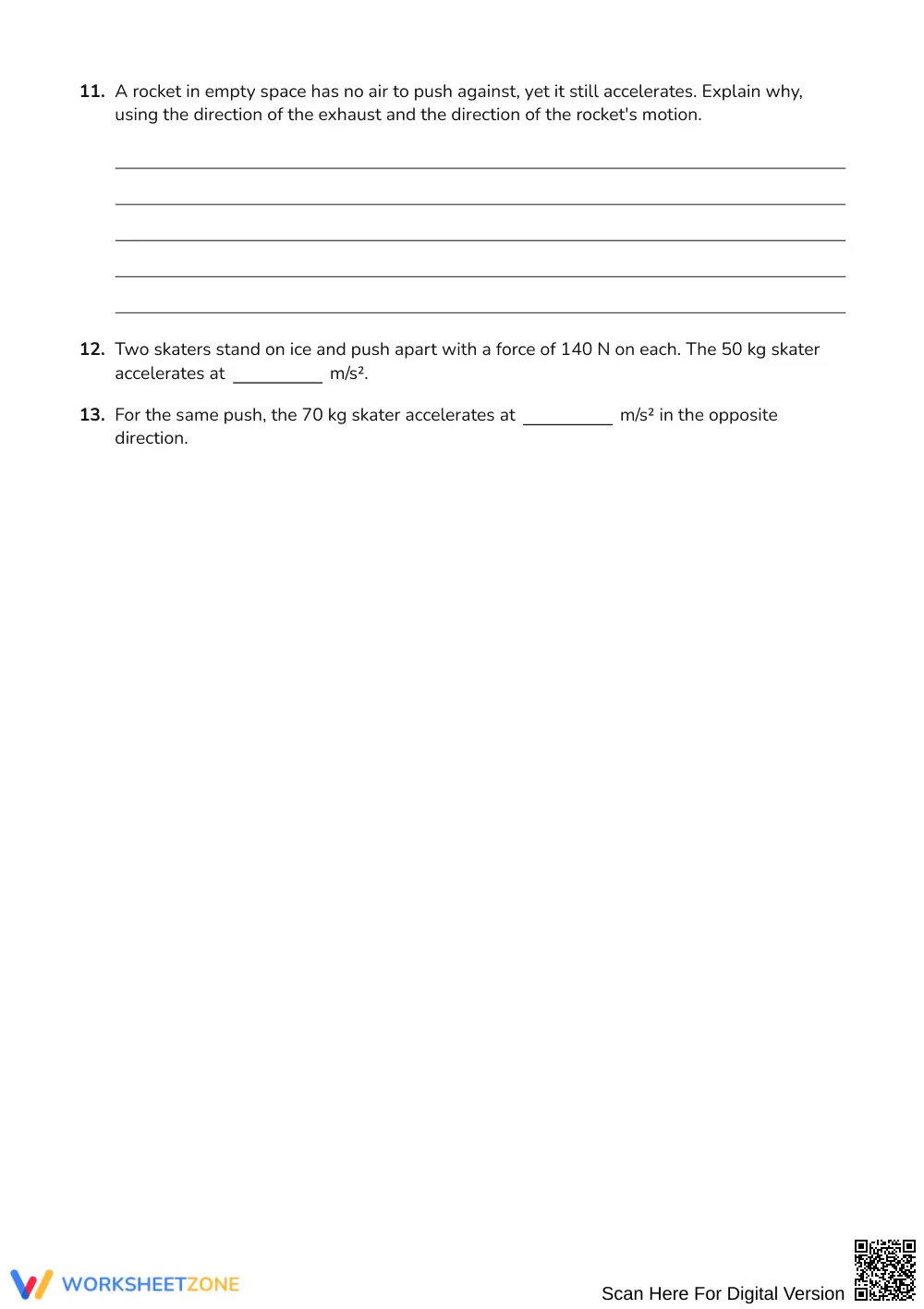
a = F/mand mass-acceleration graphs to calculate how changing object masses alters individual accelerations under equal forces. - Independent Practice (Part C): Students independently explain authentic phenomena, including mosquito-truck collisions, space propulsion mechanics without ambient air, and colliding ice skaters.
This sequence follows a gradual-release instructional model that moves students from foundational identification of force pairs to independent mathematical and conceptual synthesis.
Standards Alignment
This worksheet addresses physical science standards governing forces and interactions. Students analyze data to support the claim that Newton's third law of motion describes the mutual forces exerted between two interacting bodies. The tasks integrate qualitative reasoning with proportional mathematics. Both conceptual and mathematical frameworks can be copied directly into lesson plans, IEP goals, or district curriculum mapping tools.
How to Use It
Deploy this activity immediately following direct instruction on Newton's laws of motion. During guided work, watch for the persistent misconception that the larger or faster object exerts a greater force in an interaction. For mid-unit review, pair students for collaborative problem-solving on the collision data sets. Expect completion within 45 to 60 minutes.
Who It's For
Designed for physical science and introductory physics classrooms in grades 8 through 12, this packet suits general education and college-preparatory learners. Sentence frames support emerging bilingual students during written explanations. Pair this worksheet directly with a dynamic cart-and-track laboratory investigation or force sensor demonstration.
According to research highlighted in Fisher & Frey (2014), systematic gradual-release sequences substantially improve student retention of counterintuitive scientific principles by bridging concrete data with abstract conceptual reasoning. Newton's Third Law frequently challenges secondary science students because everyday intuition incorrectly suggests that larger colliding bodies exert disproportionately larger forces. By isolating variables across 21 structured tasks, this worksheet directly targets common misconceptions regarding interaction pairs, balanced forces, and mass-dependent acceleration. Students actively construct conceptual understanding by pairing equal-and-opposite force rules with quantitative calculations using the fundamental relationship between force, mass, and acceleration. This deliberate scaffold helps students distinguish between the internal forces of an interaction pair and the distinct external forces acting upon individual bodies within a multi-object physical system.


