































Complete Newton's First Law Worksheet | Grades 8-12 Science

Paste this activity's link or code into your existing LMS (Google Classroom, Canvas, Teams, Schoology, Moodle, etc.).
Students can open and work on the activity right away, with no student login required.
You'll still be able to track student progress and results from your teacher account.
This science worksheet develops students' ability to construct, interpret, and revise models of Newton's First Law of Motion. Through force diagrams, kinematic graphs, and cause-and-effect sequences, learners confront common misconceptions about balanced forces, constant velocity, and inertia. Students prove that zero net force maintains an object's state of rest or constant motion.
At a Glance
- Grade: Grades 8–12 · Subject: Science
- Standard: Modeling Motion — Construct, complete, and revise models of balanced forces and inertia
- Skill Focus: Newton's First Law modeling and misconception revision
- Format: 4 pages · 20 problems · Answer key included · PDF
- Best For: Physics concept practice and model critique
- Time: 45–60 minutes
What's Inside
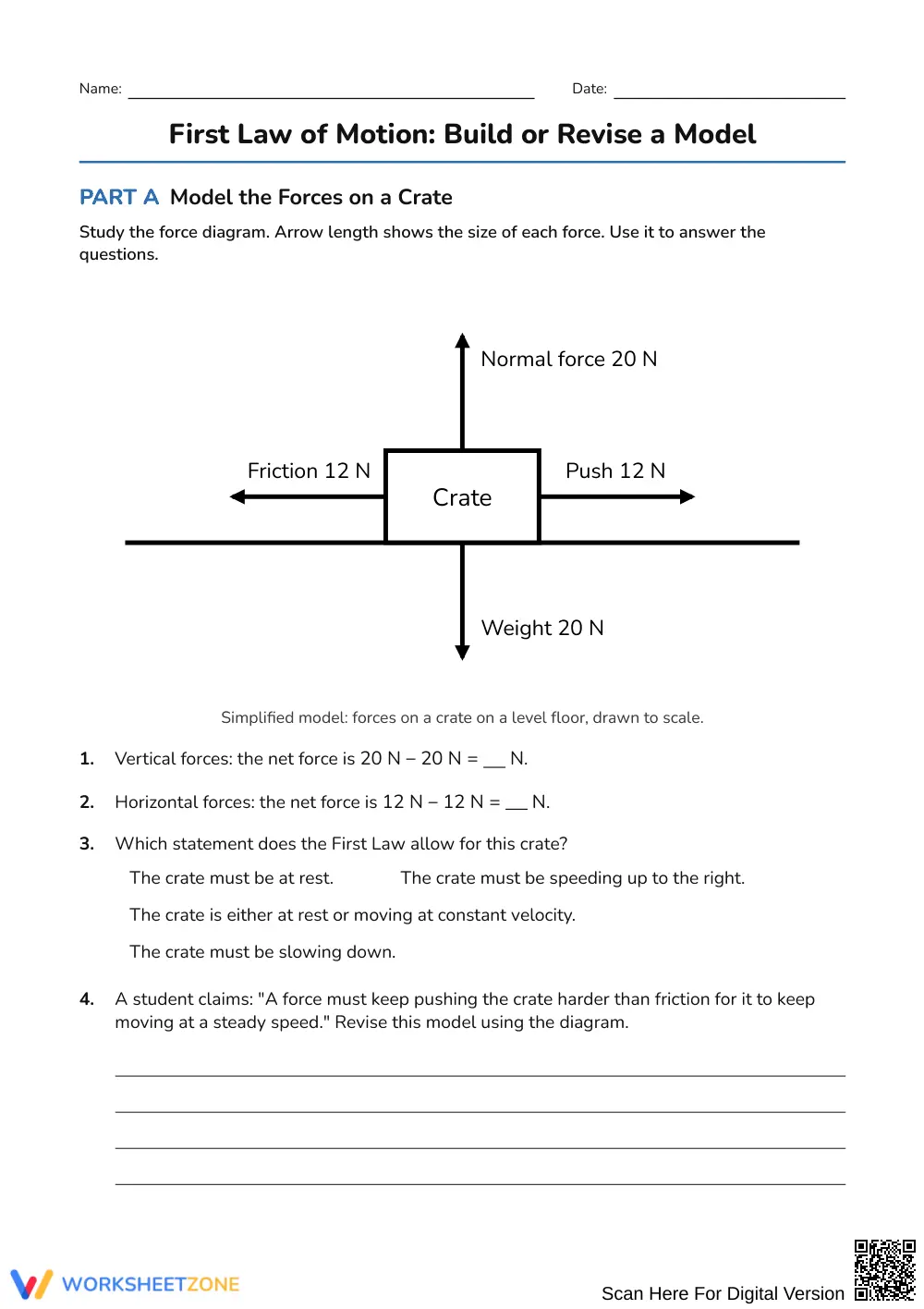
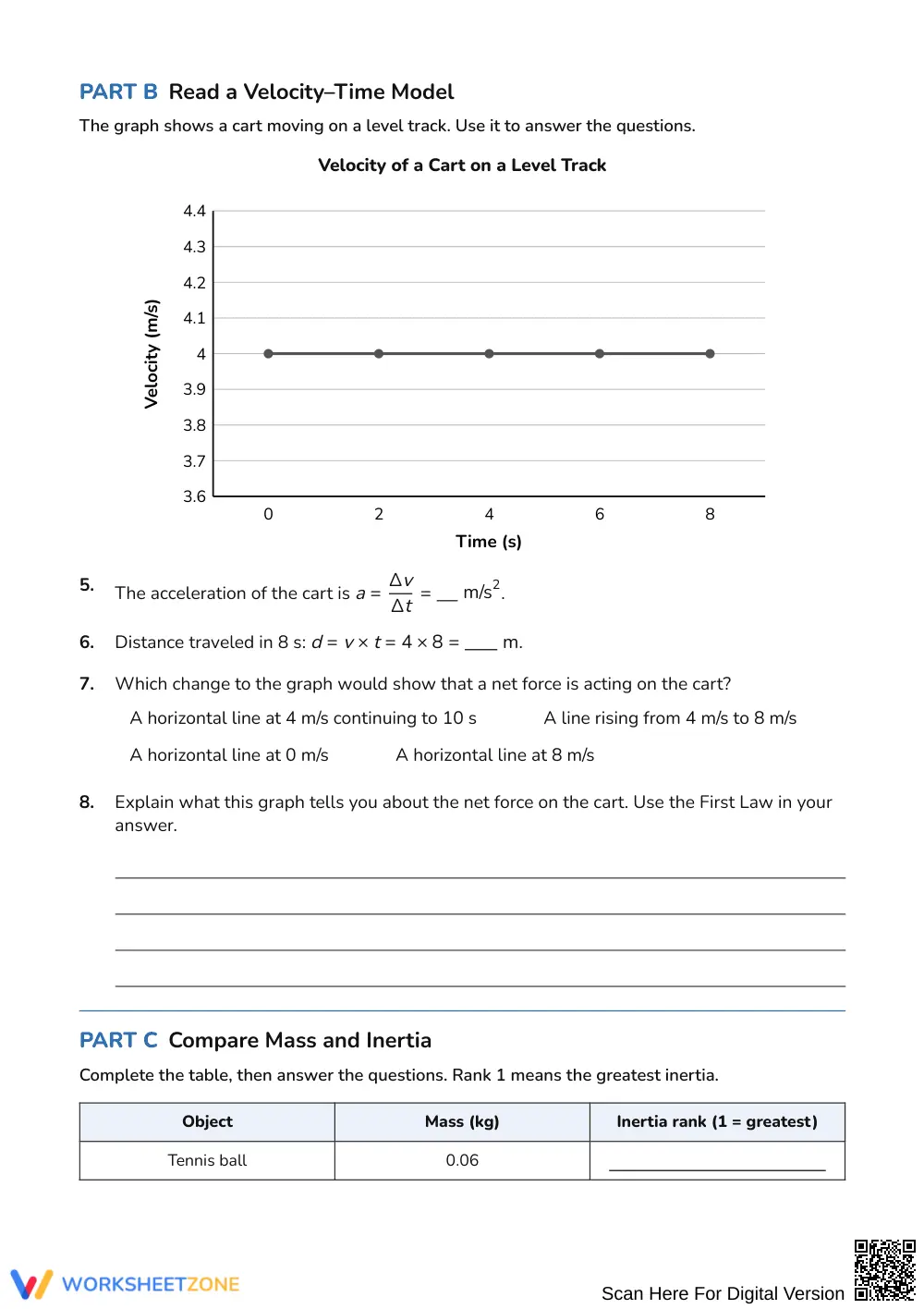
Across 4 pages, this resource features 20 modeling tasks spanning four representations. Students analyze scaled free-body force diagrams on a crate, interpret velocity–time graphs with zero acceleration, rank mass and inertia in structured tables, and trace cause-and-effect sequences in sudden vehicle stops. A 4-page answer key provides complete qualitative explanations and mathematical solutions.
Skill Progression
- Guided Practice (Part A, 5 tasks): Students evaluate balanced horizontal and vertical vectors on a crate, identifying net forces and correcting flawed claims about constant velocity.
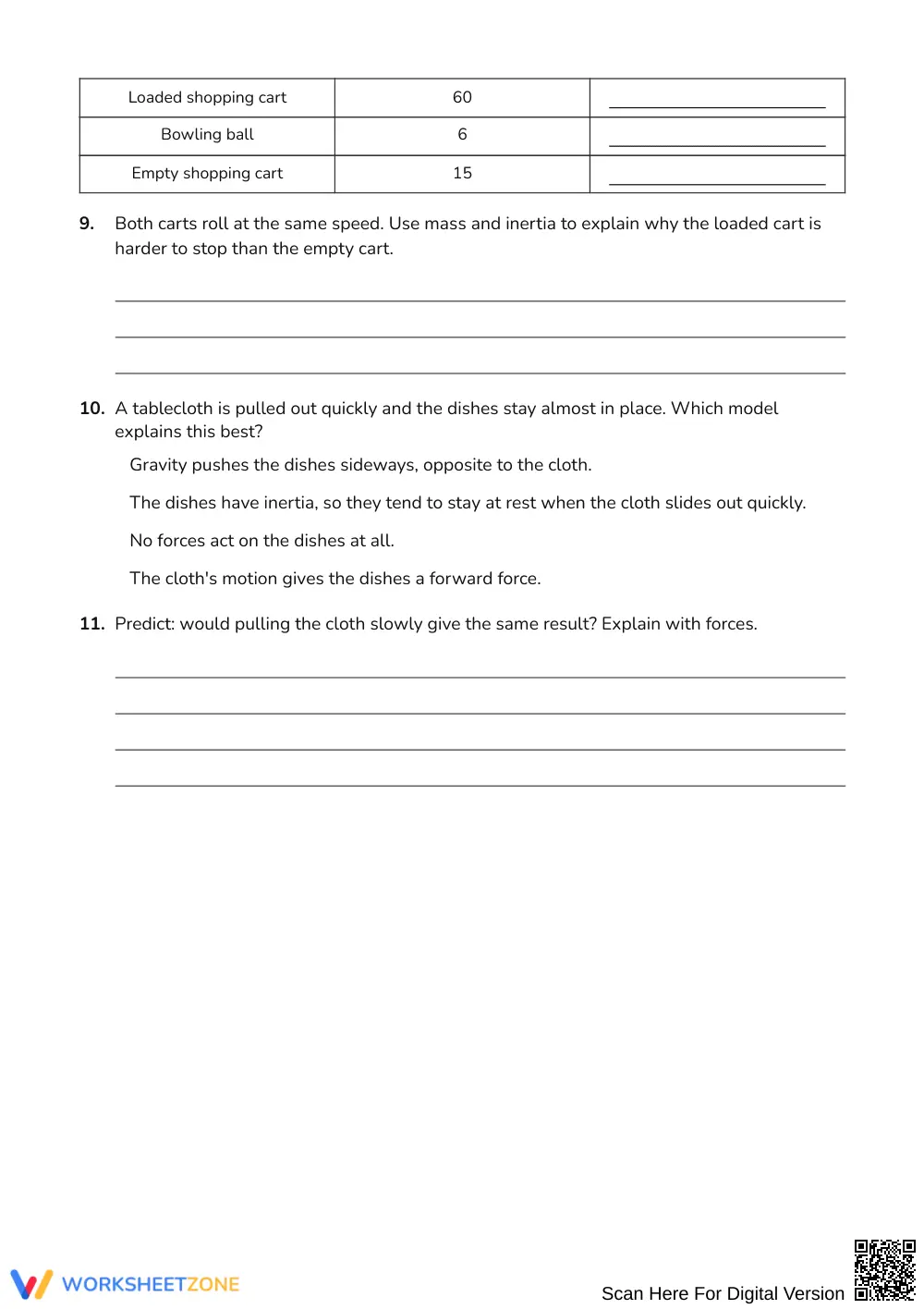
- Supported Practice (Parts B & C, 8 tasks): Learners link horizontal motion graphs to zero net force and rank inertia in data tables to explain friction and tablecloth phenomena.
- Independent Practice (Part D, 7 tasks): Students complete collision flowcharts, calculating deceleration forces and revising claims about inertia pushing passengers forward.
This sequence implements the gradual-release framework, moving students from guided visual analysis to independent causal critique.
Standards Alignment
This worksheet aligns with secondary physical science standards where students construct explanations and models showing how balanced and unbalanced forces govern an object's motion. Learners evaluate force balances and apply inertia to predict dynamic behavior. Both standard codes can be copied directly into lesson plans, IEP goals, or district curriculum mapping tools.
How to Use It
Use this resource after introducing balanced forces to replace passive lecture with active model revision. During work time, check whether students incorrectly invent forward forces during vehicle deceleration. Students typically complete the 20 problems in 45 to 60 minutes during collaborative station rotations or targeted independent practice.
Who It's For
This practice set supports middle school physical science and high school introductory physics students learning to critique scientific models. Differentiate by providing acceleration formulas as an extra scaffold, and pair the activity with an inertia cart demonstration.
Scientific modeling is an essential competency in secondary physical science education, enabling learners to visualize invisible forces and correct stubborn misconceptions regarding Newton's First Law of Motion. According to Fisher & Frey (2014), structured modeling activities that pair visual representations with scaffolded critique significantly enhance conceptual understanding by moving students deliberately from guided interpretation to independent reasoning. This 4-page worksheet guides Grades 8–12 students through 20 targeted modeling problems, examining net force balances, constant velocity graphs, mass-dependent inertia, and deceleration dynamics. By requiring students to identify errors in intuitive statements—such as the belief that continuous force is required to sustain steady velocity—the resource operationalizes evidence-based formative assessment. Teachers can use the complete 4-page answer key to evaluate qualitative student explanations, address intuitive force errors in real time, and confirm rigorous alignment with foundational physical science mechanics standards.


