
































Complete Newton's First Law Worksheet | Grades 8-12 Science

Paste this activity's link or code into your existing LMS (Google Classroom, Canvas, Teams, Schoology, Moodle, etc.).
Students can open and work on the activity right away, with no student login required.
You'll still be able to track student progress and results from your teacher account.
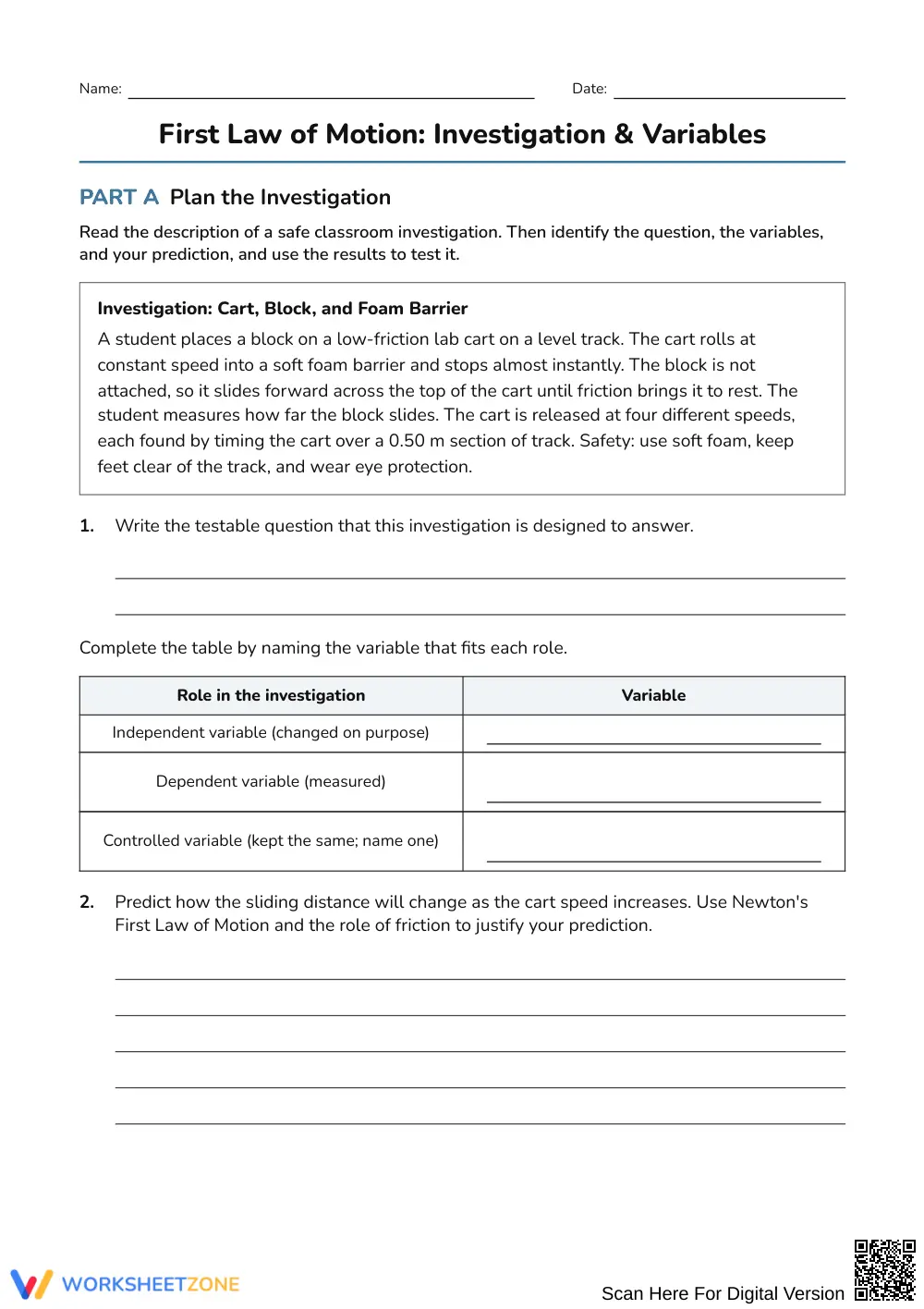
This physical science worksheet equips students in grades 8–12 to deconstruct experimental design and connect empirical data directly to Newton's First Law of Motion. Learners identify testable questions, isolate experimental variables, interpret deceleration data from a cart-and-barrier trial, and evaluate how balanced horizontal forces preserve constant velocity across diverse physical scenarios.
At a Glance
- Grade: 8–12 · Subject: Science
- Standard: Newton's First Law — Plan investigations and use evidence to demonstrate how forces change motion
- Skill Focus: Experimental design, variable identification, and inertia analysis
- Format: 4 pages · 17 problems · Answer key included · PDF
- Best For: Lab prep or force analysis practice
- Time: 45–55 minutes
What's Inside
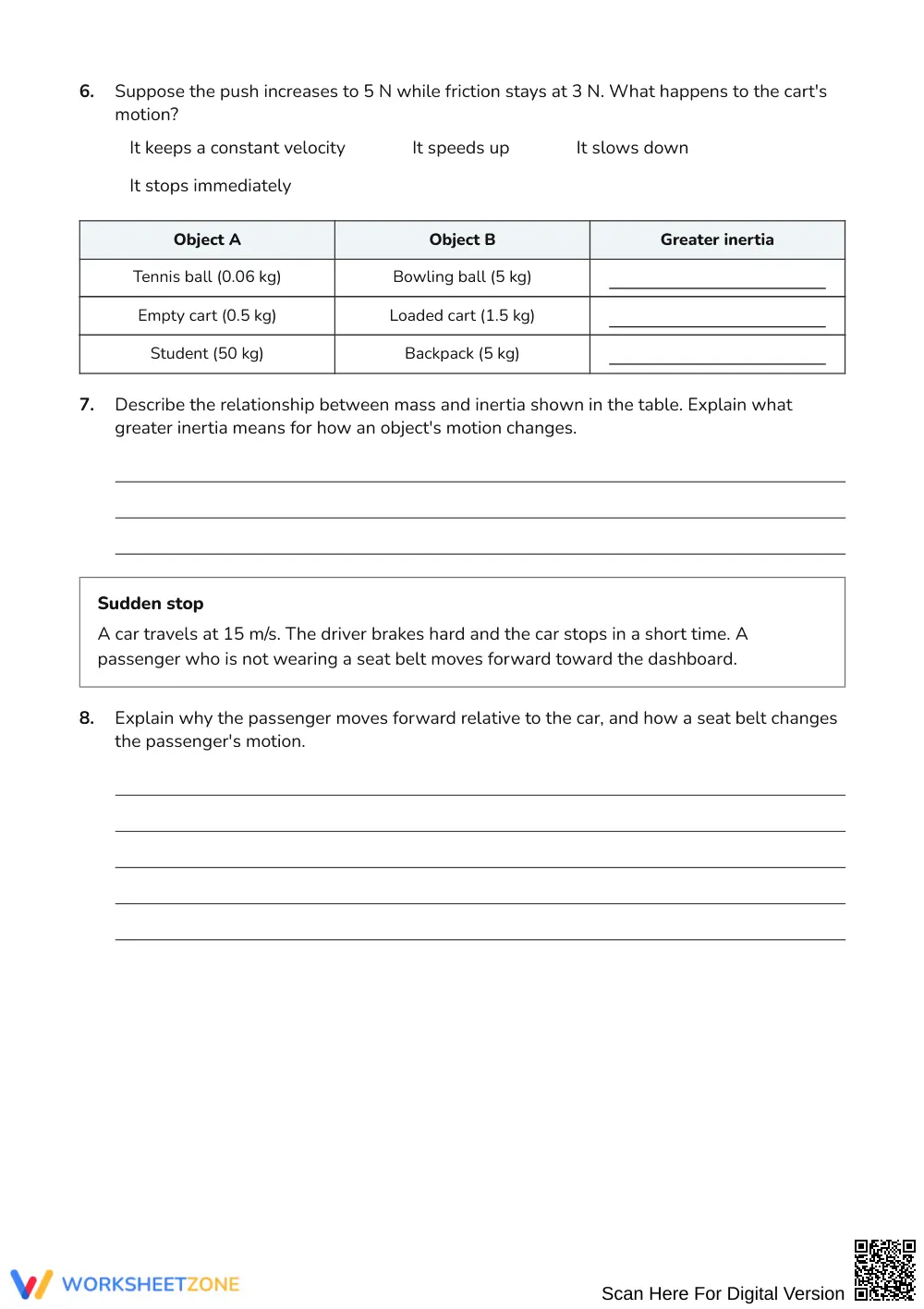
Across four structured student pages, this resource presents 17 targeted analytical tasks organized into two thematic parts. Part A presents a complete classroom investigation featuring a lab cart, sliding friction block, and foam deceleration barrier, asking students to articulate testable hypotheses, classify independent, dependent, and controlled variables, and project nonlinear sliding distances. Part B introduces force diagrams, quantitative mass comparisons, and qualitative scenarios like automotive seat belts and the classic tablecloth demonstration, complete with a comprehensive 4-page teacher answer key.
Skill Progression
- Guided Practice: Tasks 1–4 scaffold experimental inquiry by guiding students through a structured cart investigation to define the research question and isolate variables.
- Supported Practice: Tasks 5–10 use numerical trial data, trend extrapolation, and balanced force diagrams to examine net force and predict motion changes.
- Independent Practice: Tasks 11–17 challenge learners to apply inertia principles to real-world friction problems, automotive safety mechanisms, and common misconceptions.
This structured progression reflects an intentional gradual-release model, shifting students from guided experimental design to independent mechanical reasoning.
Standards Alignment
This resource supports middle and high school physical science performance expectations focusing on forces and interactions. Students design investigations and construct explanations demonstrating that an object either remains at rest or continues moving at constant velocity unless acted upon by an unbalanced external force. These alignment details can be copied directly into lesson plans, IEP goals, or district curriculum mapping tools.
How to Use It
Deploy this worksheet after initial direct instruction on balanced forces and inertia, or as a structured pre-lab task before conducting physical cart experiments. During independent work, conduct quick formative assessment checks on Part A's variable table to ensure students do not confuse speed with sliding distance. Most students will complete all 17 items within 45 to 55 minutes.
Who It's For
Designed for physical science and introductory physics classrooms in grades 8 through 12, this resource provides clear scaffolding for general education students and accessible entry points for English learners. Pair this worksheet directly with a live friction-track demonstration or an introductory force-body diagram anchor chart.
Structured science investigations require students to coordinate variable identification with conceptual mechanics, bridging concrete trial data and abstract physical principles. According to research documented in Fisher & Frey (2014), systematic cognitive scaffolds that prompt learners to justify physical predictions using empirical observations substantially improve conceptual retention in secondary science domains. This 17-problem worksheet reinforces experimental precision by requiring students to separate independent variables from outcome metrics, evaluate net force equilibrium, and articulate how mass directly dictates resistance to acceleration. By grounding qualitative inertia concepts in reproducible cart-and-barrier data, the resource helps high school and middle school learners dismantle persistent misconceptions surrounding force and motion, establishing a dependable foundation for subsequent quantitative studies of Newton's second law and conservation of momentum.


