



























Complete Net Population Change Worksheet | Grade 10 Biology
Paste this activity's link or code into your existing LMS (Google Classroom, Canvas, Teams, Schoology, Moodle, etc.).
Students can open and work on the activity right away, with no student login required.
You'll still be able to track student progress and results from your teacher account.
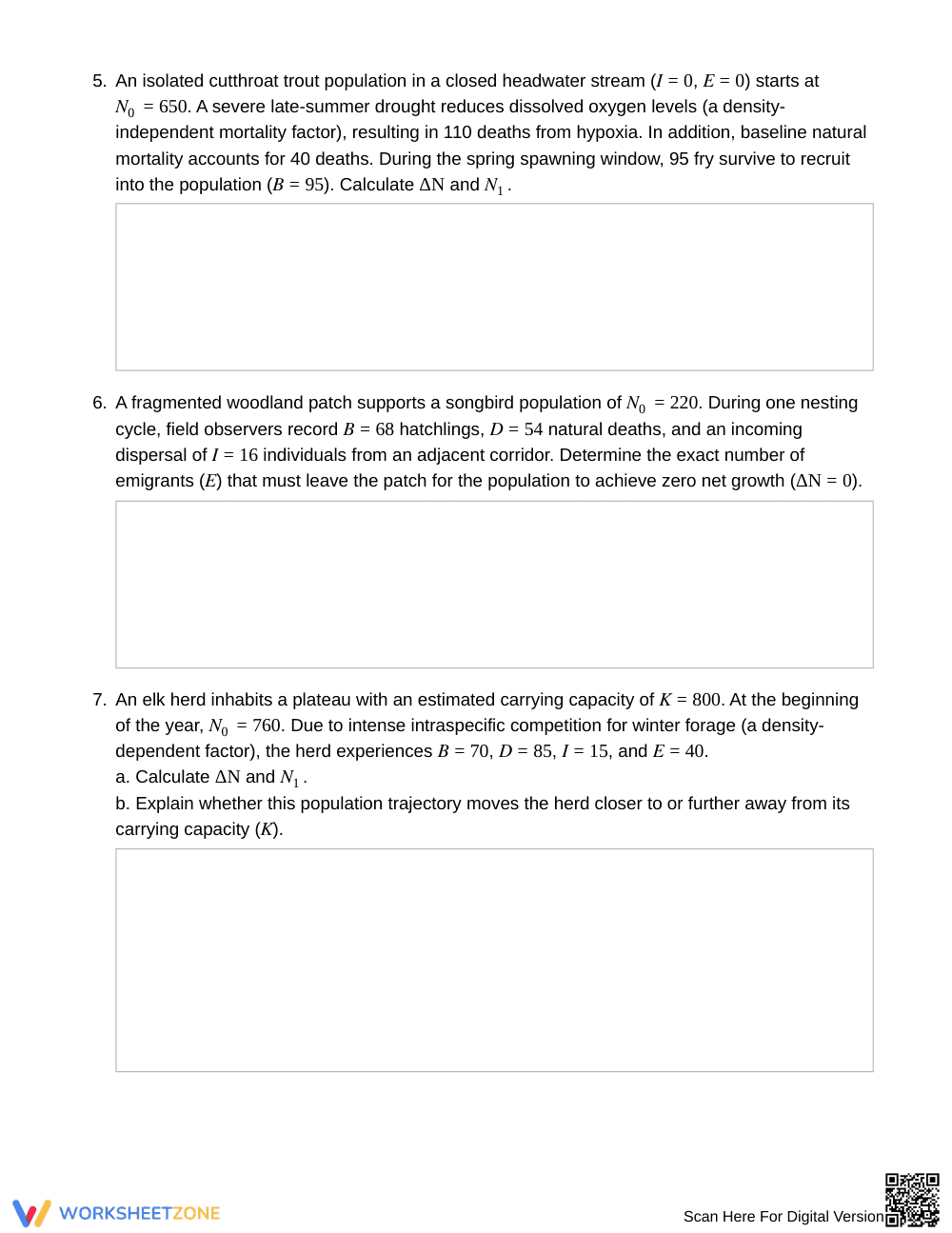
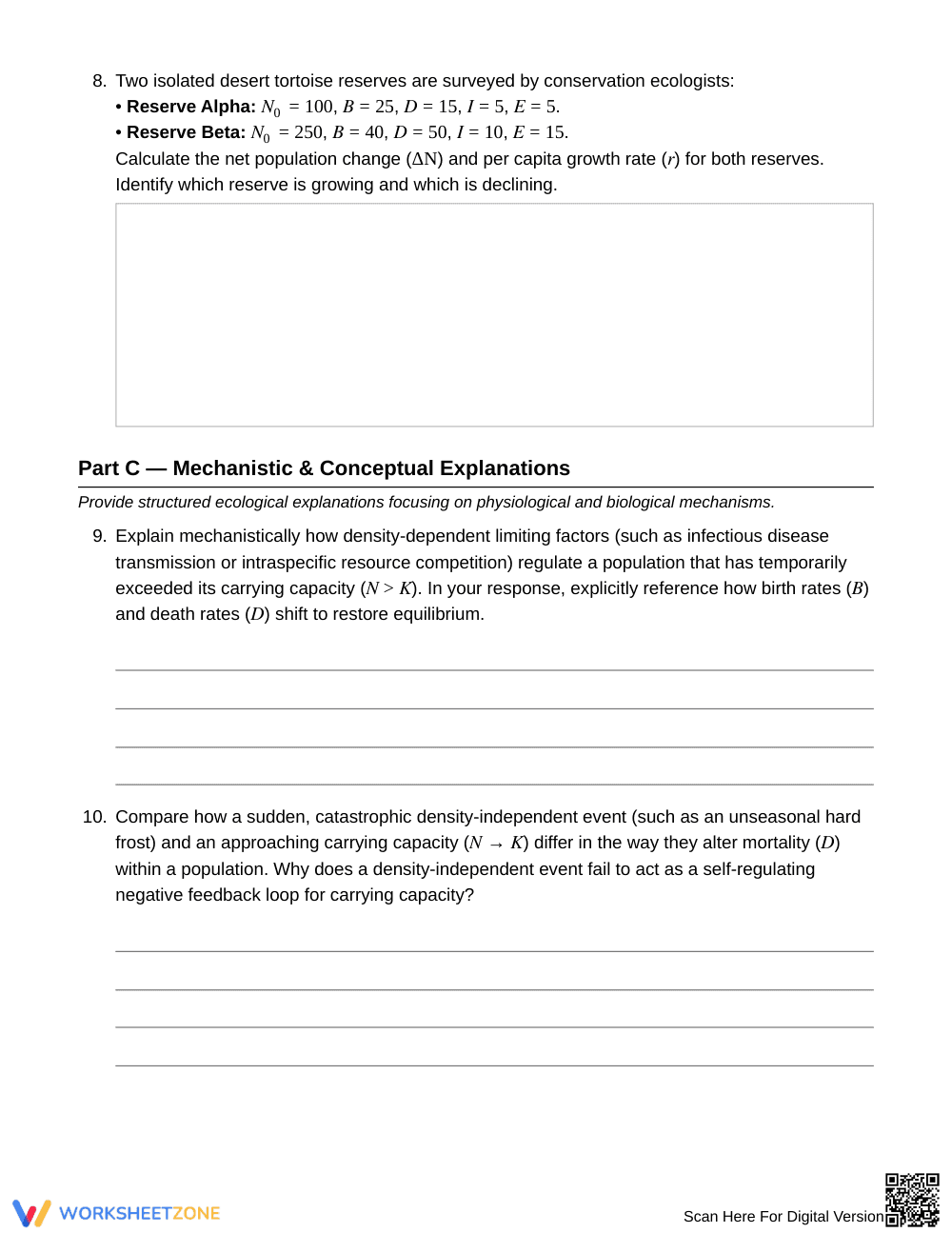
This comprehensive biology worksheet trains high school students to calculate net population changes using standard demographic formulas and evaluate carrying capacity constraints. Learners compute birth, death, immigration, and emigration rates across multi-year data sets while distinguishing between density-dependent and density-independent limiting factors affecting population equilibrium.
At a Glance
- Grade: 10 · Subject: Biology
- Standard: Population Dynamics — Calculate population growth rates and model carrying capacity limits
- Skill Focus: Populations & Carrying Capacity: Calculate Net Population Change
- Format: 5 pages · 10 problems · Answer key included · PDF
- Best For: High school ecology practice and review
- Time: 45–55 minutes
What's Inside: The resource features 10 structured quantitative and conceptual tasks arranged across 5 pages, supported by complete worked formulas, a multi-year demographic data table, and a detailed 3-page teacher answer key showing step-by-step calculations and model written responses.
Skill Progression
- Guided Practice: Tasks 1–3 establish fundamental computation routines by walking students through the core demographic formula, per capita rate conversions, and direction of growth determinations.
- Supported Practice: Tasks 4–8 present multi-year cohort tables, closed-system constraints, target zero-growth balances, and carrying capacity comparisons across distinct wildlife reserves.
- Independent Practice: Tasks 9–10 challenge learners to synthesize ecological theory through extended free-response explanations contrasting density-dependent negative feedback mechanisms with density-independent environmental disturbances.
This structured progression adheres to the gradual release of responsibility model, guiding students systematically from algorithmic calculation to high-level ecological reasoning.
Standards Alignment
Aligned with high school life science standards for ecological dynamics, this activity requires students to use mathematical representations to support explanations of factors affecting carrying capacity and population sizes. Both curriculum descriptors can be copied directly into lesson plans, IEP goals, or district curriculum mapping tools.
How to Use It
Deploy this worksheet after direct instruction on population ecology or as a mid-unit formative assessment. During guided practice, observe whether students properly combine immigration and births before subtracting combined mortality and emigration values. Students typically complete the 10 problems within 45 to 55 minutes of focused class time or independent study.
Who It's For
This resource is designed for Grade 10 Biology and Environmental Science students mastering quantitative ecology. It pairs effectively with logistic growth graphing activities, carrying capacity simulations, or introductory predator-prey case studies.
Structured quantitative modeling in secondary science reinforces student comprehension of dynamic biological systems. According to Fisher & Frey (2014), implementing an intentional gradual release framework enables high school learners to transition successfully from teacher-guided arithmetic models to complex, independent scientific reasoning. This 10-task worksheet addresses core high school ecology expectations by guiding students through the demographic balance equation to calculate net population change and per capita growth rates. By embedding structured computational tables alongside open-ended analytical prompts, the resource requires students to evaluate how density-dependent limiting factors establish ecological carrying capacity. Biology educators can implement this resource to provide rigorous, scaffolded practice that develops quantitative literacy and conceptual mastery in population dynamics, ensuring students master the mathematical models necessary for advanced biological analysis.


