































Complete Natural Selection Worksheet | Grades 8-12 Science

Paste this activity's link or code into your existing LMS (Google Classroom, Canvas, Teams, Schoology, Moodle, etc.).
Students can open and work on the activity right away, with no student login required.
You'll still be able to track student progress and results from your teacher account.
This comprehensive science worksheet guides secondary students through building, interpreting, and revising scientific models of natural selection. Learners evaluate mechanistic causal chains, analyze multi-generation population shift data, and correct pervasive teleological misconceptions using real-world mouse fur distribution scenarios.
At a Glance
- Grade: Grades 8–12 · Subject: Science
- Standard: Construct and revise an explanation based on evidence for natural selection
- Skill Focus: Build or Revise a Model
- Format: 4 pages · 19 problems · Answer key included · PDF
- Best For: Modeling practice and misconception repair
- Time: 45–60 minutes
What's Inside: The 4-page activity packet features 19 targeted tasks organized into three distinct structural parts. Students complete cyclical process diagrams, graph and classify directional, stabilizing, and disruptive selection data across five shade classes, and evaluate Lamarckian misconceptions within an authentic experimental case study with complete solutions provided.
Skill Progression
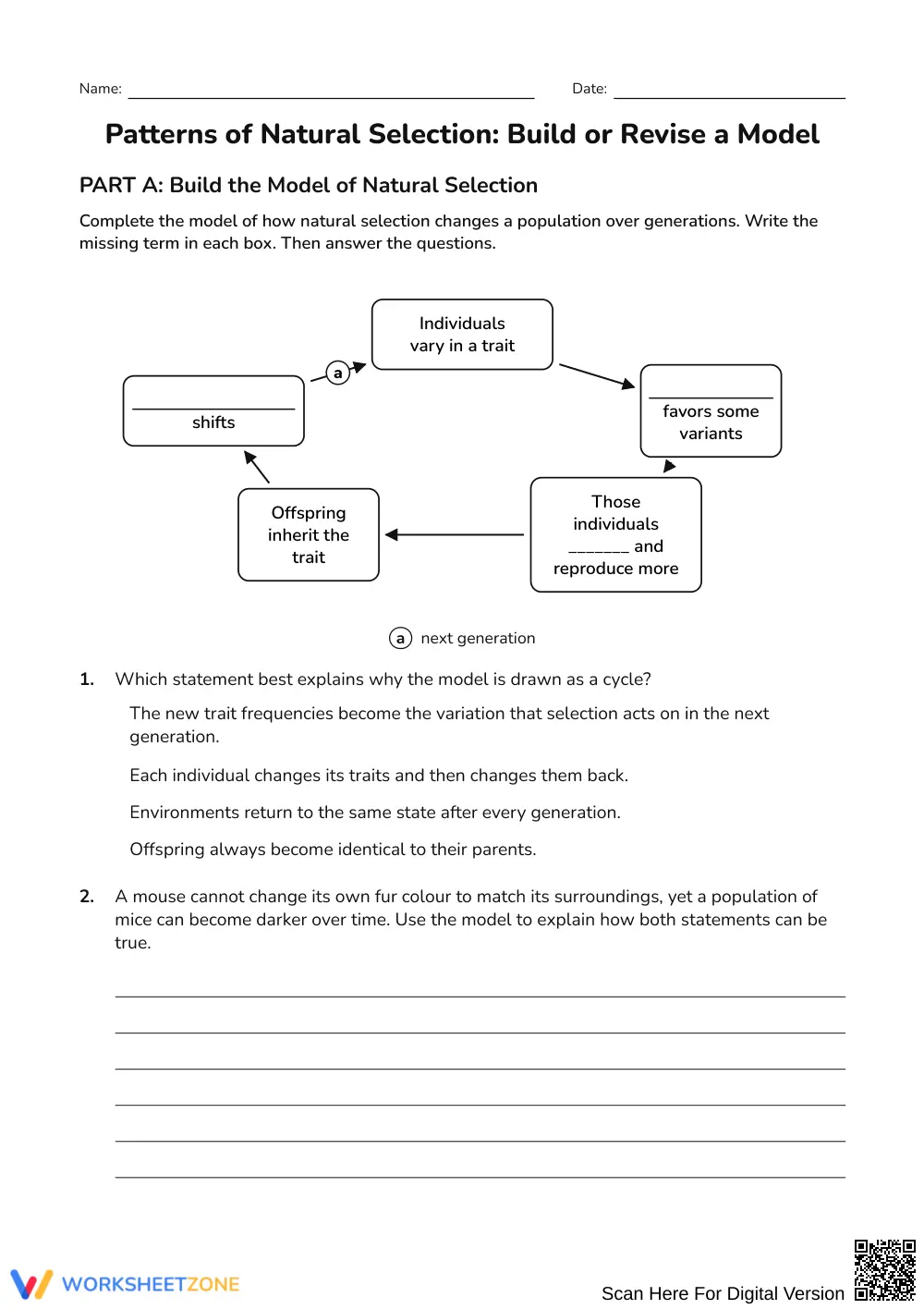
- Guided practice (Part A, 4 tasks): Students sequence the core evolutionary cycle from individual variation to trait frequency shifts, explaining why selection acts on populations rather than individuals.
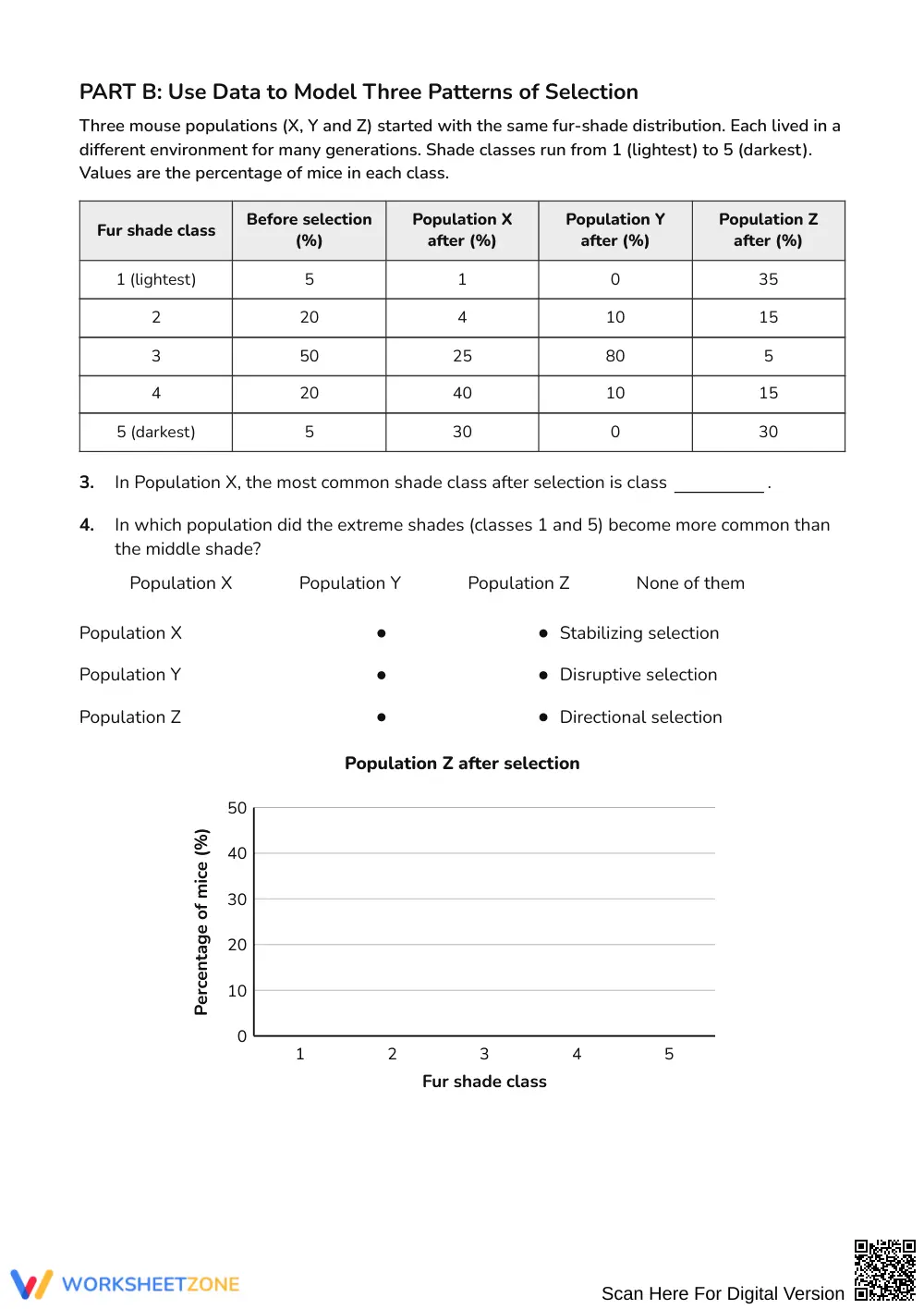
- Supported practice (Part B, 8 tasks): Learners inspect percentage tables across five phenotypic classes, graph bimodal disruptive curves, and classify directional, stabilizing, and disruptive selection modes.
- Independent practice (Part C, 7 tasks): Students critique an erroneous student model, calculate generation-over-generation percentage point shifts, and construct claim-evidence-reasoning arguments for environmental change.
This structured progression mirrors the gradual release of responsibility framework, transitioning students from foundational concept modeling to independent evaluation and empirical revision.
Standards Alignment
This resource aligns with secondary life science standards focusing on the construction, evaluation, and revision of evidence-based models explaining how natural selection leads to adaptation in populations. Supporting standards address mathematical thinking through data interpretation and graphical representation of phenotypic distributions across successive generations. Both standard descriptions can be copied directly into lesson plans, IEP goals, or district curriculum mapping tools.
How to Use It
Deploy this packet directly after introductory instruction on evolutionary mechanisms to solidify conceptual understanding before summative assessment. For mid-lesson formative checks, circulate during Part C to observe whether students detect the fatal flaw of intentional individual adaptation versus differential reproductive success. The full assignment requires 45 to 60 minutes for complete individual execution or paired collaborative inquiry.
Who It's For
Designed for biology and life science students in grades 8 through 12, this resource includes quantitative distributions and analytical prompts suitable for general and advanced courses. Pair this activity with an interactive rock pocket mouse natural selection simulation or a foundational genetic variation anchor chart for optimal conceptual integration.
According to Fisher & Frey (2014), scaffolded cognitive apprenticeships that challenge students to identify errors in conceptual models significantly deepen domain comprehension compared to passive reading routines. When high school biology students actively interrogate flawed explanations of adaptive processes, they confront persistent misconceptions regarding organismal intent and Lamarckian inheritance. By coupling qualitative mechanistic pathways with quantitative distribution graphing, this 19-task modeling resource ensures learners directly operationalize evolutionary principles across multiple generations. Students examine empirical shifts, classify three distinct patterns of environmental selection, and formulate evidence-based predictions grounded in differential reproductive fitness. This dual emphasis on model construction and model revision provides rigorous practice in secondary science classrooms, translating abstract evolutionary theory into visible, testable population dynamics while ensuring teachers have access to verifiable assessment data.


