































Complete Natural Selection Worksheet | Grades 8-12 Science

Paste this activity's link or code into your existing LMS (Google Classroom, Canvas, Teams, Schoology, Moodle, etc.).
Students can open and work on the activity right away, with no student login required.
You'll still be able to track student progress and results from your teacher account.
This natural selection cause-and-effect worksheet guides students through tracing how inherited variation and selective environmental pressures alter traits over generations. Biology students analyze empirical finch data, distinguish directional, stabilizing, and disruptive selection, and resolve common evolutionary misconceptions across 20 scaffolded exercises.
At a Glance
- Grade: Grades 8–12 · Subject: Science
- Standard: Natural Selection Standards — Explain how selective pressures cause changes in population traits over generations
- Skill Focus: Patterns of Natural Selection: Cause and Effect
- Format: 4 pages · 20 problems · Answer key included · PDF
- Best For: Biology practice and data analysis
- Time: 40–50 minutes
What's Inside
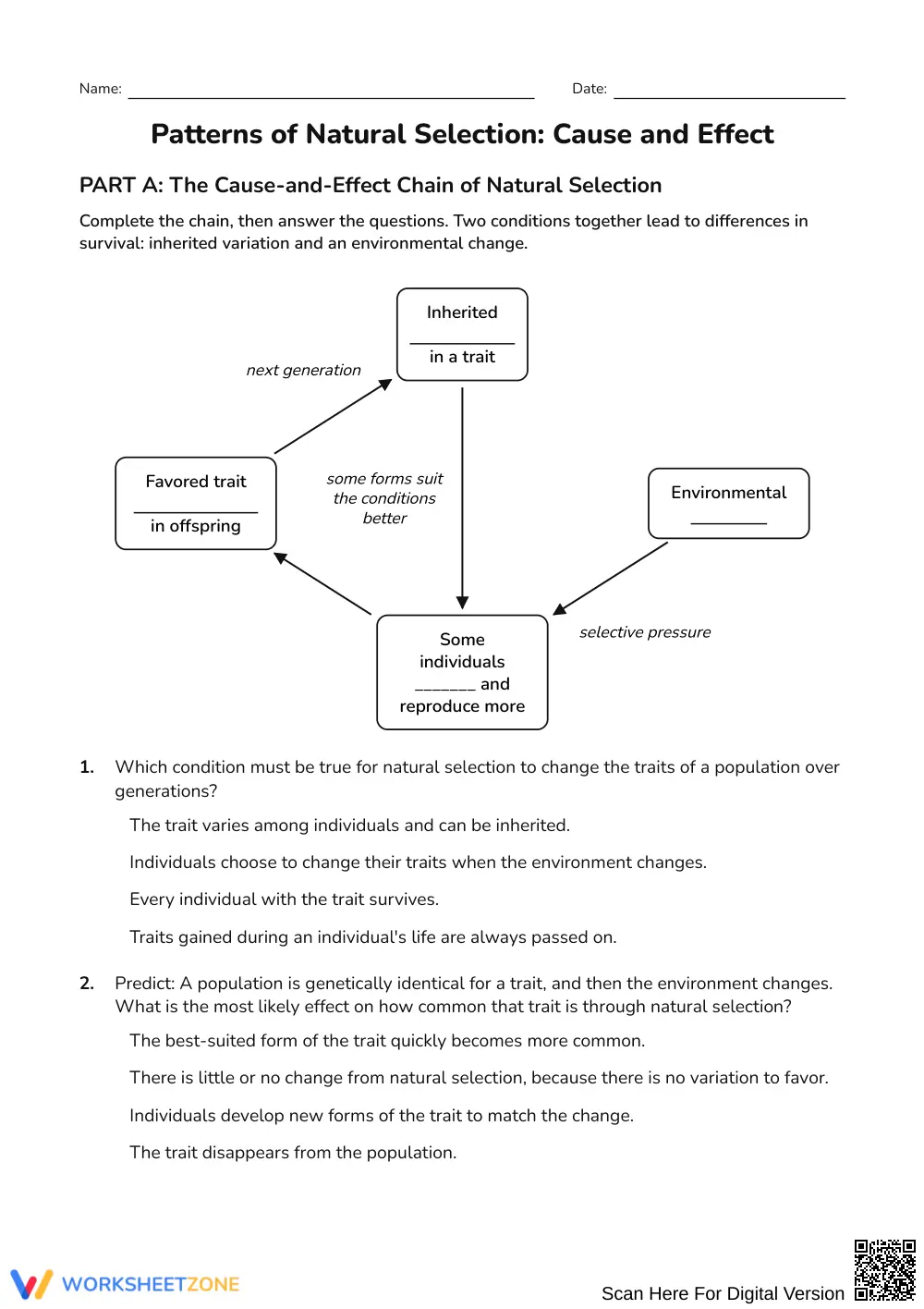
This 4-page worksheet includes 20 targeted problems paired with a complete 4-page answer key. Part A provides a cause-and-effect flow model with conceptual multiple-choice items. Part B features a Galápagos finch case study with data tables, trait distributions, and structured written prompts using target vocabulary. Part C provides pattern definitions, scenario classification, distribution predictions, and an explicit misconception-correction task.
Skill Progression
- Guided practice (Part A, 4 problems): Students trace the cause-and-effect chain connecting variation and environmental change to differential survival.
- Supported practice (Part B, 6 problems): Learners analyze numerical finch data, explaining selective shifts using the terms variation, survive, and offspring.
- Independent practice (Part C, 10 problems): Students classify stabilizing, directional, and disruptive selection, forecast trait shifts, and correct teleological reasoning.
This gradual-release structure moves students from conceptual frameworks to independent biological data analysis.
Standards Alignment
This worksheet aligns with middle and high school life science standards requiring students to construct explanations based on evidence for how natural selection leads to adaptation in populations. A supporting crosscutting standard focuses on cause and effect, prompting students to evaluate how environmental changes drive trait distributions. Both standard codes can be copied directly into lesson plans, IEP goals, or district curriculum mapping tools.
How to Use It
Use this activity during direct instruction as guided group practice or immediately following a lesson as an independent evaluation. When reviewing Part B, check whether students recognize that trait variation existed before the drought rather than developing in response to need. The worksheet requires approximately 40 to 50 minutes to complete.
Who It's For
This resource supports students in Grades 8 through 12 studying general biology or life science. Built-in vocabulary cues and graphic models assist developing readers and English learners, while extension items challenge advanced students. Pair this printable with a direct instruction presentation on natural selection mechanisms for optimal student comprehension.
According to Fisher & Frey (2014), structured gradual-release frameworks significantly enhance conceptual acquisition in science by shifting cognitive responsibility from guided teacher modeling to independent student application. This Grades 8–12 science worksheet develops student mastery of natural selection cause-and-effect relationships alongside patterns of directional, stabilizing, and disruptive selection. Through twenty scaffolded problems across four instructional pages, students examine quantitative biological data, evaluate finch beak distributions before and after environmental shifts, and actively dismantle persistent misconceptions regarding intentional adaptation. Aligned to life science standards on natural selection and evolution, this resource pairs empirical data analysis with structured vocabulary prompts, ensuring that learners explain how differential reproductive success alters population traits over successive generations. The accompanying four-page answer key provides complete model explanations for formative assessment, supporting standards-based instructional planning and targeted student intervention across secondary biology classrooms.


