




























Views
Downloads



Complete Narrator Perspective Worksheet | Grade 6 ELA

Paste this activity's link or code into your existing LMS (Google Classroom, Canvas, Teams, Schoology, Moodle, etc.).
Students can open and work on the activity right away, with no student login required.
You'll still be able to track student progress and results from your teacher account.
This five-page worksheet helps Grade 6 students identify first-person, third-person limited, and third-person omniscient narration and analyze how each perspective controls the information a reader receives. Through two paired passages set in the same robotics-competition scene, students move from identification to evidence-based analysis to prediction, building the close-reading habits RL.6.6 demands.
At a Glance
- Grade: 6 · Subject: ELA
- Standard:
RL.6.6— Explain how an author develops the point of view of the narrator or speaker- Skill Focus: Narrator perspective and scope of access
- Format: 5 pages · 12 problems · Answer key included · PDF
- Best For: Guided and independent practice on POV
- Time: 25–40 minutes
What's Inside
Students read two original fiction passages—Text A (first-person) and Text B (third-person omniscient)—depicting the same robotics trial from different vantage points. A key-terms box defines all three narrator types in student-friendly language. The 12 tasks span three parts: multiple-choice identification (Part A, 3 items), evidence-based short-response analysis (Part B, 6 items), and perspective-change prediction prompts (Part C, 3 items). A two-page answer key covers every question.
Skill Progression
- Part A (3 items): Students classify each text's point of view using the key-terms box as a scaffold and write a brief comparison sentence.
- Part B (6 items): Students cite textual evidence to explain how narrator access shapes information flow and reader interpretation.
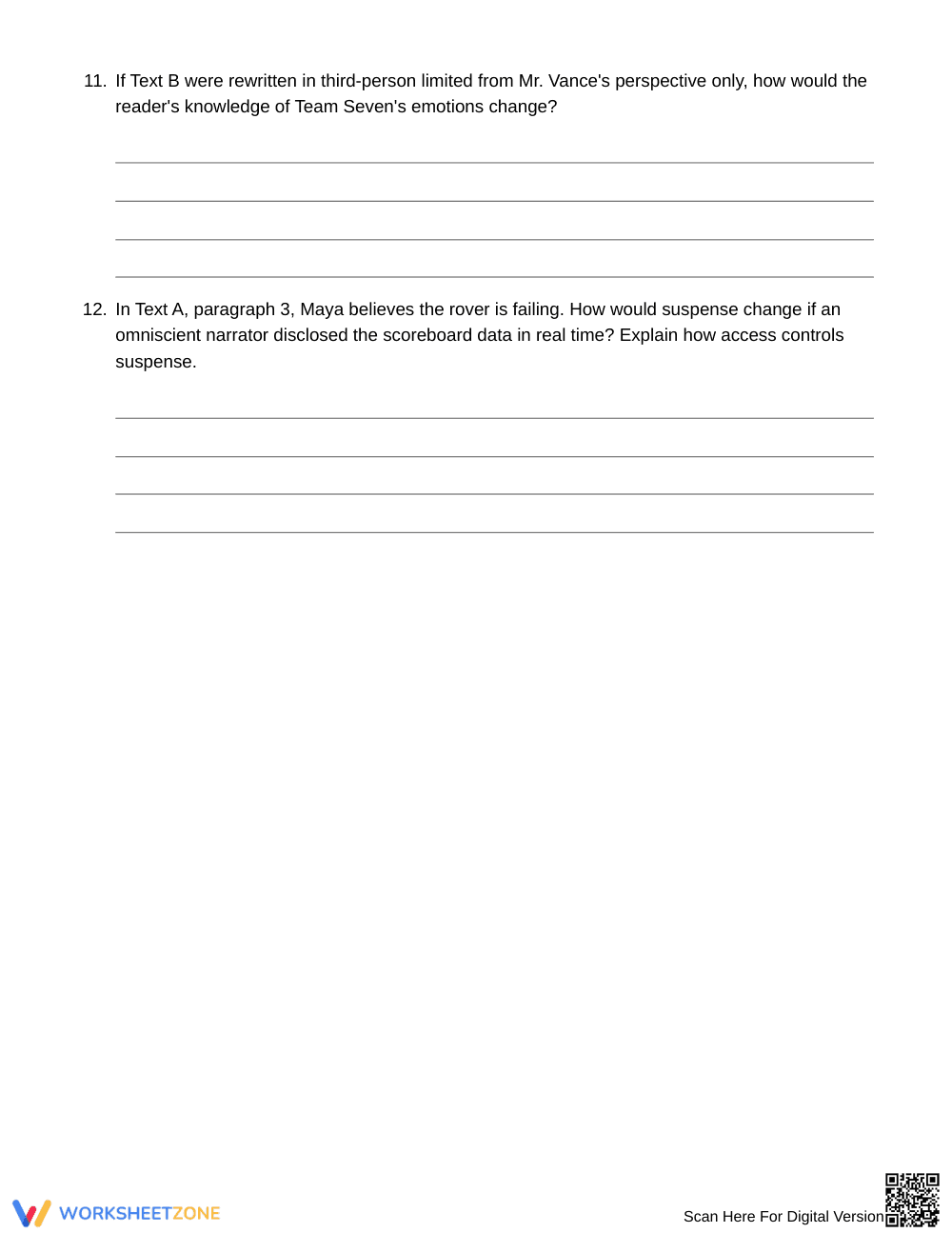
- Part C (3 items): Students predict how switching narrator perspective would alter tension and reader knowledge, applying understanding without scaffolded cues.
This gradual-release structure mirrors the I Do, We Do, You Do framework, moving students from recognition through analysis to transfer.
Standards Alignment
Every task maps to RL.6.6: Explain how an author develops the point of view of the narrator or speaker in a text. Part B also reinforces RL.6.1 by requiring textual evidence to support analytical claims.
How to Use It
Assign Part A after direct instruction on narrative point of view; use Parts B and C as independent or partner practice. For formative assessment, scan Part B responses for whether students distinguish between external observation and internal narrator access. Expect completion in 25 to 40 minutes depending on reading level.
Who It's For
Designed for on-grade sixth-grade readers in any fiction or literature unit. Struggling readers benefit from the key-terms box and paragraph-specific prompts, while advanced students are stretched by Part C's perspective-shift predictions.
This RL.6.6 worksheet targets a skill the 2024 NAEP reading framework identifies as foundational to literary comprehension: recognizing how an author's narrator choice shapes information available to the reader. Across 12 tasks, students identify first-person, third-person limited, and third-person omniscient perspectives, cite evidence of narrator access boundaries, and predict how a point-of-view change would transform tension and reader knowledge. Research by Fisher and Frey (2014) confirms that a gradual-release model—moving from guided identification to evidence-based analysis to independent transfer—produces stronger retention of complex literacy skills than isolated drill. The paired-passage design gives students a controlled comparison: the same scene through two narrative lenses, making access scope concrete rather than abstract. Teachers can use the answer key for rapid scoring or peer review.


