




























Views
Downloads



Complete Narrator Choice Worksheet | Grade 6 ELA

Paste this activity's link or code into your existing LMS (Google Classroom, Canvas, Teams, Schoology, Moodle, etc.).
Students can open and work on the activity right away, with no student login required.
You'll still be able to track student progress and results from your teacher account.
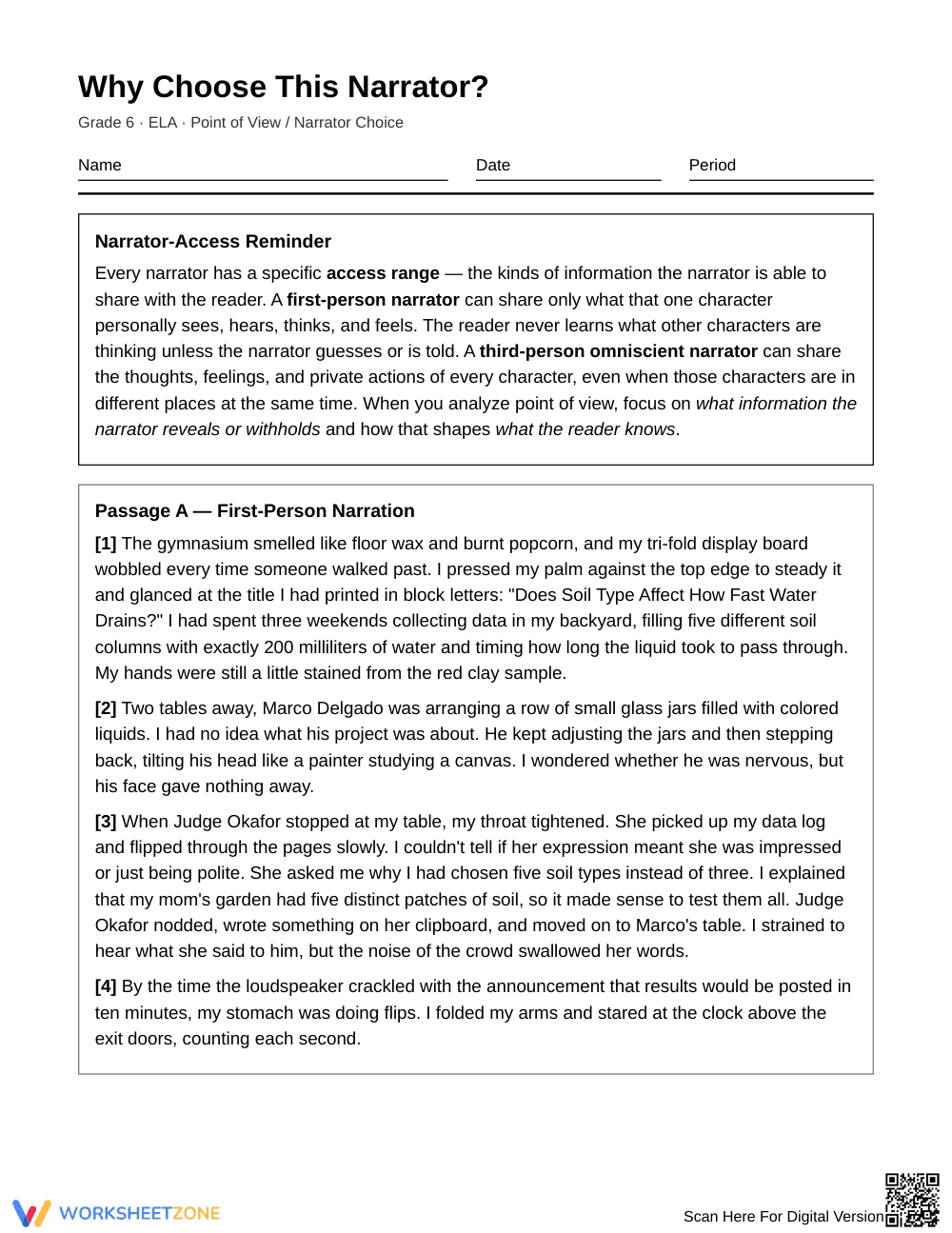
This point of view worksheet guides Grade 6 students to analyze how an author's narrator choice shapes reader knowledge. By contrasting first-person and third-person omniscient accounts of a shared science fair scene, students identify narrator access limits, examine information gaps, and evaluate authorial intent.
At a Glance
- Grade: 6 · Subject: ELA
- Standard:
RL.6.6— Explain how an author develops the narrator's point of view- Skill Focus: Narrator Access Range and Point of View
- Format: 5 pages · 8 problems · Answer key included · PDF
- Best For: Point of view analysis and close reading
- Time: 35–45 minutes
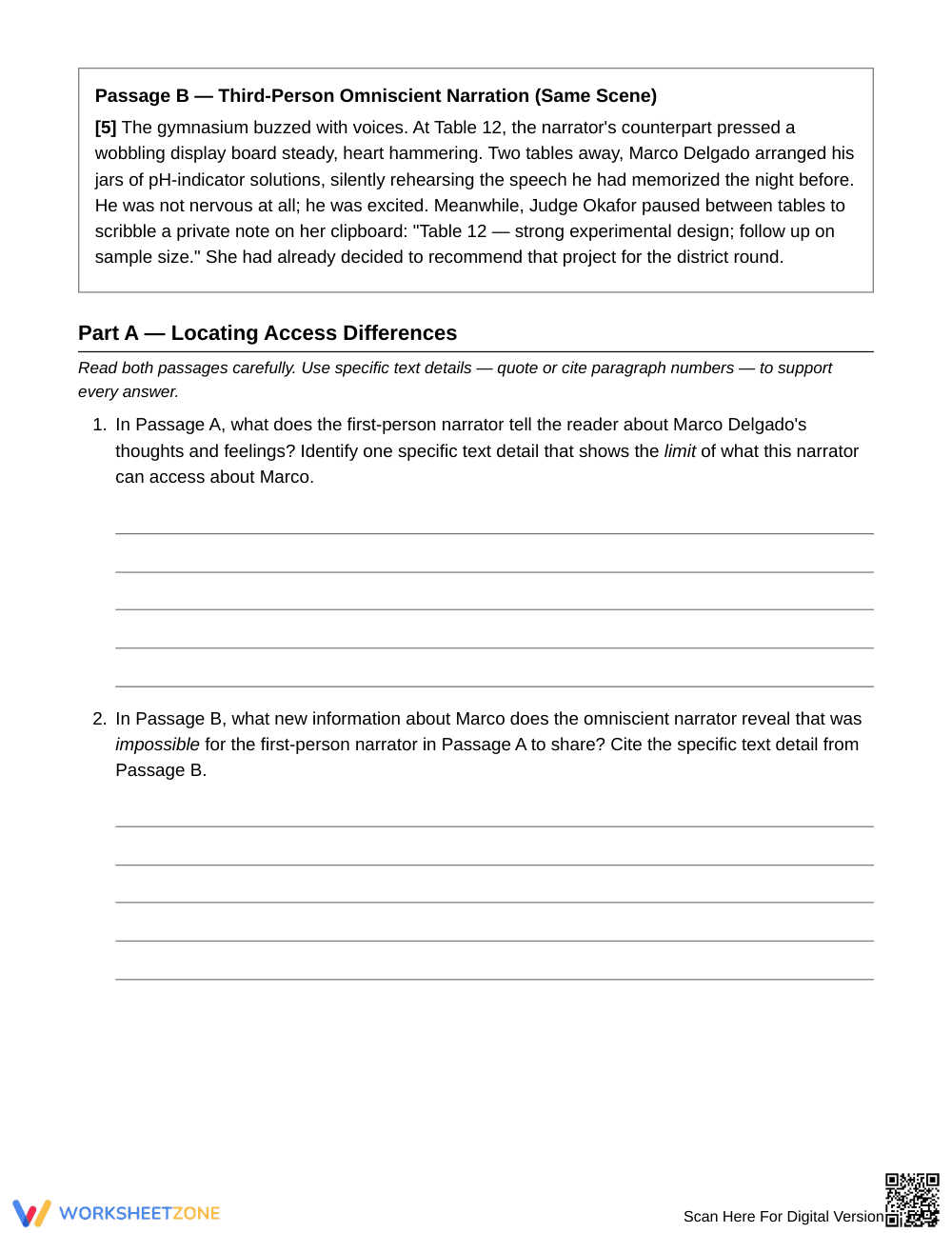
The 5-page printable resource opens with a Narrator-Access Reminder reference box defining first-person and third-person omniscient viewpoints. Students read two parallel narrative passages depicting the same science fair scenario from distinct perspectives. Across 8 text-dependent written response items, learners cite textual evidence to compare narrator access, followed by a 3-page explanatory answer key.
Skill Progression
- Guided practice (Part A, 2 tasks): Students locate concrete differences in narrator access across both passages, identifying what each narrator reveals about Marco Delgado.
- Supported practice (Part B, 4 tasks): Learners analyze how narrator boundaries control reader knowledge, contrasting internal sensations with withheld judging decisions using paragraph citations.
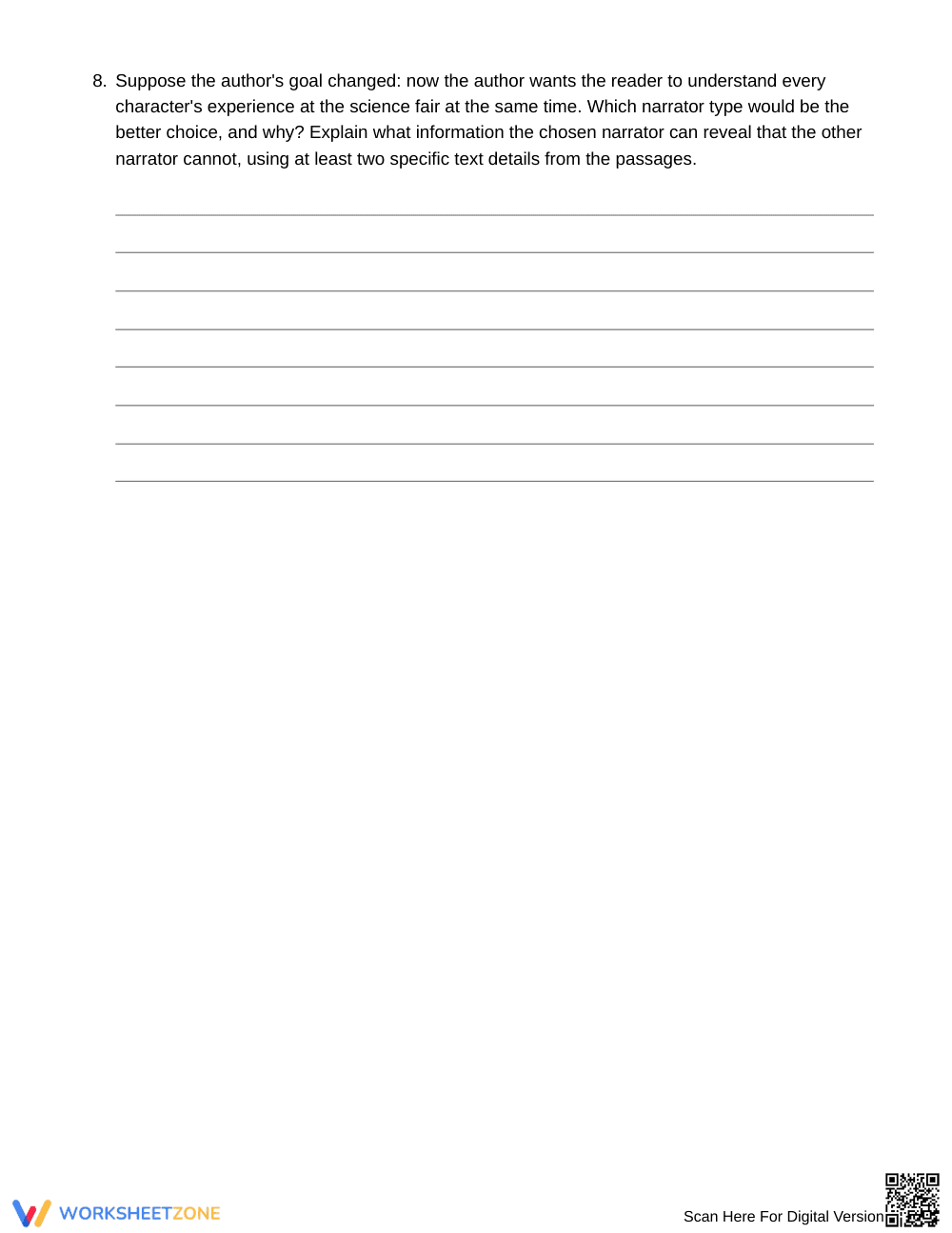
- Independent practice (Part C, 2 tasks): Students write extended responses justifying why an author selects a specific narrator to build suspense or reveal multiple perspectives.
This structured progression leverages gradual-release scaffolding, moving learners from text comparison to literary evaluation.
Standards Alignment
This worksheet aligns with primary standard RL.6.6: Explain how an author develops the point of view of the narrator or speaker in a text. It also reinforces RL.6.1 by requiring explicit textual citations for every analytical response. Both standard codes can be copied directly into lesson plans, IEP goals, or district curriculum mapping tools.
How to Use It
Deploy this activity immediately after direct instruction on narrative perspective during independent practice or paired literature circles. During completion, check that students cite specific paragraph details in Part B rather than giving generalized summaries. Most sixth-grade students will complete the dual-passage analysis and all 8 questions within 35 to 45 minutes.
Who It's For
This resource is designed for Grade 6 general education and middle school reading intervention students mastering narrative technique. It supports English language learners through side-by-side passage comparisons. Pair this worksheet with a whole-class novel study anchor chart exploring internal versus omniscient narration.
Mastering standard RL.6.6 requires Grade 6 students to move beyond simply identifying narrative perspective to explaining how an author's choice of narrator directly governs reader knowledge. According to research on close reading by Fisher & Frey (2014), structured instructional scaffolds that contrast paired texts foster critical metacognitive awareness of authorial craft and narrative boundaries. This point of view worksheet operationalizes that research through side-by-side first-person and third-person omniscient passages illustrating an identical science fair scene. By analyzing narrator access limits across 8 sequential tasks, students observe firsthand how restricted viewpoints build suspense while omniscient perspectives deliver comprehensive dramatic context. Learners cite explicit textual evidence to defend analytical conclusions, establishing rigorous close-reading routines essential for secondary literature study. This targeted exercise provides educators with clear, actionable formative assessment data to evaluate student mastery of perspective analysis.


