




























Views
Downloads



Complete Narrator Boundary Worksheet | Grade 6 ELA

Paste this activity's link or code into your existing LMS (Google Classroom, Canvas, Teams, Schoology, Moodle, etc.).
Students can open and work on the activity right away, with no student login required.
You'll still be able to track student progress and results from your teacher account.
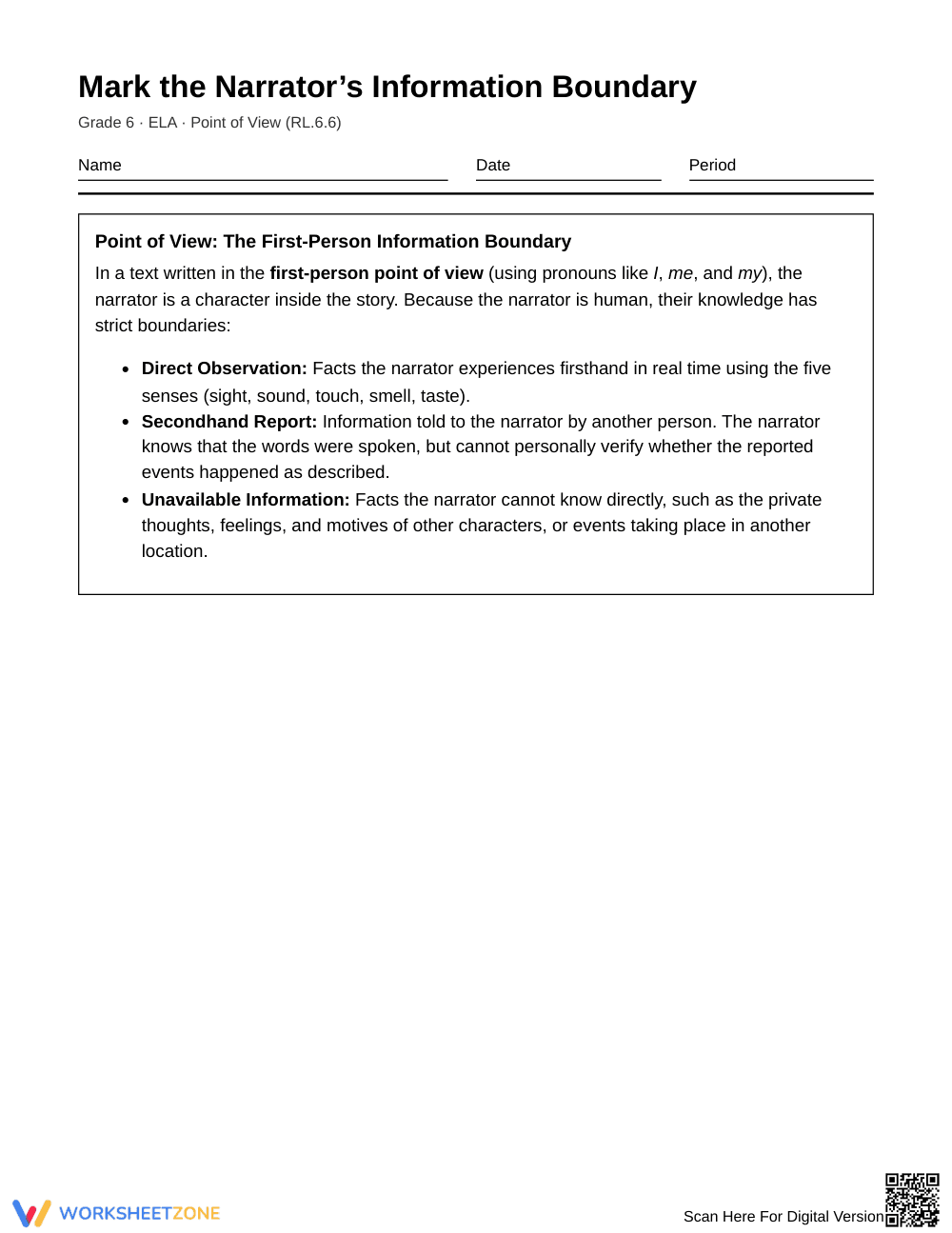
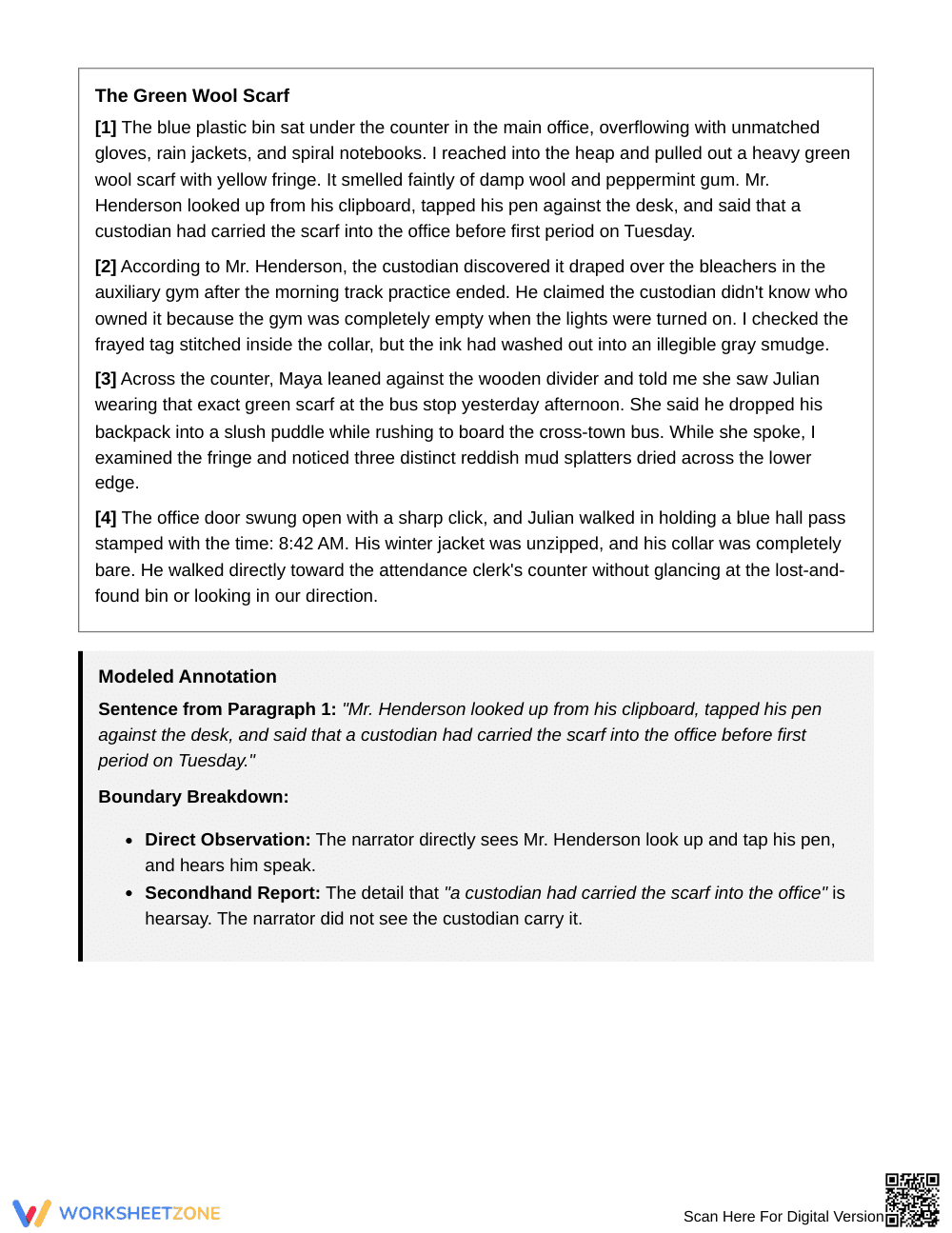
This Grade 6 reading literature worksheet trains students to analyze first-person point of view by charting the narrator's information boundary. Students examine an original passage, "The Green Wool Scarf," to distinguish firsthand sensory observations from secondhand reports and unavailable knowledge, developing critical text-analysis skills aligned directly to standard RL.6.6.
At a Glance
- Grade: 6 · Subject: ELA
- Standard:
RL.6.6— Explain how an author develops the point of view of the narrator- Skill Focus: Mark the Narrator’s Information Boundary
- Format: 5 pages · 10 problems · Answer key included · PDF
- Best For: Point of view close reading practice
- Time: 30–45 minutes
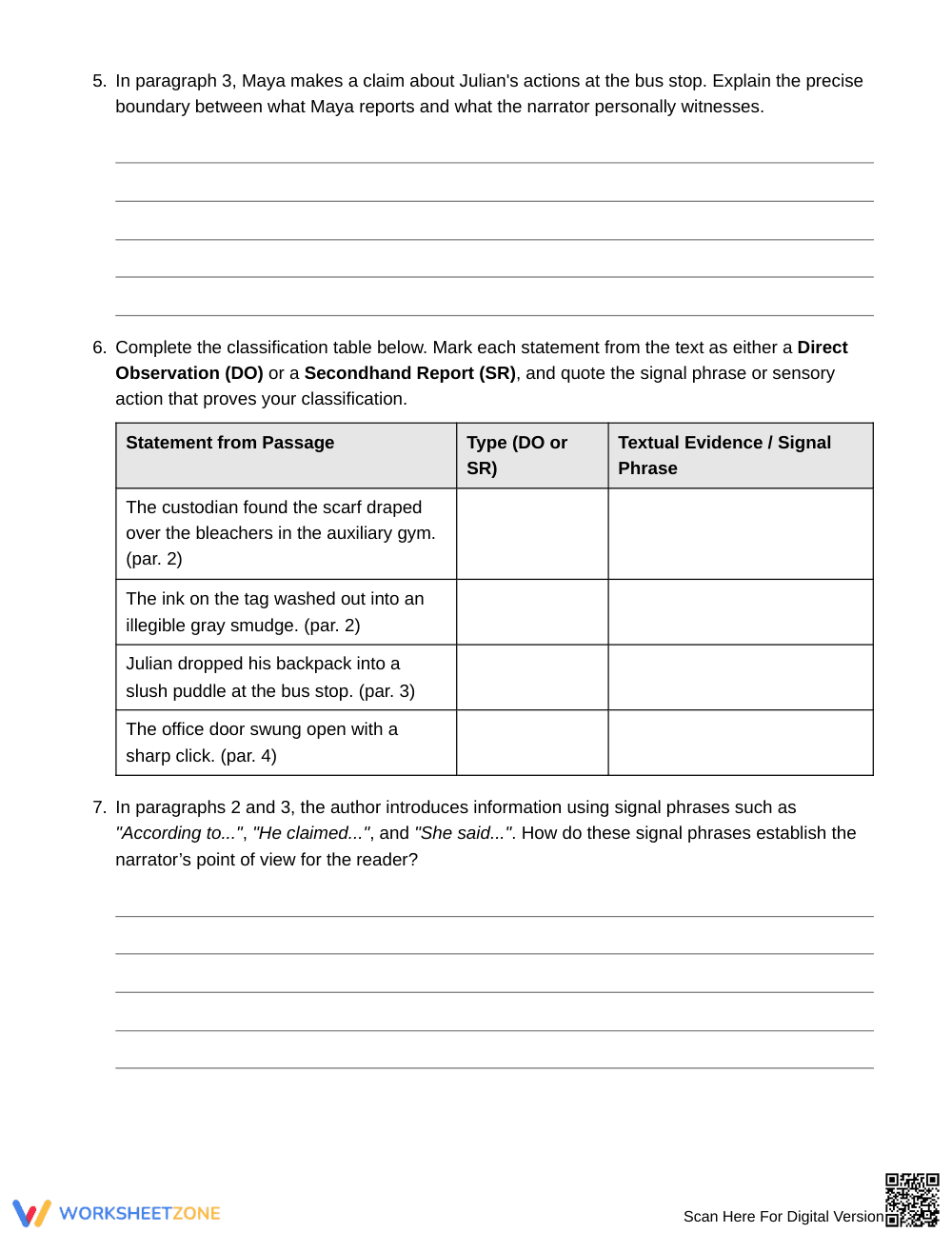
The resource features an original realistic fiction passage accompanied by a modeled annotation box, an evidence classification table, multiple-choice checks, and text-dependent short-response prompts across 5 pages. Students evaluate signal phrases, classify details as direct observations or secondhand reports, and explain narrative constraints using a complete 3-page explanatory answer key.
Skill Progression
- Guided practice (Tasks 1–3): Students analyze modeled examples and identify direct sensory details observed firsthand by the narrator within the opening paragraphs.
- Supported practice (Tasks 4–8): Learners complete a 4-part evidence classification chart and analyze signal phrases to differentiate witnessed facts from unverified secondhand reports.
- Independent practice (Tasks 9–10): Students synthesize their analysis through extended written responses explaining why internal motives and unobserved events remain outside the first-person information boundary.
This structured progression follows a gradual-release model, shifting students from concrete sensory identification to nuanced literary analysis of point of view constraints.
Standards Alignment
This worksheet directly targets RL.6.6: Explain how an author develops the point of view of the narrator or speaker in a text. Additionally, it supports RL.6.1 by requiring students to cite explicit textual evidence and signal phrases to substantiate their analytical claims. Both standard codes can be copied directly into lesson plans, IEP goals, or district curriculum mapping tools.
How to Use It
Deploy this resource during independent practice following a mini-lesson on narrative perspective, or assign it as a targeted small-group intervention for students learning to separate character knowledge from reader knowledge. During instruction, check student classifications in Part B to verify whether learners notice attribution tags like "she said." Expected completion time is 30 to 45 minutes.
Who It's For
This worksheet is designed for Grade 6 ELA students mastering literary analysis standards, including English language learners who benefit from explicit signal phrase categorization and modeled annotations. Pair this resource with an anchor chart on narrative perspectives or a whole-class close reading of a text with an unverified first-person narrator.
According to Fisher & Frey (2014), structured close reading routines that isolate text mechanisms—such as narrative perspective—significantly enhance adolescent reading comprehension and analytical writing. Standard RL.6.6 requires Grade 6 students to explain how authors develop narrative point of view, moving beyond pronoun identification toward evaluating the limitations of a narrator's knowledge. By requiring students to classify information as direct observation, secondhand report, or unavailable internal thought, this 10-task worksheet builds explicit evidentiary tracking habits. The scaffolded architecture moves learners from sensory identification to text-dependent evaluation, ensuring students understand how narrative framing shapes reader perception. Grounded in intentional text-dependent questioning, this resource equips middle school readers with the exact analytical framework necessary to evaluate narrator reliability, cite textual proof, and demonstrate mastery across complex literary texts.


